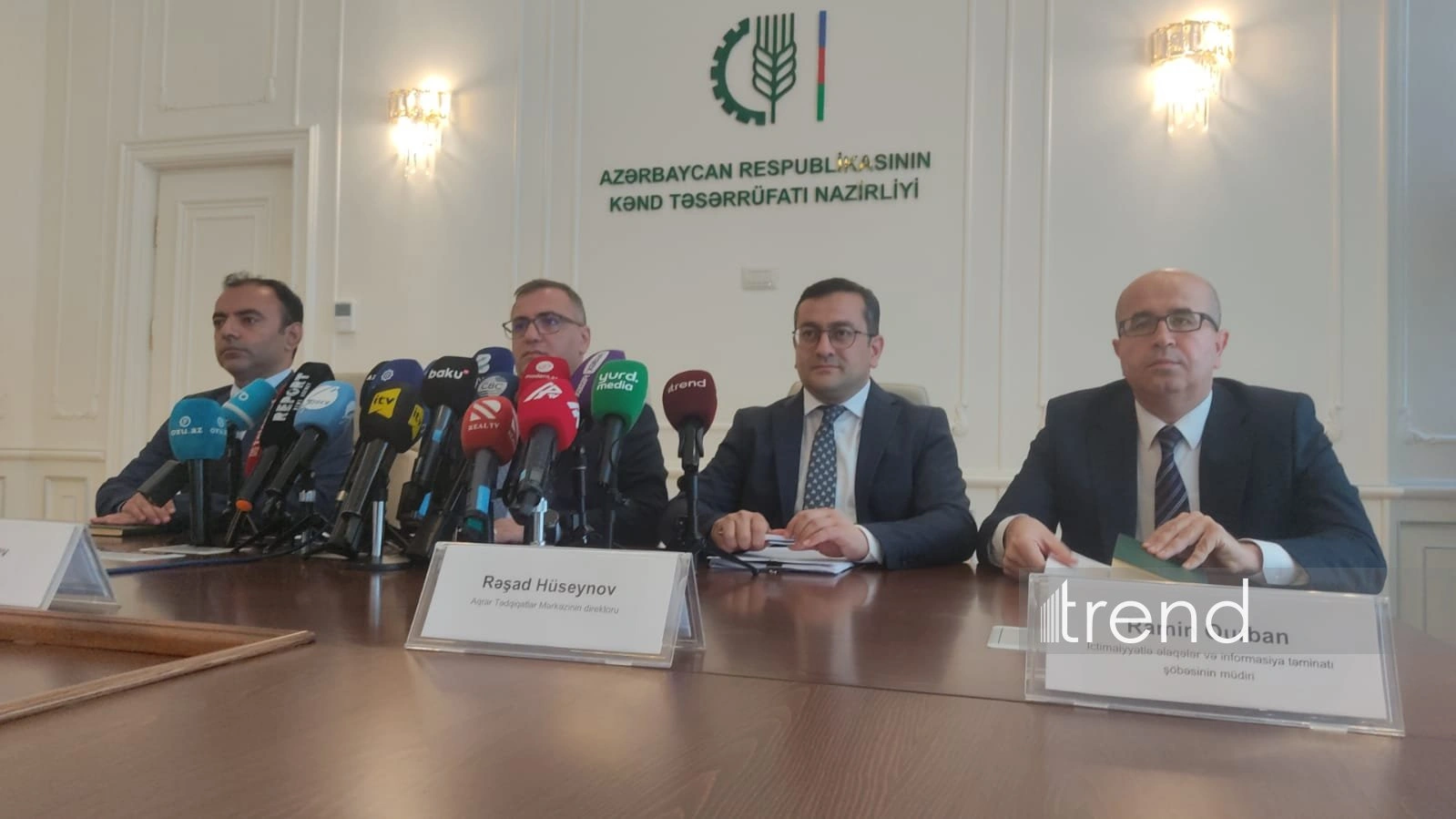
BAKU, Azerbaijan, June 4. Over the past ten
years, the agricultural sector has seen growth of more than 37%,
the Deputy Minister of Agriculture Zaur Aliyev said at a press
conference, Trend
reports.
He added that important work is simultaneously underway to
develop the infrastructure supporting the sector’s growth: this
includes the construction of grain elevators, the expansion of the
logistics network, and the acceleration of digitalization
processes.
According to him, one of the program’s main goals is to increase
employment in agriculture and raise farmers’ incomes:
“There are a number of factors that necessitate the development
of the State Program. Global challenges in the agro-industrial
sector, growing public demand for food, risks associated with
climate change, and instability in global markets pose serious
threats to food security. These reasons necessitate the development
of the State Program.
The new State Program is being developed based on a
comprehensive approach that covers both production and all stages
of the value chain, he added.”
The new state program takes a comprehensive approach to ensuring
the sustainable and balanced development of the agricultural
sector. Its main objectives include strengthening food security,
increasing productivity, developing production within a competitive
value chain, and fully restoring agricultural activities in the
liberated territories.
Plans include strengthening the legal and institutional
framework to support the program’s implementation, as well as
digitizing processes.
In line with the program’s main objectives, the average annual
growth rate of gross domestic product generated by agriculture,
forestry, and fisheries is projected to be at least 2% during the
period from 2026 through 2030. At the same time, exports of
agricultural and processed fish products are projected to increase
by an average of 6% per year.
By 2030, the plan is to increase the average wheat yield per
hectare in specialized regions to 50 centners. As a result,
production is expected to increase by approximately 20%, and
self-sufficiency levels are expected to rise.
Moreover, it is planned to expand the area of land using modern
irrigation systems to 300,000 hectares. At the same time, the goal
is to increase the area of intensive and super-intensive orchards
by 20,000 hectares.
In cotton production, the plan is to increase the average yield
per hectare in specialized regions to 50 centners by 2030, as well
as to quadruple the volume of processed cotton.
In livestock farming, the plan is to increase milk production by
10% and meat production by 20%. Through the development of sheep
farming, the goal is to achieve full self-sufficiency in lamb.
In the fisheries and aquaculture sector, the plan is to increase
production to 7,700 tons, raise the level of self-sufficiency, and
expand export opportunities. To this end, legislation will be
improved, and support mechanisms strengthened, including subsidies
and tax breaks.
The scope of agricultural subsidies is also being expanded, and
the use of certified seeds is being encouraged. According to the
Council’s decision, in addition to the existing regional
distribution, additional measures are being introduced: a subsidy
for blueberry cultivation in the Guba-Khachmaz economic region, a
subsidy for cotton in the village of Goydallakli in the Agsu
District, a subsidy for tobacco in the Nakhchivan Autonomous
Republic, as well as a subsidy for planting super-intensive peach
(nectarine) orchards in the territories liberated from occupation,
in the Khojavend District.
In accordance with the Council’s decision, it has also been
established that in 2026, farmers with a total planted area of more
than 10 hectares of wheat or more than 100 hectares of barley who
do not use certified seeds will receive a subsidy reduced by 20%.
“Farmers are advised to take these requirements into account now
when preparing and procuring seeds for the upcoming fall planting
season,” he noted.
The Deputy Minister stated that the ministry has a number of
proposals for improving the subsidy system. These proposals also
include changes to existing decisions and regulations that form the
basis of the subsidy system.
According to him, there is a need to introduce new approaches
and new tools in the area of subsidies:
“These changes will significantly contribute to improving the
overall effectiveness of the subsidy system. In line with the
established development goals for specialized, intensive, and
semi-intensive farms, there are plans to establish small and large
livestock farms. At the same time, one of the main priorities is to
increase the level of professionalism and commercialization in the
agricultural sector.
During the program’s preparatory phase, preliminary discussions
were held with the Central Bank, the Business Development Fund, and
other relevant institutions to ensure financial accessibility, and
certain agreements were reached.
“In particular, a new interest rate subsidy instrument for loans
will increase the availability of financial resources for both
banks and farmers. There are also plans to eliminate information
asymmetry to ensure easier access to the sector for financial
institutions,” the deputy minister noted.