For British Prime Minister Keir Starmer, foreign policy has increasingly become a political refuge.
While his domestic authority faces mounting pressure at home, Starmer has sought to position Britain at the centre of a reshaped European security order, strengthening ties with key allies as the continent adapts to growing uncertainty over long-term American commitment to European defence, The Economist points out.
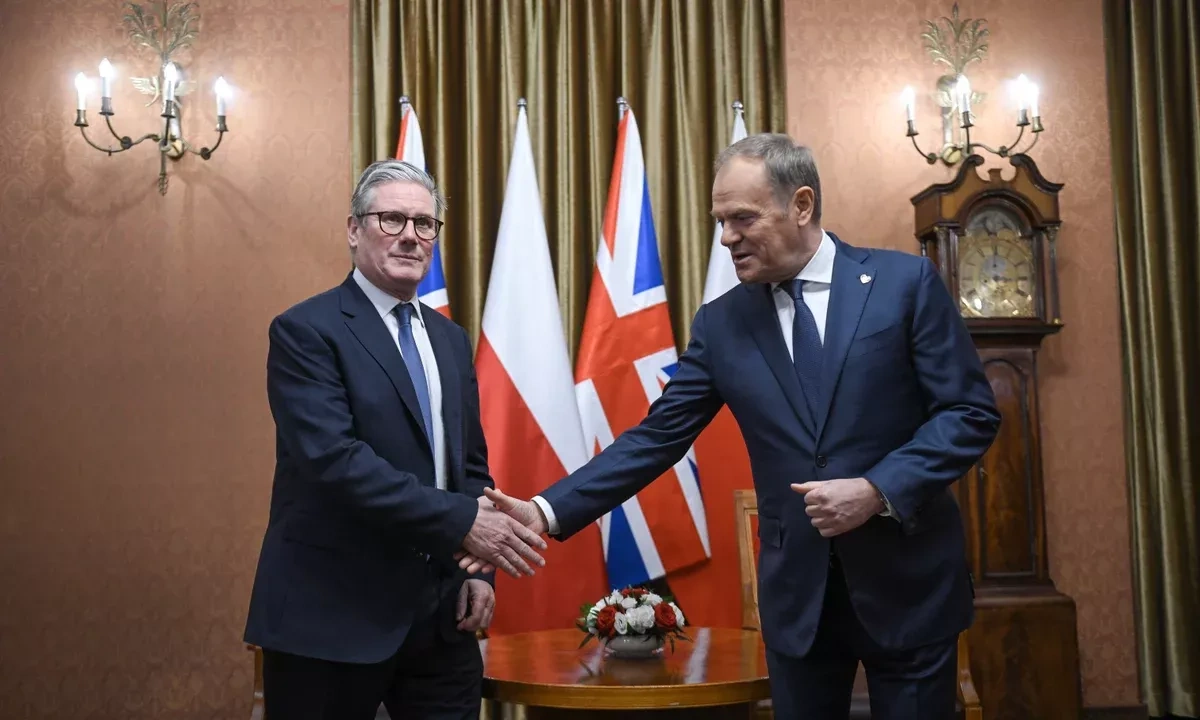
That strategy is now moving eastward. On May 27, Starmer is expected to sign a new defence and security treaty with Polish Prime Minister Donald Tusk, deepening cooperation between two countries that have emerged as some of Europe’s strongest supporters of Ukraine.
The agreement follows a series of recent diplomatic initiatives by London, including expanded defence cooperation with France and Germany. Britain and Poland had already signed smaller bilateral agreements in 2017 and 2023 covering military training and cybersecurity, but the new treaty is expected to go much further.
Officials say the pact will focus not only on defence, but also on economic resilience, energy security, illegal migration and organised crime. It is also expected to reaffirm commitments to mutual defence and expand collaboration between British and Polish defence industries.
Britain’s government says defence cooperation with Poland has already generated around £8 billion ($10.9 billion) for the British economy over the past three years.
The two countries also share closely aligned positions on Russia and Ukraine. According to data from the Kiel Institute for the World Economy, cumulative bilateral aid to Ukraine since Russia’s full-scale invasion in 2022 amounted to roughly 0.8% of Britain’s 2021 GDP and 1.0% of Poland’s.
Migration has also created deep social ties between the two countries. Britain’s 2021 census recorded approximately 734,000 Polish-born residents in England and Wales, making Poles the country’s second-largest foreign-born population after Indians.
But while the partnership is strengthening, differences remain beneath the surface.
Polish officials have reportedly expressed frustration at Britain’s growing reliance on the so-called “E3” format — an informal grouping of Britain, France and Germany used by Starmer to coordinate European diplomacy.
Poland argues that its strategic position and growing military strength entitle it to a larger role in shaping Europe’s future security architecture.
One Polish diplomat described it as “only natural” for Warsaw to be involved at a “high level” in any future settlement involving Europe, Russia and Ukraine.
Poland’s growing confidence is underpinned by rapid economic and military expansion. International Monetary Fund forecasts suggest Poland’s GDP per capita, adjusted for purchasing power parity, could approach Britain’s level by 2030.
Warsaw is also moving faster than many European allies on defence spending. NATO estimates Poland spent 4.3% of GDP on defence last year — the highest level in the alliance — while Britain aims to reach 3.5% only by 2035.
Poland’s Finance and Economy Minister Andrzej Domanski summed up Warsaw’s urgency bluntly: “We just cannot afford to lose time.”
Despite Britain’s continued influence through its nuclear deterrent and diplomatic reach, the evolving partnership reflects a broader shift underway in Europe — one in which Poland increasingly expects not just cooperation with major powers, but a seat alongside them at the continent’s top table.
By Sabina Mammadli