A growing debate over military conscription in Germany is exposing a sharp generational divide, as younger Germans increasingly oppose compulsory service while political leaders push for stronger armed forces amid mounting security concerns in Europe.
The country suspended mandatory military service in 2011, but Russia’s war in Ukraine and uncertainty over long-term US security guarantees to Europe have brought the issue back into political focus. Concerns intensified after US President Donald Trump questioned NATO defence commitments and revived tensions with Denmark over Greenland, Anadolu noted in its article.
Although Berlin has not formally reinstated conscription, the government recently introduced a new military service model requiring men turning 18 to complete questionnaires regarding their willingness and suitability to serve in the Bundeswehr, Germany’s armed forces. Women can participate voluntarily.
Security analyst Rafael Loss said Europe’s changing geopolitical environment has increased pressure on European states to strengthen their own defence capabilities.
“The need to be more self-sustainable as European defense means that we need more people, we need more capabilities and we need a more European defense by Europeans, for Europeans,” he told Anadolu.
Yet many younger Germans remain deeply sceptical about the direction of the debate.
A recent survey by the European Council on Foreign Relations found strong opposition among Germans aged 18 to 29 to mandatory military service, while older age groups generally supported the idea. Germany showed one of the starkest generational gaps in Europe, with net opposition among younger respondents reaching 46%.
The issue has become particularly sensitive in Germany, where memories of militarism and the world wars continue to shape public attitudes toward the military.
At the same time, the Bundeswehr is facing recruitment shortages. Germany’s armed forces currently number around 185,400 active-duty soldiers, while military planners aim to have a force of 460,000 troops, including reservists, by the mid-2030s.
Mandatory questionnaires are already being sent to 18-year-olds, and compulsory physical examinations for young men are expected to begin by mid-2027.
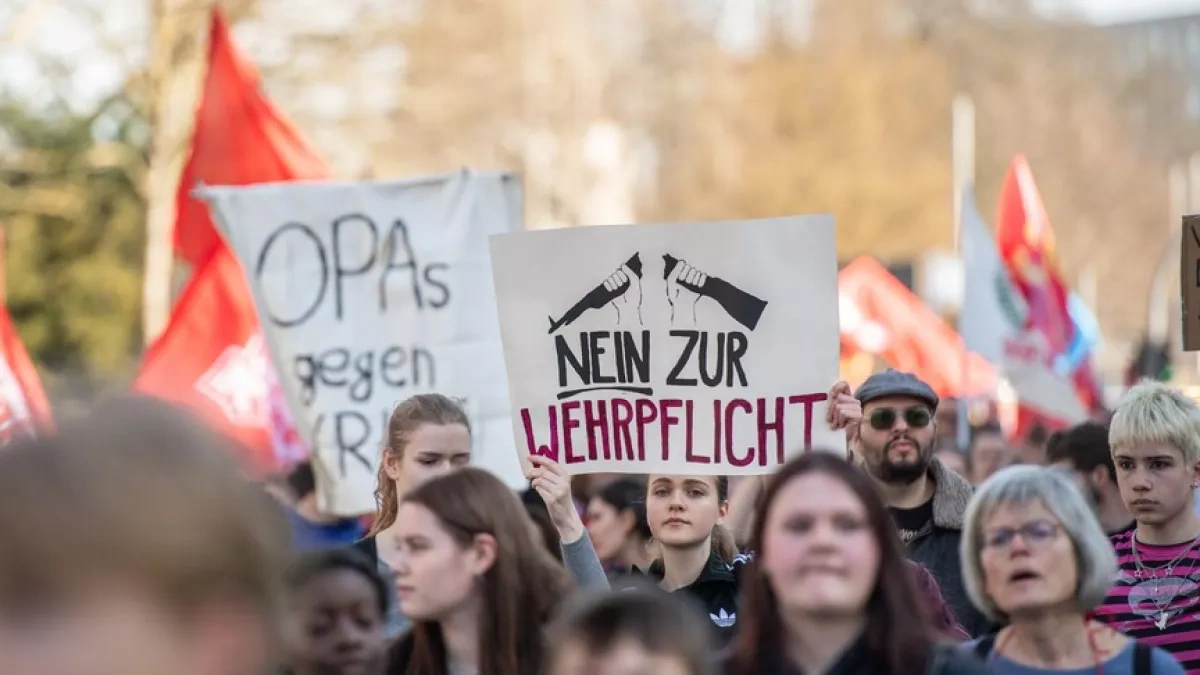
Youth activist Bela Breitner, spokesperson for the School Strike Against Conscription movement, said many young people fear Germany is moving toward broader militarisation.
“We are against the stepwise reintroduction of conscription,” he said.
Breitner said the movement had organised three nationwide strike days, each drawing around 50,000 participants.
“Our government explicitly states that they want to be ready for war in 2029, and these are just some of the measures we see,” he said. “We don't think that's something that we have an interest in.”
He argued that military expansion benefits defence industries while increasing pressure on public services and living standards.
“A safe country is one that lives in peace and invests in people’s lives, not one that expands military structures,” Breitner said.
Opposition to conscription is also being driven by moral and legal concerns. German law student Ahmet Deveci said Germany’s constitution protects the right to refuse military service on grounds of conscience.
He also warned that expanding military service could eventually draw Germany into foreign conflicts.
“We have seen that Germany is supporting many wars and shipping weapons to many countries that participate in wars,” Deveci said.
Despite the backlash, analysts say support for a stronger Bundeswehr has grown since Russia’s invasion of Ukraine in 2022, particularly among older Germans who increasingly view Russia as a direct threat to European security.
Still, Loss said many Germans remain uncomfortable with the idea of Germany becoming Europe’s dominant military power.
“They don’t see Germany being the leader to defend Europe,” he said. “But they see Germany very much as part of a leading collective of countries.”
By Sabina Mammadli