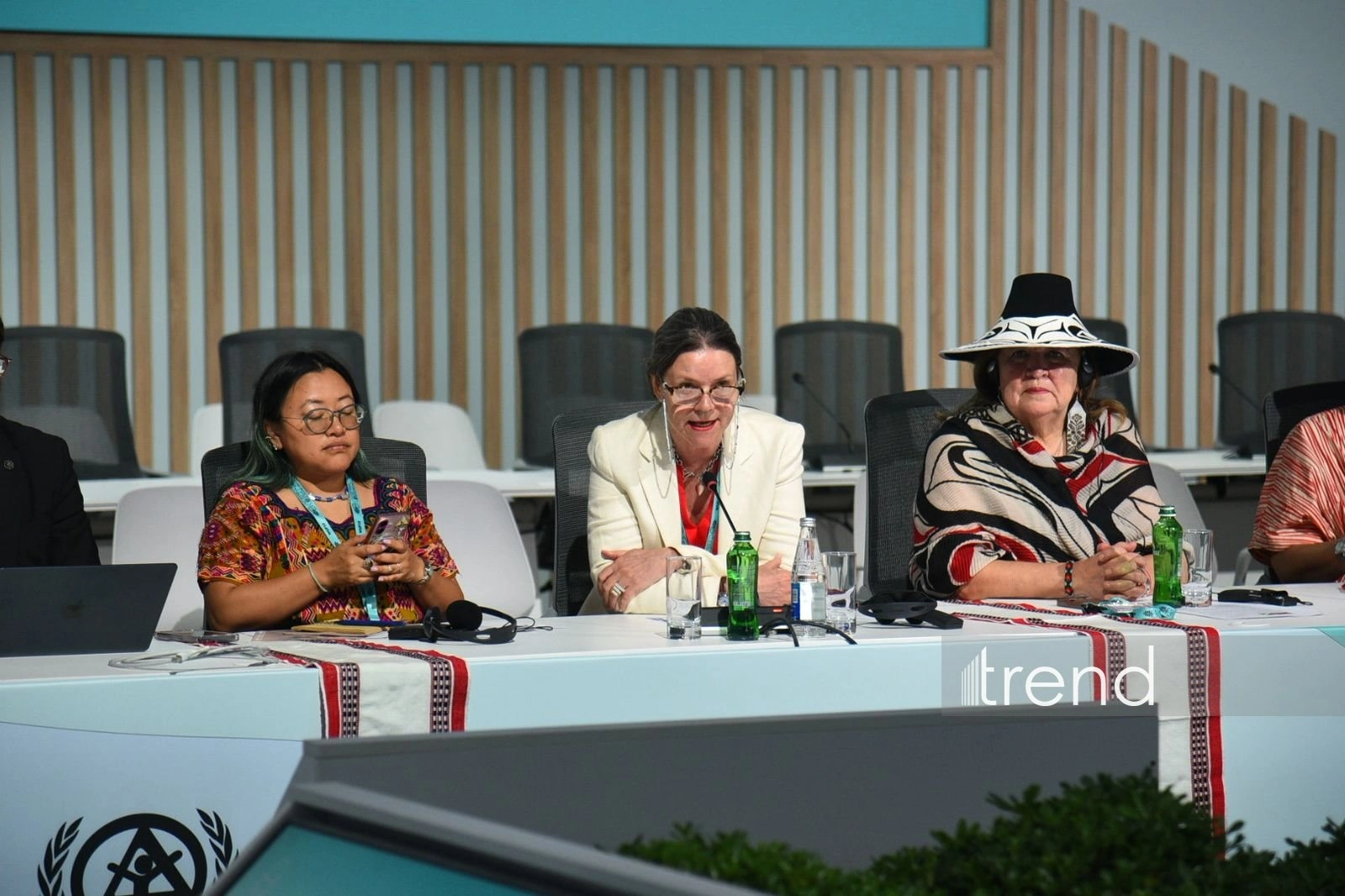
BAKU, Azerbaijan, May 22. Special state
institutions should be established to solve the problems of
indigenous peoples, Director General for Relations with Civil
Society Organizations at the Mexican Foreign Ministry, Mariana
Posada Lombana, said at the roundtable on "Indigenous Peoples'
Rights" held in Baku as part of WUF13, Trend reports.
According to her, it's impossible to talk about development
without social justice. Social justice refers to government
policies that ensure more equitable use of resources and aim to
reduce the deep gap between the wealthy and the less wealthy
segments of society.
She noted that Mexico is a multicultural country, where
indigenous peoples, mestizos, and other ethnic groups live
together.
"It's impossible to speak of indigenous peoples as a single and
homogeneous group. They have different ethnicities, languages,
places of residence, and unique traditions. Therefore, it is not
possible to apply the same policies to all communities. The
characteristics of each ethnic group must be taken into account,"
he stressed.
According to Lombana, the number of people who identify as
indigenous in Mexico is about 15% of the country's population.
Moreover, approximately 3.1 million people consider themselves
representatives of Afro-Mexican or African communities, which is
equivalent to 2.4% of the population.
She pointed out that the protection of the rights of indigenous
peoples should be established at the highest level of state
policy.
"The Mexican Constitution recognizes the rights of indigenous
peoples and Afro-Mexican communities to autonomy,
self-determination, the use of traditional legal norms, land
ownership, as well as the use of natural resources," she
explained.
The director-general emphasized that the creation of special
state institutions to address the problems of indigenous peoples is
also important. According to her, the institutions operating in
this direction in Mexico are engaged in the implementation of the
rights of indigenous peoples, ensuring their sustainable
development and preserving their cultural identity.
Lombana added that indigenous peoples' rights should not be
considered as a separate issue, but as an integral part of all
government programs related to gender equality, women's rights,
children, youth, the elderly, and persons with disabilities.
"Indigenous peoples should be represented in all aspects of
government policies and should not be neglected in any area," she
concluded.
Today marks the final day of the 13th session of the World Urban
Forum (WUF13).
The first day included a ministerial meeting dedicated to the
New Urban Agenda, a ministerial roundtable, assemblies for women
and civil society, business sessions, and discussions on urban
prosperity. An official ceremony marking the raising of the UN and
Azerbaijani flags also took place.
The second day stood out for the inaugural Leaders' Summit,
featuring high-level discussions on the global housing crisis,
urbanization policy, and urban resilience. Concurrently, the
opening of the Mexico City pavilion took place, serving as a
significant platform for expanding cooperation with the Latin
American region and preparing for WUF14.
The third day of WUF13 featured a comprehensive program of
events covering the global housing crisis, the formation of safe
and inclusive cities, climate resilience, artificial intelligence
and urban governance, green urbanization, social equity, and
sustainable transport.
One of the highlights of the third day was the signing of a
sister-city memorandum between the Azerbaijani city of Shusha and
the Turkish city of Trabzon.
The fourth day of WUF13 featured a broad program of events
dedicated to urbanization, climate change, inclusive urban
development, housing policy, and sustainable governance.
The fifth day of WUF13 continued discussions on the global
housing crisis, the creation of safe and inclusive cities, climate
resilience, the use of artificial intelligence in urban management,
green urbanization, and social equality.
One of the important events of the UN Special Program for the
Economies of Central Asia (SPECA) Cities Forum, held on the fourth
day, was the announcement of Almaty’s official accession to the
“Declaration of Intent on the Establishment of the SPECA Smart
Climate-Resilient Cities Forum.”
Also, for the first time in WUF history and at Azerbaijan’s
initiative, the “WUF13 NGO Forum: Global Partnership and
Decision-Making” was held.
WUF13, which has attracted more than 40,000 registered
participants from 182 countries, will continue until May 22. Held
under the theme “Housing the world: Safe and resilient cities and
communities,” the forum brings together governments, international
organizations, experts, and representatives of civil society to
strengthen global cooperation in the field of sustainable urban
development.