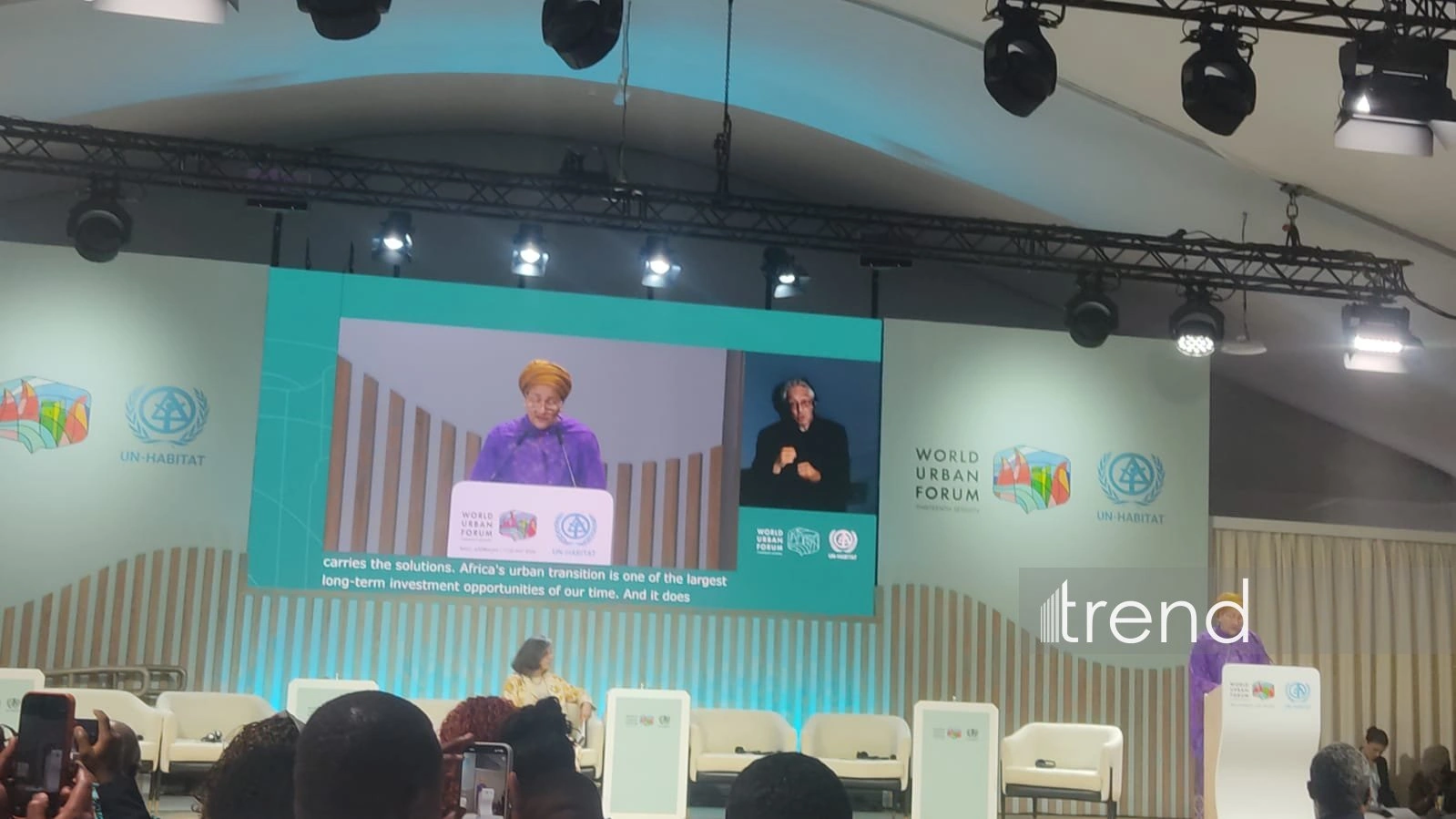
BAKU, Azerbaijan, May 21. Africa receives below
3% of global housing finance, UN Deputy Secretary-General Amina J.
Mohammed said at a discussion titled "Africa Affordable Housing
Compact – Deal Room Investor Special Session" within the
framework of the 13th session of the World Urban Forum (WUF13),
Trend reports.
She noted that in order to address the housing shortage in
Africa, finance must be aligned with development strategies,
technical capabilities must be harmonized with the capacity of
executive partners, while new technologies and skills must serve to
create decent jobs.
According to her, at the same time, developing sustainable urban
and office solutions, as well as building effective implementation
platforms that can deliver scalable and bankable project
portfolios, is of particular importance.
"Because the challenges ahead require a systemic approach at
this level. Housing provision is also one of the key pillars of the
promise of sustainable development: providing adequate and
accessible housing for everyone means creating an environment in
which all other development goals can be realized.
Adequate and accessible housing has many positive impacts.
First, it strengthens social stability, as secure housing is the
largest and most valuable asset for low-income households. It
directly contributes to health and supports gender equality, as
legally secure housing strengthens the social and legal position of
women. It also plays a crucial role in terms of climate and
sustainability; since Africa’s housing stock is still in the
development stage, decisions made today will determine the
emissions profile of the coming decades.
In addition, the housing sector makes a strong contribution to
the creation of decent jobs. As a result, this approach supports
the formation of sustainable cities where no one is left
behind.
Despite all this, Africa receives less than 3% of global housing
financing, while almost 20% of the world's urban population lives
there. This shows a serious imbalance," she noted.
Today marks the fifth day of WUF13 in Baku.
The first day included a ministerial meeting dedicated to the
New Urban Agenda, a ministerial roundtable, assemblies for women
and civil society, business sessions, and discussions on urban
prosperity. An official ceremony marking the raising of the UN and
Azerbaijani flags also took place.
The second day stood out for the inaugural Leaders' Summit,
featuring high-level discussions on the global housing crisis,
urbanization policy, and urban resilience. Concurrently, the
opening of the Mexico City pavilion took place, serving as a
significant platform for expanding cooperation with the Latin
American region and preparing for WUF14.
The third day of WUF13 featured a comprehensive program of
events covering the global housing crisis, the formation of safe
and inclusive cities, climate resilience, artificial intelligence
and urban governance, green urbanization, social equity, and
sustainable transport.
One of the highlights of the third day was the signing of a
sister-city memorandum between the Azerbaijani city of Shusha and
the Turkish city of Trabzon.
The fourth day of WUF13 featured a broad program of events
dedicated to urbanization, climate change, inclusive urban
development, housing policy, and sustainable governance.
One of the important events of the UN Special Programme for the
Economies of Central Asia (SPECA) Cities Forum, held on the fourth
day, was the announcement of Almaty’s official accession to the
“Declaration of Intent on the Establishment of the SPECA Smart
Climate-Resilient Cities Forum.”
Also, for the first time in WUF history and at Azerbaijan’s
initiative, the “WUF13 NGO Forum: Global Partnership and
Decision-Making” was held.
WUF13, which has attracted more than 40,000 registered
participants from 182 countries, will continue until May 22. Held
under the theme “Housing the world: Safe and resilient cities and
communities,” the forum brings together governments, international
organizations, experts, and representatives of civil society to
strengthen global cooperation in the field of sustainable urban
development.