BAKU, Azerbaijan, May 20. A resilient city
should have not only strong buildings, but also must survive crises
with its infrastructure, transportation system, green zones, social
facilities, economic life, and social solidarity, Turkish Deputy
Minister of Environment, Urbanization and Climate Change Hasan
Suver said, Trend
reports.
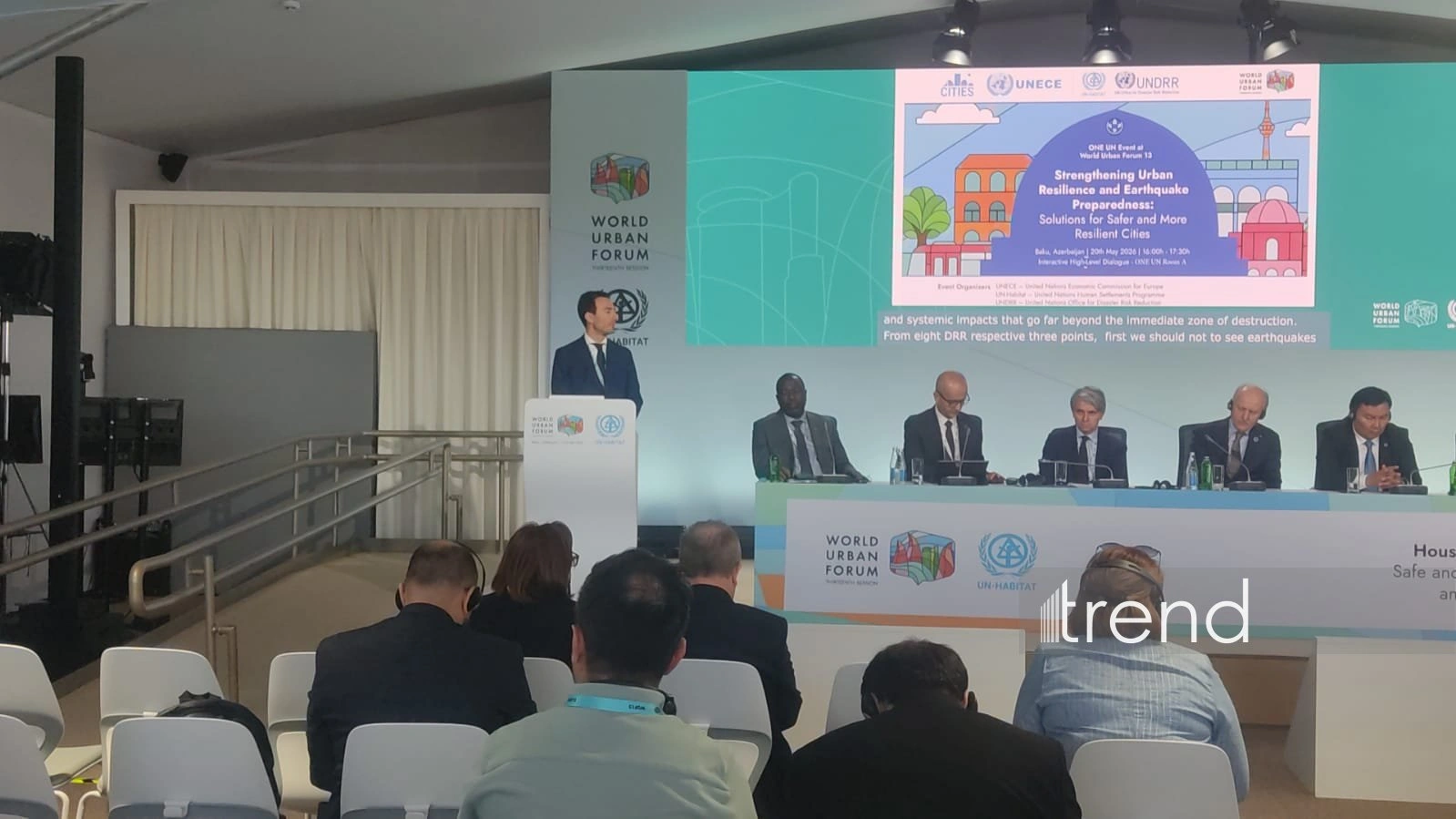
He made the remark during a conference titled "Strengthening
Urban Earthquake Preparedness ONE UN Solutions for Safer and More
Resilient Cities" held within the framework of the 13th session of
the World Urban Forum (WUF13) in Baku.
The official noted that due to its geographical location, his
country faces the risk of many natural disasters, especially
earthquakes.
According to him, urban planning policy is not only about growth
and development, but also about safety, sustainability, risk
reduction, and disaster preparedness.
"For us, a sustainable city is not just a city with solid
buildings. A sustainable city is a city that can withstand crises
with its infrastructure, transport system, green areas, social
facilities, economic life, and social solidarity. Our main
principle in combating earthquake risk is not to intervene after a
disaster, but to reduce risks before it occurs. This approach is
based on safe construction, proper land selection, sound urban
planning, and sustainable infrastructure policies," he added.
Today marks the fourth day of WUF13 in Baku.
The first day included a ministerial meeting dedicated to the
New Urban Agenda, a ministerial roundtable, assemblies for women
and civil society, business sessions, and discussions on urban
prosperity. An official ceremony marking the raising of the UN and
Azerbaijani flags also took place.
The second day stood out for the inaugural Leaders' Summit,
featuring high-level discussions on the global housing crisis,
urbanization policy, and urban resilience. Concurrently, the
opening of the Mexico City pavilion took place, serving as a
significant platform for expanding cooperation with the Latin
American region and preparing for WUF14.
The third day of WUF13 featured a comprehensive program of
events covering the global housing crisis, the formation of safe
and inclusive cities, climate resilience, artificial intelligence
and urban governance, green urbanization, social equity, and
sustainable transport.
WUF13, which has attracted more than 40,000 registered
participants from 182 countries, will continue until May 22. Held
under the theme “Housing the world: Safe and resilient cities and
communities,” the forum brings together governments, international
organizations, experts, and representatives of civil society to
strengthen global cooperation in the field of sustainable urban
development.