BAKU, Azerbaijan, May 20. Our country turns
into an increasingly attractive destination for migrants due to its
steady economic expansion, diverse opportunities, and an
environment that proactively supports social integration, said
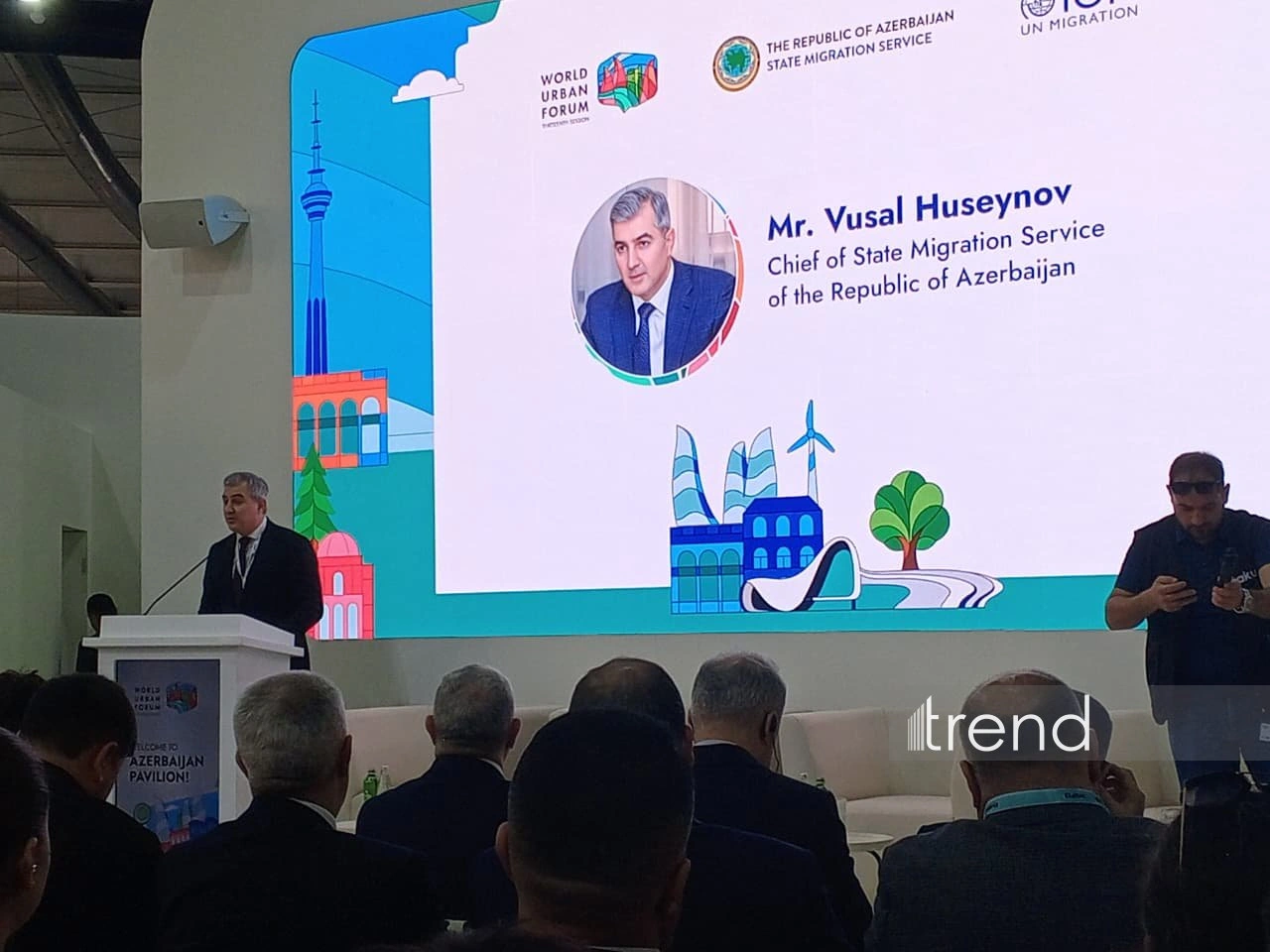
Vusal Huseynov, Chief of the State Migration Service of Azerbaijan,
Trend reports.
He made the remarks during a panel discussion titled "Migration
and Cities: A Framework for Safe, Innovative and Sustainable
Governance" held within the framework of the 13th session of the
World Urban Forum (WUF13) in Baku.
According to him, migration governance and municipal
administration can no longer undergo consideration in isolation
from one another; instead, they require synchronized
development.
He noted that more than half of the global population currently
resides in cities, with this metric projected to hit 70% by the
year 2050.
"Cities stand as the physical spaces where migration realities
materialize. People seek safety, opportunities, public services,
education, and inclusivity here. Migrants contribute to societies
not only through manual labor and entrepreneurship but also by
infusing knowledge, creativity, and social dynamism," Huseynov
emphasized.
He pointed out that while governments allocate substantial
investments into modern urban development, sustainable cities do
not rely solely on physical infrastructure.
"Human capital, innovation, creativity, collaboration, and
social inclusion serve as the foundational drivers accelerating
municipal growth. Without human-centered governance, even the most
advanced infrastructure cannot guarantee long-term resilience," the
service chief added.
Huseynov stated that Azerbaijan prioritizes innovation,
inclusivity, and rights-based approaches within its national
migration policy framework.
Today marks the fourth day of WUF13 in Baku.
The first day included a ministerial meeting dedicated to the
New Urban Agenda, a ministerial roundtable, assemblies for women
and civil society, business sessions, and discussions on urban
prosperity. An official ceremony marking the raising of the UN and
Azerbaijani flags also took place.
The second day stood out for the inaugural Leaders' Summit,
featuring high-level discussions on the global housing crisis,
urbanization policy, and urban resilience. Concurrently, the
opening of the Mexico City pavilion took place, serving as a
significant platform for expanding cooperation with the Latin
American region and preparing for WUF14.
The third day of WUF13 featured a comprehensive program of
events covering the global housing crisis, the formation of safe
and inclusive cities, climate resilience, artificial intelligence
and urban governance, green urbanization, social equity, and
sustainable transport.
WUF13, which has attracted more than 40,000 registered
participants from 182 countries, will continue until May 22. Held
under the theme “Housing the world: Safe and resilient cities and
communities,” the forum brings together governments, international
organizations, experts, and representatives of civil society to
strengthen global cooperation in the field of sustainable urban
development.