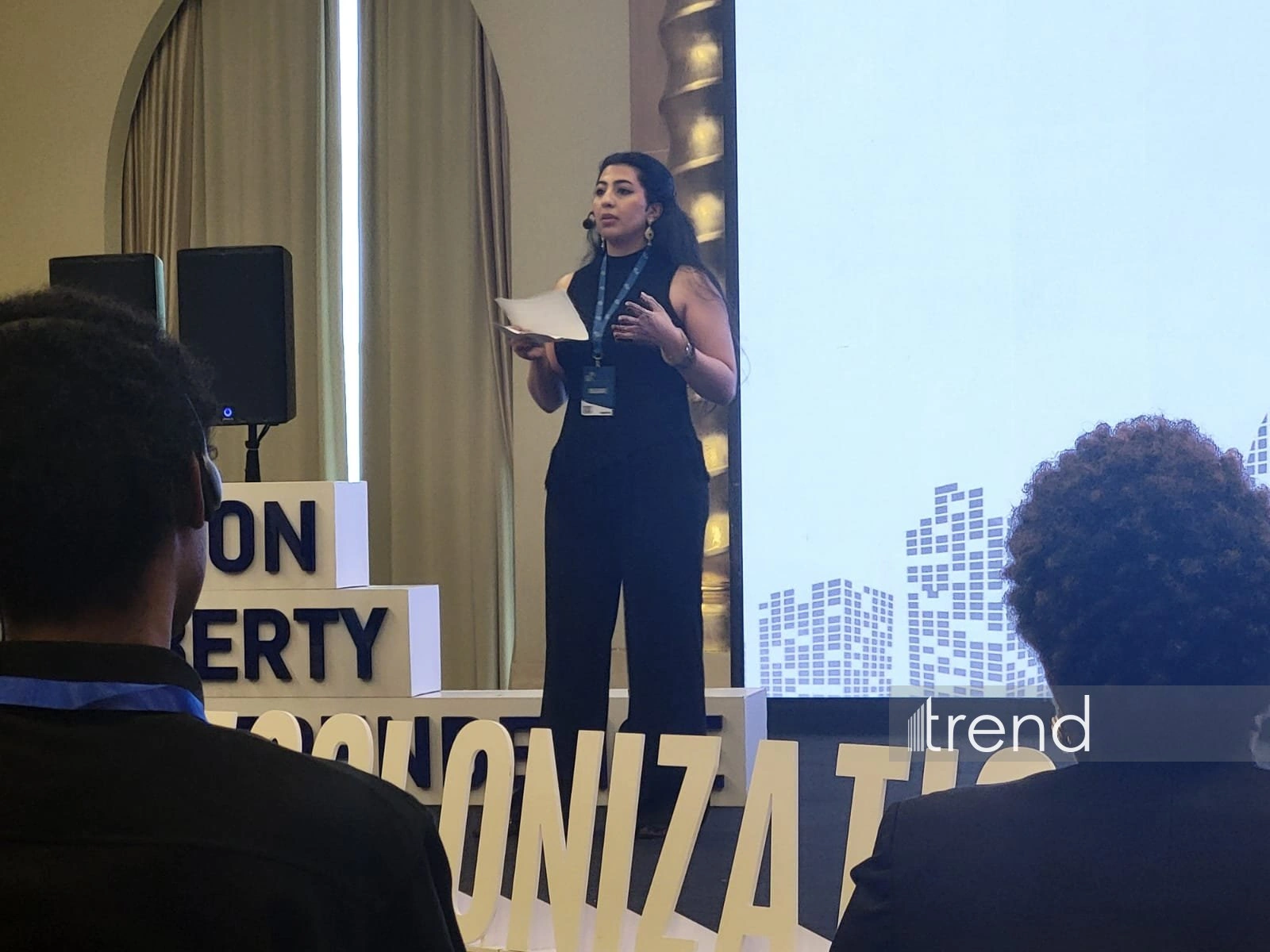
BAKU, Azerbaijan, May 20. Urbanization in the
nations of the Global South must incorporate local culture,
historical heritage, and youth participation in decision-making
processes, Bouinzal Ouhaila, founder and legal consultant at Nobu
Consulting, said, Trend reports.
The expert made the remarks during the international conference
titled "The Role of Youth in Decolonizing Urbanization," held
within the framework of the 13th session of the World Urban Forum
(WUF13) in Baku.
"When we speak about the decolonization of urbanization, it does
not simply concern buildings and infrastructure. It concerns whom
the cities undergo construction for, and whose voices shape their
future," she noted.
According to Ouhaila, urban development in Morocco, as in many
countries across the Global South, continues to reflect historical
and social inequalities. She pointed out that rapid municipal
growth frequently outpaces social integration, leading to systemic
challenges in housing, transport, and equitable access to
opportunities.
To illustrate these dynamics, she cited Casablanca, Rabat, and
Marrakech. In Casablanca, a persistent gap remains between
macro-economic expansion and the actual living conditions of youth
in working-class neighborhoods. Discussing Rabat, Ouhaila noted
that young people frequently feel marginalized from decision-making
structures and the formulation of urban policies.
She directed particular attention to Marrakech, where
traditional Moroccan houses—riads—consistently undergo conversion
into hotels and commercial tourist facilities.
"While this generates economic opportunities, it simultaneously
raises critical concerns regarding housing affordability, the
preservation of community life, and cultural heritage," she
emphasized.
Ouhaila stated that contemporary urban development must move
away from copying foreign or colonial architectural blueprints.
"Our cities should mirror local culture, traditions, and
lifestyles. Architecture encompasses far more than physical
structures; it embodies memory, identity, and a sense of
belonging," she said.
According to her, decolonizing urbanization requires finding a
delicate balance between modernization and the safeguarding of
historical legacies. The Moroccan representative also underscored
the vital role of education for the younger generation.
"Access to quality education empowers young people to comprehend
urban policy frameworks, defend their rights, and actively
participate in the development of their own communities," she
noted.
Youth in Morocco, Ouhaila concluded, already engage dynamically
in grassroots community initiatives, environmental projects, and
digital civic activism.
Today marks the fourth day of WUF13 in Baku.
The first day included a ministerial meeting dedicated to the
New Urban Agenda, a ministerial roundtable, assemblies for women
and civil society, business sessions, and discussions on urban
prosperity. An official ceremony marking the raising of the UN and
Azerbaijani flags also took place.
The second day stood out for the inaugural Leaders' Summit,
featuring high-level discussions on the global housing crisis,
urbanization policy, and urban resilience. Concurrently, the
opening of the Mexico City pavilion took place, serving as a
significant platform for expanding cooperation with the Latin
American region and preparing for WUF14.
The third day of WUF13 featured a comprehensive program of
events covering the global housing crisis, the formation of safe
and inclusive cities, climate resilience, artificial intelligence
and urban governance, green urbanization, social equity, and
sustainable transport.
WUF13, which has attracted more than 40,000 registered
participants from 182 countries, will continue until May 22. Held
under the theme “Housing the world: Safe and resilient cities and
communities,” the forum brings together governments, international
organizations, experts, and representatives of civil society to
strengthen global cooperation in the field of sustainable urban
development.