BAKU, Azerbaijan, May 20. Azerbaijan applies
nature-based solutions within its urban development policy, viewing
them as a core mechanism for building resilient and
climate-adaptive cities through a balanced approach to urban growth
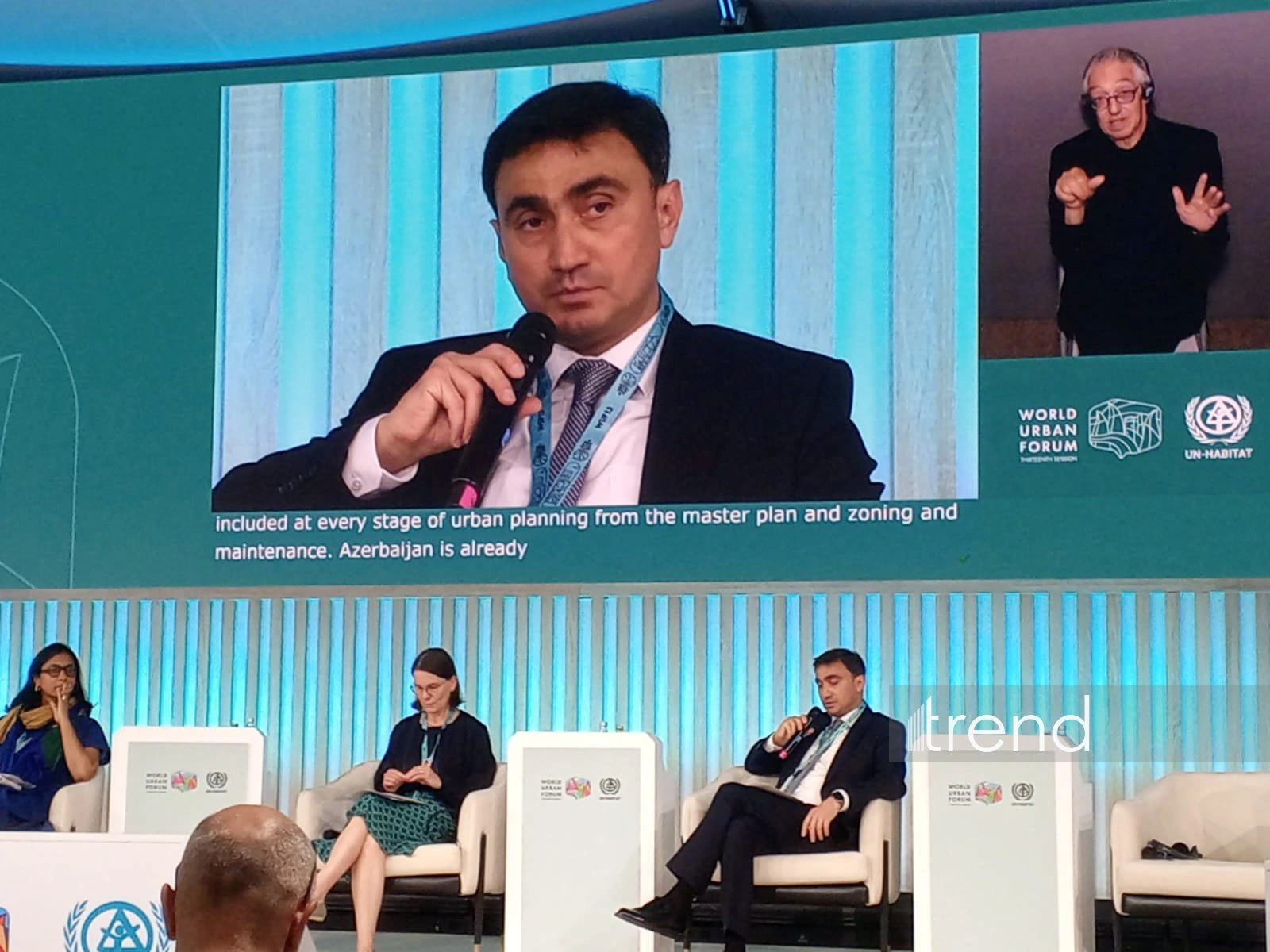
and environmental protection, said Aghakarim Samadzadeh, First
Deputy Minister of Ecology and Natural Resources of Azerbaijan,
Trend reports.
The official made the remarks during a panel session titled "The
Climate-Housing Nexus" held within the framework of the 13th
session of the World Urban Forum (WUF13) in Baku.
He noted that cities currently stand at the front lines of the
fight against climate change, with roughly 58% of the global
population residing in urban areas that increasingly face climate
risks like heatwaves, flooding, and water scarcity. According to
him, pressure on natural ecosystems intensifies simultaneously,
demanding that nature-based solutions integrate seamlessly into
housing and urban development policies across all planning
stages—from master plans and zoning to construction and asset
management.
Samadzadeh added that Azerbaijan already implements this
methodology within its housing and municipal development
frameworks. He pointed out that the Socio-Economic Development
Strategy for 2022–2026, alongside its extension to 2030,
establishes clean environment and "green growth" as top national
priorities.
He also shared that Azerbaijan actively develops green energy
zones and "smart city" and "smart village" concepts, while
simultaneously driving ecosystem restoration across its liberated
territories. In this context, he highlighted ongoing cooperation
with Türkiye to set up a dedicated afforestation center, which will
anchor restoration and greening operations throughout Karabakh and
Eastern Zangezur.
Today marks the fourth day of WUF13 in Baku.
The first day included a ministerial meeting dedicated to the
New Urban Agenda, a ministerial roundtable, assemblies for women
and civil society, business sessions, and discussions on urban
prosperity. An official ceremony marking the raising of the UN and
Azerbaijani flags also took place.
The second day stood out for the inaugural Leaders' Summit,
featuring high-level discussions on the global housing crisis,
urbanization policy, and urban resilience. Concurrently, the
opening of the Mexico City pavilion took place, serving as a
significant platform for expanding cooperation with the Latin
American region and preparing for WUF14.
The third day of WUF13 featured a comprehensive program of
events covering the global housing crisis, the formation of safe
and inclusive cities, climate resilience, artificial intelligence
and urban governance, green urbanization, social equity, and
sustainable transport.
WUF13, which has attracted more than 40,000 registered
participants from 182 countries, will continue until May 22. Held
under the theme “Housing the world: Safe and resilient cities and
communities,” the forum brings together governments, international
organizations, experts, and representatives of civil society to
strengthen global cooperation in the field of sustainable urban
development.