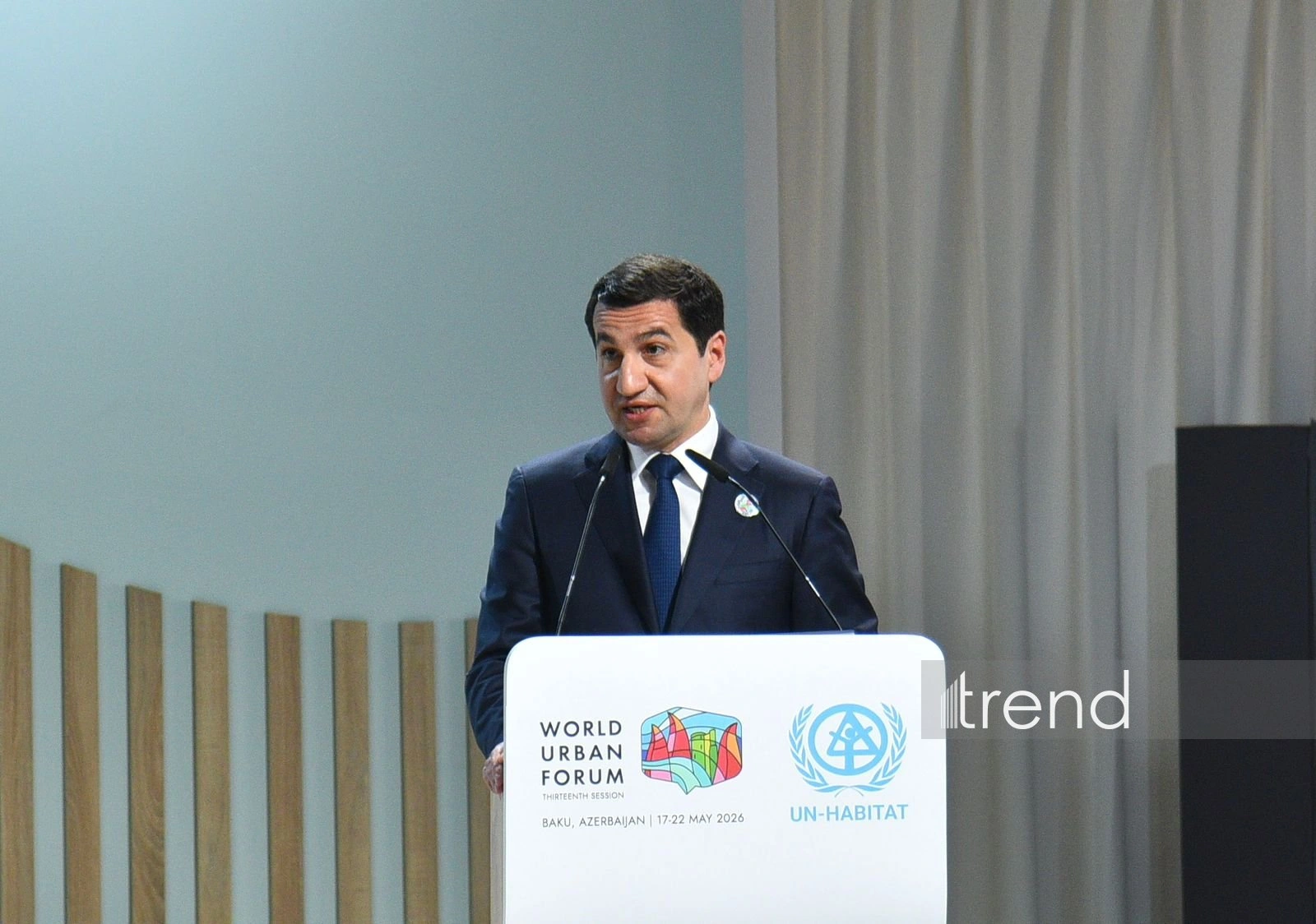
BAKU, Azerbaijan, May 19. Azerbaijan has
created 300 megawatts of green energy potential in the liberated
areas, Hikmet Hajiyev, Assistant to the President of the Republic
of Azerbaijan and Head of the Foreign Policy Affairs Department of
the Presidential Administration, said, Trend reports.
Hajiyev expressed these views during the panel discussion
“Housing at the Center of Global Coalitions,” held as part of
WUF13.
He recalled that since 2024, the war and conflict between
Azerbaijan and Armenia have ended. The South Caucasus is no longer
recognized as a region of war and conflict. Azerbaijan has fully
restored its territorial integrity and sovereignty.
The official noted that the peace process with Armenia, which
began at the Washington summit last year, has created favorable
geopolitical conditions for long-term peace and security in the
region.
"However, when we returned to the liberated territories, we
encountered a completely different picture. It was unimaginable
devastation. Aghdam city, which my president also mentioned
yesterday, was once a city of 100,000 people. This city has been
destroyed to such an extent that it is called the 'Hiroshima of the
Caucasus'.
Hiroshima was destroyed by nuclear weapons. Agdam was
deliberately destroyed, stone by stone. Nine cities of Azerbaijan
were almost completely destroyed."
The presidential aide emphasized that the process of returning
one million refugees and internally displaced persons to their
native lands is currently underway. This is a huge mission facing
the Azerbaijani government.
"A large-scale mine clearance campaign is underway in the
liberated territories because security and safe housing are a key
part of the housing concept. We tried to learn international
experience in the liberated territories. We evaluate the activities
of the UN and other international organizations in post-conflict
regions, but frankly, we weren't completely satisfied with the
speed of these mechanisms because there was a certain fatigue in
donor countries. However the main issue for Azerbaijan was time.
IDPs had lived with the desire to return to their homes for 30
years.
That's why we have developed our own model of post-conflict
reconstruction. Taking into account international experience, we
have developed a special model for Azerbaijan," Hajiyev added.
He emphasized that President Ilham Aliyev personally leads the
entire process at a strategic level, giving relevant instructions
to state agencies.
"First of all, infrastructure is being created, access to
territories is being provided, and demining work is being carried
out in parallel.
Unfortunately, it's impossible to completely prevent mine
incidents. Since 2020, more than 420 mine incidents have occurred
in the liberated areas because people are first trying to return to
their homes and the graves of their loved ones. However, most of
those roads are mined.
We are trying to ensure the safe return of people by clearing
those areas. President Ilham Aliyev has declared Karabakh and East
Zangezur a green energy zone. These areas have great potential in
terms of hydropower, solar and other renewable energy sources," he
explained.
Hajiyev noted that currently Azerbaijan has created 300
megawatts of renewable energy potential in the liberated
territories in a short period of time.
"Today we are rebuilding nine cities from scratch," he
added.
The third day of the 13th session of the World Urban Forum
(WUF13) is underway in Baku.
On the first day, a ministerial meeting dedicated to the New
Urban Agenda, a roundtable of ministers, assemblies of women and
civil society, business sessions, and discussions on urban
well-being were held. A ceremony for raising the flags of the
United Nations and Azerbaijan also took place within the framework
of the forum.
The second day of the forum drew attention with the first-ever
Leaders Summit. High-level discussions on the global housing
crisis, urbanization policy, and urban resilience were held that
day. At the same time, the Mexico City pavilion was inaugurated
within the framework of WUF13. The pavilion was presented as an
important platform for expanding cooperation with the Latin
American region and preparing for WUF14.
WUF13, which has attracted more than 40,000 registered
participants from 182 countries, will continue until May 22. Held
under the theme “Housing the world: Safe and resilient cities and
communities,” the forum brings together governments, international
organizations, experts, and representatives of civil society to
strengthen global cooperation in the field of sustainable urban
development.