BAKU, Azerbaijan, May 19. Azerbaijan has shown
interest in closing the page of confrontation with its investment
in the former conflict zone, Foreign Minister Jeyhun Bayramov said
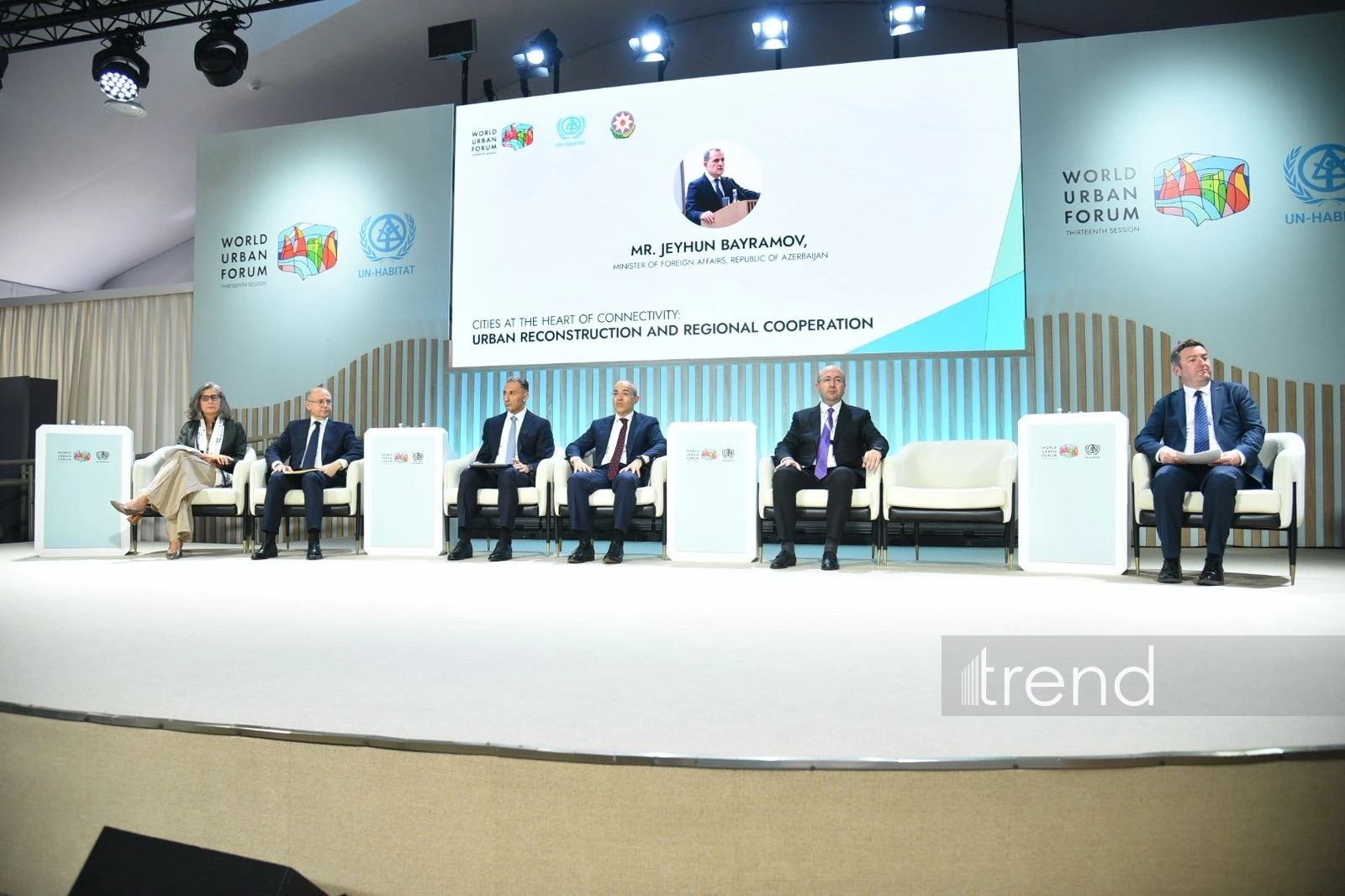
at an event on "Cities at the heart of connectivity: Urban
reconstruction and regional cooperation" held as part of WUF13 in
Baku, Trend
reports.
According to him, sustainable and well-planned cities are
essential for ensuring long-term economic and social benefits.
The minister noted that precisely on the basis of this approach,
Azerbaijan launched a large-scale reconstruction and recovery
process in the liberated territories.
"All cities, settlements, and villages are being rebuilt from
scratch based on the principles of sustainability, smart
governance, green energy, climate resilience, and people-centered
urban planning.
This process is not just about building houses and roads. It's
about forming centers of economic growth, connectivity, and human
development.
At the same time, the large-scale reconstruction and settlement
projects implemented in the liberated territories immediately after
the conflict are a clear indication of Azerbaijan's commitment to
the peace agenda," he explained.
Bayramov particularly emphasized that Azerbaijan has
demonstrated its sincere interest in closing the page of
confrontation in the region by investing about $15 billion in the
former conflict zone.
"In other words, the large-scale reconstruction work carried out
by Azerbaijan in the post-conflict period should also be considered
an integral part of the peace-building strategy.
This is a strategy to leave the era of violence behind and build
a more prosperous and sustainable future," he added.
The third day of the 13th session of the World Urban Forum
(WUF13) is underway in Baku.
On the first day, a ministerial meeting dedicated to the New
Urban Agenda, a roundtable of ministers, assemblies of women and
civil society, business sessions, and discussions on urban
well-being were held. A ceremony for raising the flags of the
United Nations and Azerbaijan also took place within the framework
of the forum.
The second day of the forum drew attention with the first-ever
Leaders Summit. High-level discussions on the global housing
crisis, urbanization policy, and urban resilience were held that
day. At the same time, the Mexico City pavilion was inaugurated
within the framework of WUF13. The pavilion was presented as an
important platform for expanding cooperation with the Latin
American region and preparing for WUF14.
WUF13, which has attracted more than 40,000 registered
participants from 182 countries, will continue until May 22. Held
under the theme “Housing the world: Safe and resilient cities and
communities,” the forum brings together governments, international
organizations, experts, and representatives of civil society to
strengthen global cooperation in the field of sustainable urban
development.