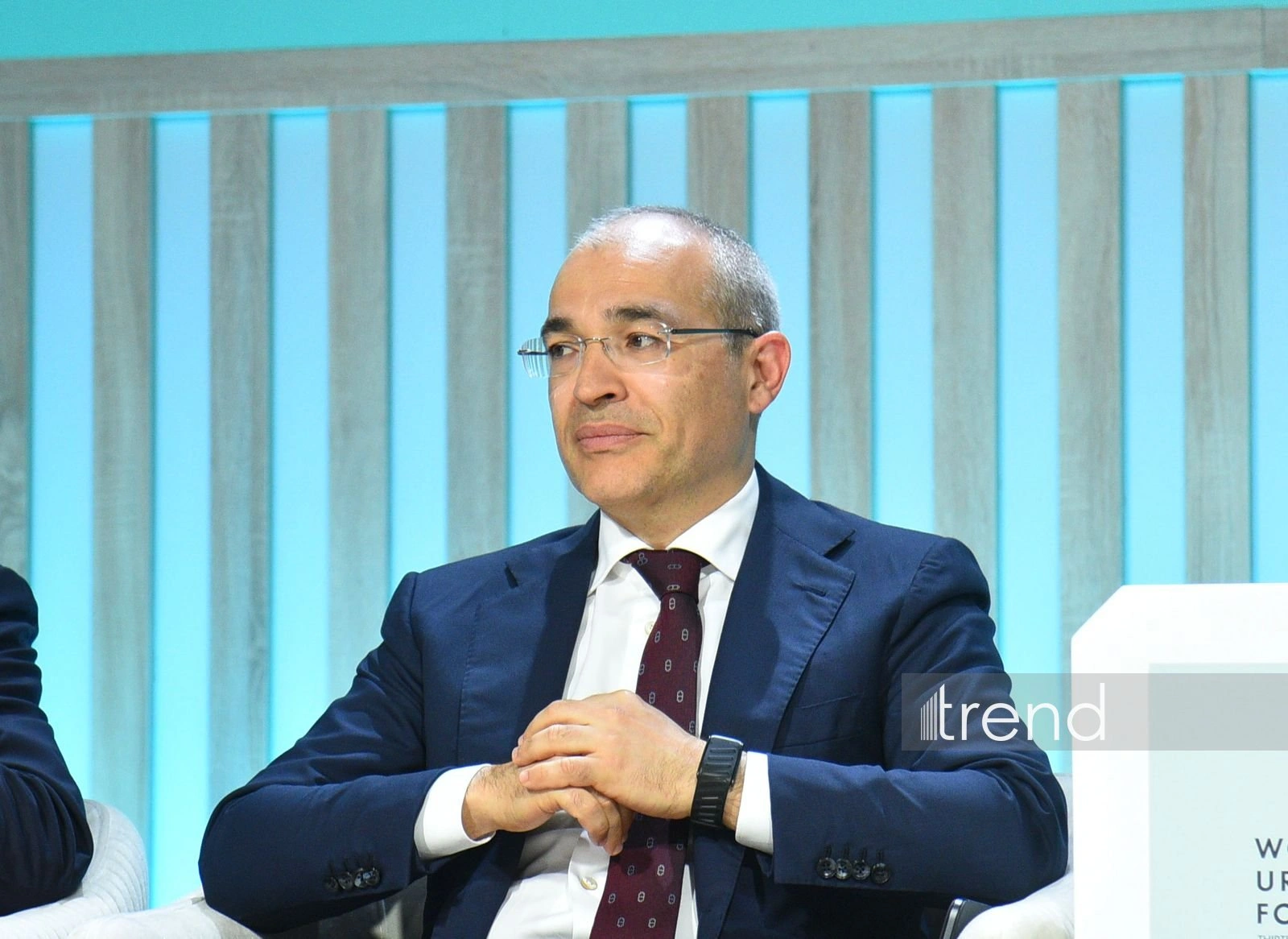
BAKU, Azerbaijan, May 19. Baku is one of the
region's largest economic hubs, the country's Minister of Economy,
Mikayil Jabbarov, said, Trend reports.
He made the statement at the event “Cities at the Heart of
Connectivity: Urban Reconstruction and Regional Cooperation,” held
in Baku as part of WUF13.
The minister noted that although Baku and Sumgayit are different
cities from an administrative standpoint, from the perspective of
economic analysis and interconnection, they form a single large
economic space.
According to him, this territory accounts for a significant portion
of the country’s gross domestic product, employment, and urban
development activities.
Furthermore, Jabbarov stressed that Azerbaijan’s economic
development strategy is based on a harmonious blend of local and
foreign talent,
Mikayil Jabbarov noted that the “Sea Breeze” project being
implemented in Baku represents a new model of a suburban city,
while the “White City” concept demonstrates a new approach to
urbanization within the city.
The minister added that new projects based on the concept of
inner-city urbanization are currently being implemented in
collaboration with investors from the Middle East.
He emphasized that the polycentric approach adopted in the
capital’s master plan helps transform issues related to quality of
life, employment, public spaces, and transportation accessibility
into more sustainable economic development. “Baku stands out among
cities located within a two-hour radius in terms of infrastructure
quality, economic opportunities, tourism, and living conditions,”
the minister added.
Meanwhile, the third day of the 13th session of the World Urban
Forum (WUF13) is underway in Baku.
On the first day, a ministerial meeting dedicated to the New
Urban Agenda, a roundtable of ministers, assemblies of women and
civil society, business sessions, and discussions on urban
well-being were held. A ceremony for raising the flags of the
United Nations and Azerbaijan also took place within the framework
of the forum.
The second day of the forum drew attention with the first-ever
Leaders Summit. High-level discussions on the global housing
crisis, urbanization policy, and urban resilience were held that
day. At the same time, the Mexico City pavilion was inaugurated
within the framework of WUF13. The pavilion was presented as an
important platform for expanding cooperation with the Latin
American region and preparing for WUF14.
WUF13, which has attracted more than 40,000 registered
participants from 182 countries, will continue until May 22. Held
under the theme “Housing the world: Safe and resilient cities and
communities,” the forum brings together governments, international
organizations, experts, and representatives of civil society to
strengthen global cooperation in the field of sustainable urban
development.