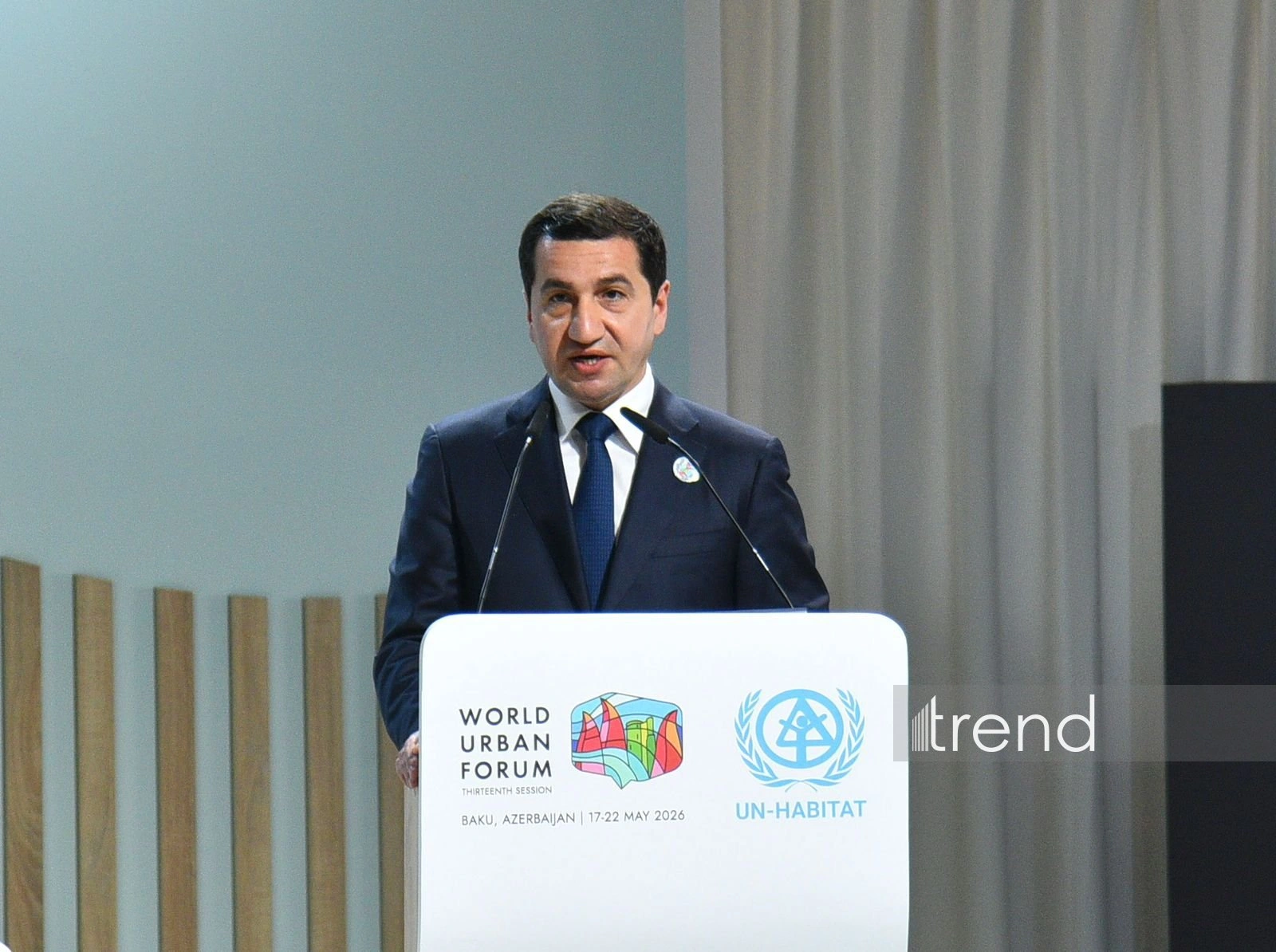
BAKU, Azerbaijan, May 19. Azerbaijan faces new
housing challenges, Hikmet Hajiyev, Assistant to the President of
the Republic of Azerbaijan and Head of the Foreign Policy Affairs
Department of the Presidential Administration, said, Trend reports.
Hajiyev expressed these views during the panel discussion
“Housing at the Center of Global Coalitions,” held as part of
WUF13.
Furthermore, Hajiyev added that for many years, Azerbaijan had
faced war and occupation by a neighboring country. Twenty-three
percent of Azerbaijan’s territory was occupied. This led to one of
the largest humanitarian crises in Europe since World War II.
Hikmet Hajiyev noted that at that time, Azerbaijan faced the
problem of one million refugees and internally displaced persons:
“All of them were deprived of their homes, living conditions, and
social opportunities.
At that time, Azerbaijan was experiencing serious economic
problems and development challenges. Despite this, the government
was forced to create shelters for refugees in tent cities. More
than three hundred settlements were used to house one million
refugees.”
The presidential aide noted that this housing program was
implemented in the context of Azerbaijan’s geopolitical situation
and post-conflict urban development: “The government sought to
provide refugees and internally displaced persons with housing,
affordable housing, and essential services. At the same time,
internally displaced persons were provided with various state
benefits. However, their main demand of the Azerbaijani government
was to return to their homes safely and with dignity.”
Given the circumstances at the time, the Azerbaijani government
took a unique step and built 300,000 apartments and houses for
refugees and internally displaced persons. The goal was to ensure
decent living conditions for these people.
After all, in every language, the phrase “my home” has a special
meaning. It doesn’t matter if it’s small or simple; for a person,
their home is their fortress. Everyone should have a home where
they can live safely with their family.
He emphasized that the main desire of internally displaced
persons had still been to return to their homeland, but that era is
now in the past. Azerbaijan is facing new realities and new housing
challenges.
The third day of the 13th session of the World Urban Forum
(WUF13) is underway in Baku.
On the first day, a ministerial meeting dedicated to the New
Urban Agenda, a roundtable of ministers, assemblies of women and
civil society, business sessions, and discussions on urban
well-being were held. A ceremony for raising the flags of the
United Nations and Azerbaijan also took place within the framework
of the forum.
The second day of the forum drew attention with the first-ever
Leaders Summit. High-level discussions on the global housing
crisis, urbanization policy, and urban resilience were held that
day. At the same time, the Mexico City pavilion was inaugurated
within the framework of WUF13. The pavilion was presented as an
important platform for expanding cooperation with the Latin
American region and preparing for WUF14.
WUF13, which has attracted more than 40,000 registered
participants from 182 countries, will continue until May 22. Held
under the theme “Housing the world: Safe and resilient cities and
communities,” the forum brings together governments, international
organizations, experts, and representatives of civil society to
strengthen global cooperation in the field of sustainable urban
development.