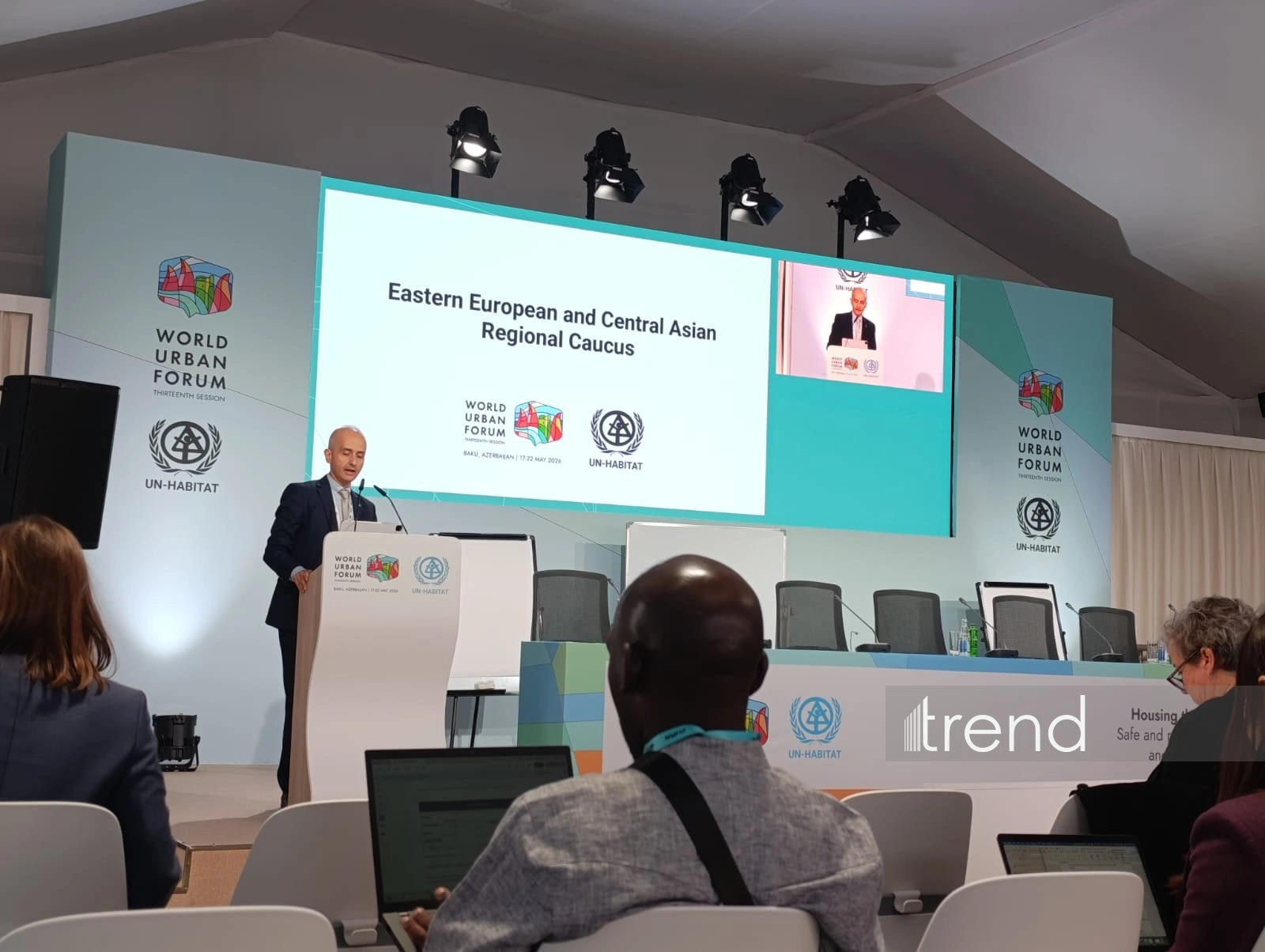
BAKU, Azerbaijan, May 19. A UN-Habitat office
may soon open in Ashgabat, Turkmenistan, Director of the UN-Habitat
Regional Office for Eastern Europe and Central Asia Irfan Ali said
during the Eastern European and Central Asia Caucus at the World
Urban Forum (WUF13), Trend reports.
"Our office currently covers 25 countries in Eastern Europe,
Southern Europe, the Western Balkans, Türkiye, Russia, the
Caucasus, and Central Asia.
Currently, the regional office is based in Istanbul, along with
other UN agencies. We already have four country programs: in Kyiv,
Ukraine, Moscow, Kosovo, and here in Baku. I hope we will soon have
a project office in Ashgabat, Turkmenistan," he said.
Ali noted that rapid urbanization is occurring in the region,
particularly in its Eastern European part.
"All countries in the region are vulnerable to the impacts of
climate change, which we see everywhere, as well as to the risks of
natural disasters. We remember what happened in Türkiye two years
ago—the devastating earthquake. And many countries in the region
are also exposed to similar risks. This motivates us to work more
actively on strengthening resilience and make this topic a priority
in our cooperation in the region," he added.
WUF13 is taking place in Baku from May 17 to 22 within the
framework of cooperation between the UN-Habitat program and the
Government of Azerbaijan.
The event's program brings together various stakeholders and
representatives of like-minded groups to discuss one of the most
pressing global challenges – the issue of housing provision.
Dedicated to the theme "Housing the World: Safe and Resilient
Cities and Communities," WUF13 gathers national governments from
around the world, as well as communities, professionals, and
partners to exchange views, shape policy approaches, and accelerate
action toward solutions in sustainable urban development.
The program provides an opportunity for high-level discussions
through practical, solution-oriented platforms and interactive
meeting formats, ensuring that global policy is anchored in local
experience.