BAKU, Azerbaijan, May 5. President of
Azerbaijan Ilham Aliyev has expressed a clear and concrete position
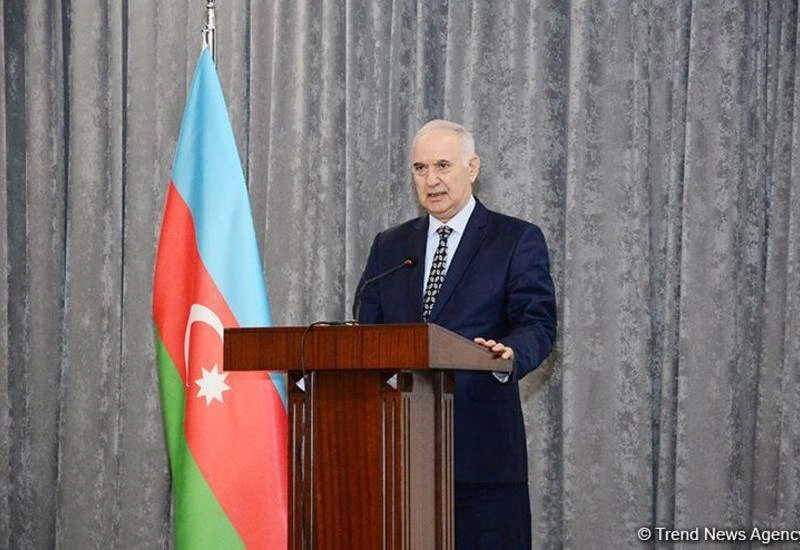
on relations with European institutions, political analyst Azer
Garayev told Trend.
According to the analyst, the European Political Community
Summit held in Yerevan was remembered for its important political
messages regarding the future of the region.
"President Ilham Aliyev joined the event via video link and
presented a clear and concrete position on the peace process,
regional cooperation, and relations with European institutions.
President Ilham Aliyev's speech drew attention not only as a
description of the current situation, but also as a set of messages
that outlined the contours of geopolitical directions for the
coming years.
At the beginning of his speech, President Ilham Aliyev, as a
diplomatic gesture, expressed gratitude for the invitation to the
summit and highlighted an important point: Azerbaijan sees this
platform as a platform for cooperation, not competition. In this
context, his invitation to host the summit in Azerbaijan in 2028 is
of particular importance. Interestingly, Armenia’s support for this
initiative is a symbolic step, as President Ilham Aliyev noted,
indicating that relations between Baku and Yerevan have entered a
new stage. This is a diplomatic expression of the new reality that
has emerged in the region after many years of conflict.
The main line of the speech was the peace agenda in
Azerbaijani-Armenian relations. President Ilham Aliyev emphasized
that the parties are already 'learning to live in peace'. This
phrase reflects the psychological and political transformation of
the post-conflict period, more than a formal statement. The joint
statement signed in Washington, as well as the initialing of the
text of the peace agreement at the level of foreign ministers,
indicate that the institutional foundations of the process have
been formed. The noteworthy point here is that the Azerbaijani side
emphasizes that peace is already accepted as a fact," Garayev
noted.
According to him, the practical results of this reality were
also presented in the speech with specific figures.
"The removal of transit restrictions imposed by Azerbaijan on
Armenia and the resulting transportation of tens of thousands of
tons of cargo can be assessed as the beginning of economic
integration in the region. A more noteworthy step is the start of
Azerbaijan's export of oil products to Armenia. This can be
assessed not only as economic cooperation, but also as a strategic
gesture that serves to build mutual trust.
In the context of regional cooperation, one of the main projects
highlighted by President Ilham Aliyev was the Middle Corridor and
the Trump International Peace and Prosperity Route presented as its
component. Importance of this route, in addition to connecting
Azerbaijan with Nakhchivan, for the wider geoeconomic space was
noted. In fact, this initiative can turn the South Caucasus into an
important link in the global trade and logistics chain. Here,
economic dividends are clearly visible for both Azerbaijan and
Armenia. From this point of view, it becomes clear that the peace
process is built not only on political, but also on economic
motivations.
Although President Ilham Aliyev highly appreciated the support
provided by the European Commission to the peace process in his
speech, he clearly stated that not all European institutions share
the same position. The European Parliament and the Parliamentary
Assembly of the Council of Europe (PACE) were particularly harshly
criticized. President Ilham Aliyev accused these institutions of
double standards and emphasized that their activities were far from
objective," he said.
Garayev noted that the striking point in the opinions expressed
regarding PACE was that Azerbaijan had been actively participating
in this organization for many years and had only recently faced
restrictions.
"President Ilham Aliyev linked this change to the political
reactions that took place after the end of separatism in Karabakh.
This approach clearly reveals the position of official Baku: while
the restoration of Azerbaijan's territorial integrity should be
assessed as a step in accordance with international law, some
European institutions present it from a different perspective.
The same criticism was directed at the European Parliament.
According to President Ilham Aliyev, this institution, instead of
supporting the peace process, sabotages it. Numerous resolutions
adopted over the past five years have been presented as a tool of
pressure. In this context, the decision of the Azerbaijani
parliament to suspend cooperation with the European Parliament can
be assessed as a harsh response from official Baku. Also, the
Azerbaijani parliament, taking a more severe step against the
backdrop of the already tense relations, has adopted an official
decision to initiate procedures for the suspension of membership
within the Euronest Parliamentary Assembly. This decision indicates
that official Baku is reconsidering its model of cooperation with
European institutions and will henceforth demonstrate a more
selective and principled approach. At the same time, this step may
actually mark the beginning of a new stage in relations - a more
principled and selective model of cooperation.
In conclusion, President Ilham Aliyev congratulated Prime
Minister Nikol Pashinyan on hosting the summit in Armenia and
reiterated Azerbaijan’s commitment to the peace agenda. This was an
important detail that set the tone of the speech: despite the harsh
criticism, the overall message was constructive and
forward-looking.
Overall, the ideas voiced at the Yerevan summit indicate that
the South Caucasus is entering a new phase. The main feature of
this stage is the transition from confrontation to cooperation.
Azerbaijan acts as both an initiator and a key player in this
process. The completion of the peace agreement, the expansion of
transport and energy projects, as well as the pursuit of a more
active diplomatic line on international platforms stand out as the
main factors that will determine the future development trajectory
of the region," the analyst added.