BAKU, Azerbaijan, December 13. The
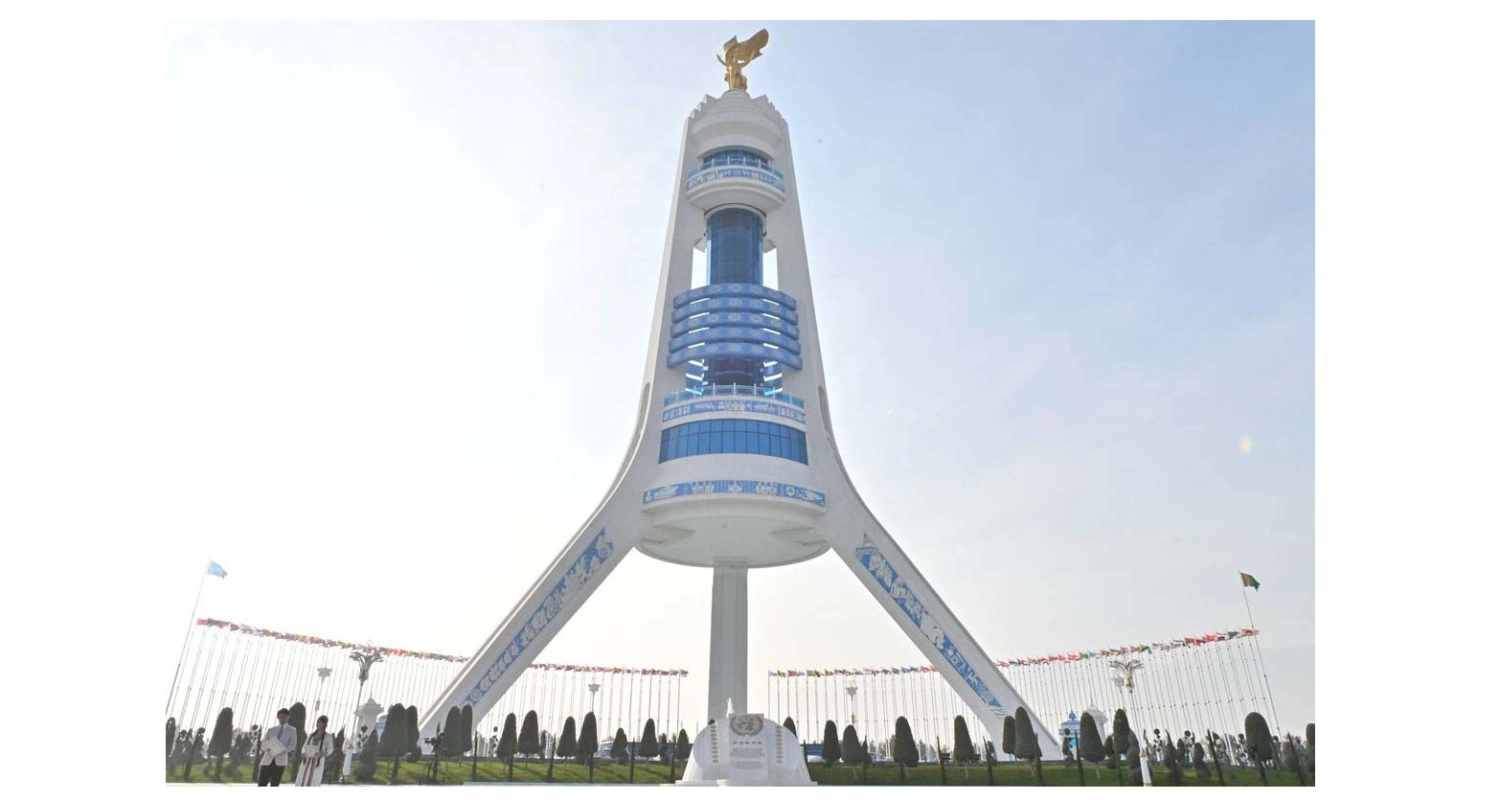
International Forum held in Ashgabat yesterday, marking the 30th
anniversary of Turkmenistan’s permanent neutrality, underscored the
ongoing need for a platform where nations with divergent strategic
interests can engage in candid dialogue and, crucially, collaborate
on tangible measures toward global stability. The event brought
together leaders from Asia, the Middle East, the Caucasus, and
Europe, along with high-level representatives from international
organizations, all gathered under the banner of Turkmenistan.
The timing of the forum coincided with three significant
milestones: the 30th anniversary of Turkmenistan's permanent
neutrality recognition, the International Day of Neutrality, and
the UN-declared 2025 International Year of Peace and Trust, an
acknowledgment that highlights Ashgabat’s enduring diplomatic
efforts at the United Nations.
While the official rhetoric surrounding global ideals of peace
might seem predictable, a more intriguing geopolitical subtext
emerged during the discussions. In 2025, amidst a backdrop of
multipolar conflicts and regional security challenges, the forum
convened leaders from countries with differing positions in the
international system, reflecting the complexity and evolving
dynamics of global diplomacy.
The forum brought together an impressive array of global
leaders, including heads of state and government from various
nations. Among the distinguished participants were Russian
President Vladimir Putin, Turkish President Recep Tayyip Erdogan,
Iranian President Masoud Pezeshkian, and the leaders of Central
Asian countries, Kazakhstan, Uzbekistan, Kyrgyzstan, and
Tajikistan. Also in attendance were Azerbaijani Prime Minister Ali
Asadov, Georgian Prime Minister Irakli Kobakhidze, Pakistani Prime
Minister Shehbaz Sharif, and Armenian President Vahagn
Khachaturyan. In addition, the forum featured the participation of
prime ministers from Myanmar and Eswatini, further broadening its
international scope.
The presence of senior representatives from prominent
international organizations—such as the United Nations (UN), the
Organization for Security and Co-operation in Europe (OSCE), the
Shanghai Cooperation Organization (SCO), the Economic Cooperation
Organization (ECO), the United Nations Educational, Scientific and
Cultural Organization (UNESCO), and the Islamic Educational,
Scientific and Cultural Organization (ISESCO)—served to underscore
the forum's importance on the global stage.
The forum commenced with a ceremonial tone, as Turkmenistan's
President Serdar Berdimuhamedov extended a warm welcome to the
participants, underscoring that neutrality is not merely a
historical achievement but a dynamic international strategy. He
emphasized that for Ashgabat, neutrality entails more than passive
observation; it represents active engagement in global dialogue,
grounded in principles of equality, respect, and mutual trust. In
his address, President Berdimuhamedov proposed the creation of a
University of Peace and Neutrality, in partnership with the United
Nations, as a further step in fostering international
collaboration.
Bringing together leaders from a broad array of nations, the
Ashgabat forum served as both a venue for strategic discussions and
a demonstration of the collective commitment to constructive
cooperation. The topics covered in plenary sessions and informal
gatherings ranged from fostering global dialogue and building trust
to advancing economic and infrastructural initiatives.
Turkish President Recep Tayyip Erdogan, in his remarks, stressed
the importance of global dialogue as a means to navigate the
prevailing uncertainty and geopolitical tensions. His speech
highlighted Türkiye's role not only as a key regional player but
also as a vital bridge between East and West, reinforcing the
strategic importance of the forum for Ankara. Erdogan also
commended Turkmenistan’s remarkable economic progress, noting that
the country has emerged as one of the fastest-growing economies in
the world. "Today, Turkmenistan stands as a model of modernity with
its thriving cities, factories, schools, and hospitals," he
affirmed.
Bilateral consultations formed an important part of the forum’s
agenda. Russian President Vladimir Putin held meetings with the
presidents of Turkmenistan and Iran to discuss deepening bilateral
cooperation, reflecting Moscow’s interest in strengthening
strategic ties in the region, particularly in the energy and
transport sectors. In this context, Turkmenistan’s role is clearly
highlighted. Annual trade between Russia and Turkmenistan exceeds
$1.6 billion. In 2025, growth dynamics are evident: in the first
quarter alone, bilateral trade increased by 21.4%, and in the first
half of the year, trade volume grew more than 30% year-on-year.
According to yesterday’s statement by the Russian president, trade
figures for the first ten months have already reached a 35%
increase.
This upward trajectory is underpinned by tangible actions. A
notable example was the participation of Rustam Minnikhanov, the
head of Russia’s Republic of Tatarstan, which maintains significant
economic interests and strong ties with Turkmenistan.
The speeches delivered by Central Asian leaders also focused on
practical and actionable issues.
Kazakhstan’s President Kassym-Jomart Tokayev highlighted the
region's ongoing water resource challenges and proposed the
establishment of an international platform to address these
critical concerns. ''Currently, within the UN system, there is no
specialized body dedicated exclusively to water issues. Therefore,
Kazakhstan suggests the creation of an International Water
Organization that would consolidate the existing mandates of
various UN agencies. An optimal solution could involve transforming
the UN-Water inter-agency mechanism into a fully-fledged
specialized UN agency or organization,” the president remarked.
As part of its upcoming tenure as chair of the Non-Aligned
Movement for the 2027-2029 period, Uzbekistan intends to designate
2027 as the Year of Preventive Diplomacy, according to President
Shavkat Mirziyoyev.
Kyrgyzstan, in turn, aims to deepen practical cooperation with
Ashgabat in energy, transport, and logistics. President Sadyr
Japarov emphasized that Turkmenistan now plays a key role in
regional transport networks thanks to the modernization of Caspian
infrastructure, the expansion of port capacities, and participation
in international logistics initiatives.
Tajikistan’s President Emomali Rahmon highlighted the importance
of “strengthening trust at the global level” as a key factor for
sustainable development.
The forum also garnered international recognition, with Chinese
President Xi Jinping sending a congratulatory message that
underscored the significance of strengthening mutual respect,
trust, and understanding on the global stage, while affirming
China’s support for Turkmenistan’s policy of neutrality.
Beyond the formal statements, the forum sparked ideas that have
the potential to evolve into tangible initiatives. Specifically,
Turkmenistan's proposal to establish a University of Peace and
Neutrality under the UN’s auspices, supported by Azerbaijan,
alongside Kazakhstan’s suggestion to transform UN-Water into a
fully-fledged specialized UN agency, represents a pathway toward
institutionalization. These proposals align with the forum's
overarching goal of bridging declarative intentions with concrete,
actionable outcomes. While the implementation of these initiatives
will depend on international support, the mere fact that they were
discussed highlights the pragmatic and forward-thinking nature of
the event.
The International Forum, commemorating the 30th anniversary of
Turkmenistan’s permanent neutrality in Ashgabat, was far more than
a routine diplomatic gathering. It served as a platform where the
interests of nations committed to strengthening stability
intersected with the ideals of multilateral cooperation. The forum
demonstrated the willingness of countries with diverse histories
and priorities to engage in dialogue on the principles of respect
and mutual understanding, while also paving the way for further
institutional development of these shared ideals.