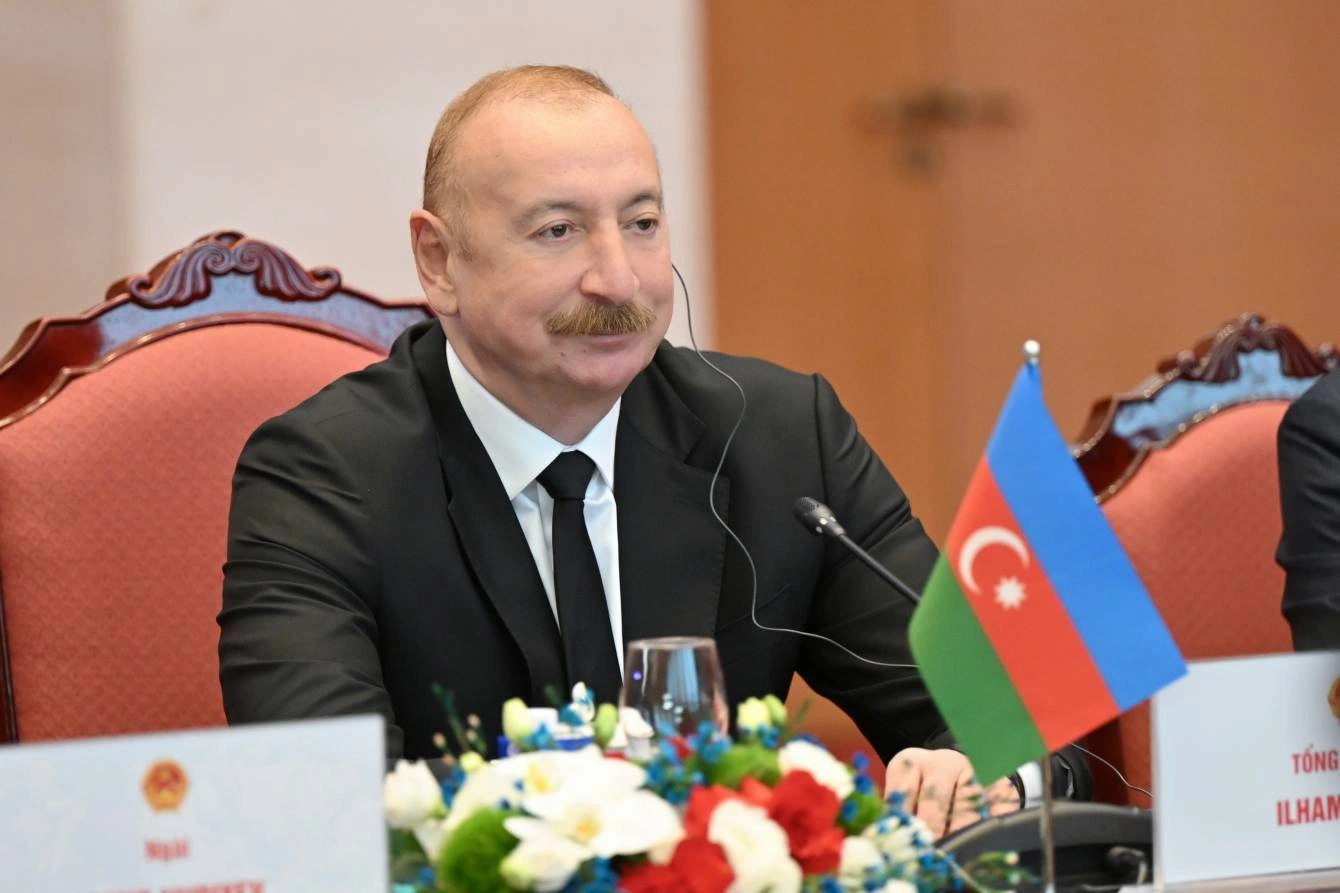
BAKU, Azerbaijan, November 21. Azerbaijani
President Ilham Aliyev has paid an official visit to Vietnam, where
he and President To Lam adopted a Joint Statement on November 21.
Looking only at these three days, one might see a successful but
isolated diplomatic episode. It is more interesting, however, to
take a step back and examine the policy Ilham Aliyev has been
pursuing across Asia over the past year and a half. From that
perspective, Hanoi is not an isolated event but a carefully
calculated move in a long-term strategy that Baku is pursuing with
confidence and without haste, as it has done before.
It all began in May last year. To Lam, General Secretary of the
Communist Party of Vietnam, made his first state visit to Baku. The
two sides agreed to establish a strategic partnership, and the
Vietnamese leader invited Ilham Aliyev to pay a return visit. "The
visit of Mr. President last year was crucial to the development of
our ties, and he was very kind to invite me. I accepted the
invitation with great pleasure, and after one year, I'm here," the
Azerbaijani president said during his meeting with Prime Minister
of Vietnam.
This diplomatic courtesy has also produced a tangible result.
Prime Minister Le Minh Hung announced that Vietnam would soon open
an embassy in Baku. Azerbaijan's embassy in Hanoi has been
operating for years, while Vietnam has not previously had a
diplomatic mission in Azerbaijan. Countries open embassies when
they are confident that their relations have a serious and
long-term future. Hanoi has gained that confidence precisely
through its engagement with Ilham Aliyev.
Vietnam did not emerge on the map in isolation. A month ago, in
mid-October, Baku hosted the summit of the Conference on
Interaction and Confidence Building Measures in Asia (CICA).
Cambodian Prime Minister Hun Manet and Lao President Thongloun
Sisoulith attended the event. Azerbaijan and Cambodia signed
agreements on trade and the avoidance of double taxation. Laos
became a full member of the organization at the summit chaired by
Azerbaijan. Meanwhile, a document signed with Vietnam last year
stipulated that Hanoi would help Baku develop ties with ASEAN.
Cambodia, Laos, and now Vietnam. Within just a few months,
Azerbaijan has established strong ties across an entire region that
had rarely featured prominently on Baku's agenda until recently.
This is no coincidence. Aliyev is opening up Southeast Asia to
Azerbaijan step by step, with Vietnam being the largest economy
among these three countries.
Perhaps the warmest moment of the talks came when the two sides
discussed the events of 2020. Ilham Aliyev recalled that
Azerbaijanis had always supported the Vietnamese people's struggle
for independence, adding: "I would like to highlight our
constructive cooperation based on mutual trust and support within
the UN, the Non-Aligned Movement, and CICA. We are grateful to
Vietnam for the support and fair position it has always maintained,
especially during the 2020 Patriotic War."
In 2020, Azerbaijan received support from countries thousands of
kilometers away from Karabakh. Such friends are not found in a
week. They are built over years, and Ilham Aliyev has been building
these relationships.
In Hanoi, the president also spoke about what Azerbaijan could
offer its partners. On the eve of the visit, in an interview with
the Vietnam News Agency, he put it this way: "Today, Vietnam is a
rapidly developing country in Southeast Asia, while Azerbaijan is a
key transport, logistics, and energy hub in the South
Caucasus."
At a meeting with Chairman of Vietnam's National Assembly Tran
Thanh Man, he added: "The supply chain of energy resources, which
is provided by Azerbaijan, is very reliable."
Ilham Aliyev offered Vietnamese businesses the Middle Corridor
as a route to markets across the region and Europe. The talks also
covered supplies of Azerbaijani petroleum products, the defense
industry, construction, tourism, and direct air links.
The figures remain modest for now, and the president does not
hide that fact. Bilateral trade exceeded $150 million last year,
but, as he noted, this figure does not yet reflect the real
potential of the two countries. At the same time, the transit of
Vietnamese cargo through Azerbaijan increased almost sixfold in the
first nine months of this year. In Hanoi, Azerbaijan's Ministry of
Energy also signed an agreement with Vietnam's ROX Group on the
construction of solar and wind power plants in Azerbaijan.
Vietnamese businesses are ready to invest in the Azerbaijani
economy, and that is one of the clearest signs of confidence.
Ilham Aliyev received a reception befitting the occasion. The
Azerbaijani president and First Lady Mehriban Aliyeva were welcomed
by To Lam and his wife, with a guard of honor and the national
anthems of both countries. Vietnam's leading media outlets - the
Communist Party newspaper Nhan Dan, the state news agency, and
Voice of Vietnam radio - provided extensive coverage of every
meeting.
"I was here more than 10 years ago, and I can see a lot of
changes," Ilham Aliyev told his Vietnamese counterparts.
Azerbaijan has changed significantly over those ten-plus years
as well. The country has restored its territorial integrity, become
a gas supplier to Europe, and emerged as a transit hub connecting
East and West. Now, under Ilham Aliyev's leadership, Azerbaijani
diplomacy is reaching parts of the world where Baku had rarely
ventured before.