BAKU, Azerbaijan, November 13. The developments
in the South Caucasus in recent years have increasingly made one
truth clear: the region’s future should no longer be shaped by
conflict and confrontation, but rather by cooperation,
transportation links, and economic integration. Azerbaijan’s
political will, particularly that of President Ilham Aliyev, and
the peace agenda he has put forward play a decisive role in shaping
this new phase.
Following the historic victory in the 44-day Patriotic War,
Azerbaijan set itself a new goal: to consolidate the results of the
war in accordance with international law, achieve lasting peace in
the region, and transform the South Caucasus from an arena of
confrontation into a platform for cooperation. Baku has sought to
achieve this goal not only through political statements, but also
through concrete proposals, diplomatic initiatives, and economic
projects. Today, we are already seeing individual elements of this
agenda being implemented.
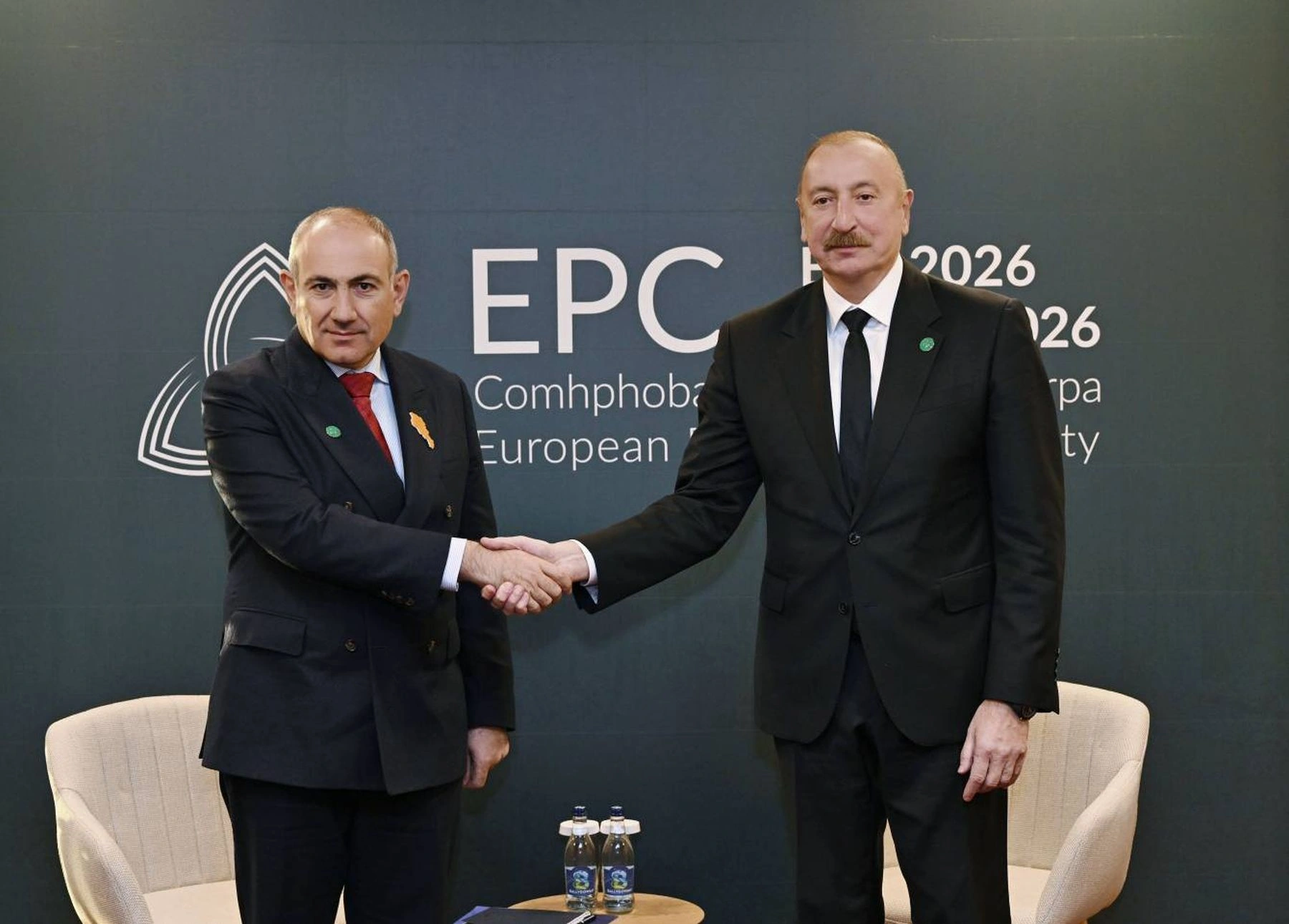
President Ilham Aliyev’s meeting with Armenian Prime Minister
Nikol Pashinyan, which took place on November 12 in Dublin, also
marked another important milestone in this very process. At the
meeting, which took place within the framework of the 9th Summit of
the European Political Community, the parties discussed advancing
the peace agenda, building on the outcomes of the Peace Summit held
on August 8, 2025, in Washington, and the signed Joint
Declaration.
The significance of the meeting lay not only in the fact that
the two leaders came together. The substance of the discussions
showed that relations between Azerbaijan and Armenia are gradually
shifting from the stage of political agreements to that of
practical cooperation aimed at transforming everyday life and
economic ties. Transportation and transit routes, trade and
economic relations, border delimitation, confidence-building
measures, the future integration of power grids, and the management
of transboundary water resources—these are the issues that today
constitute the true substance of peace.
Baku is the architect of the peace agenda; cooperation
is the key condition for the next phase
The peace proposals put forward by Azerbaijan after the war are
based on the fundamental principles of international law: mutual
recognition of sovereignty and territorial integrity, the
inviolability of state borders, the renunciation of territorial
claims against one another, and the non-use of force. This was
precisely the essence of the five principles announced by the
Ministry of Foreign Affairs in 2022.
As a result of negotiations conducted based on these principles,
the text of a peace agreement was initialed in Washington on August
8, 2025. This marked a historic step toward resolving the
decades-long conflict in the political and legal spheres. At the
same time, it should be noted that the initialed text is not yet an
officially signed and entered into force agreement. For the
agreement to be signed and enter into force, it is essential to
complete the required legal procedures.
Azerbaijan’s position is clear: lasting peace is possible only
on the basis of mutual respect for sovereignty and territorial
integrity, the renunciation of territorial claims, and normal
good-neighborly relations. Accepting this reality and integrating
Armenia into regional integration processes are crucial for its own
economic and political future. A peace agreement is the primary
legal and political foundation for this
In essence, through the new reality created by the Patriotic
War, Azerbaijan has opened up opportunities for the development of
all countries in the region, including Armenia. Armenia, which for
many years operated under a logic of blockade and confrontation, is
now beginning to see the benefits created by trade, transit,
energy, and transportation links with its neighbors. This
demonstrates that the peace agenda put forward by Azerbaijan is
beneficial not only to Baku but to the entire region.
TRIPP - An Economic Pillar of Peace and a Slow-Moving
Process
One of the notable topics at the Dublin meeting was the “Trump
Route for International Peace and Prosperity” (TRIPP) project.
President Ilham Aliyev and Nikol Pashinyan discussed the planning
and design of the project’s rail and road components, as well as
the prospects for transit connections along the route.
The significance of TRIPP extends far beyond that of a single
transportation route. In addition to establishing a connection
between Azerbaijan and Nakhchivan, this project has the potential
to reshape the transportation landscape of the South Caucasus,
accelerate freight transport between the East and West, and expand
opportunities for regional trade. The development of rail and road
infrastructure could create conditions for reducing freight transit
times and costs, diversifying routes, and expanding economic
ties.
The project also opens up significant economic opportunities for
Armenia. The country could gain the opportunity to connect to the
regional transit system, attract new investments, modernize its
infrastructure, and expand trade ties with its neighbors. For
Azerbaijan, ensuring unimpeded transport links with Nakhchivan and
strengthening its position along the East–West corridor are of
strategic importance.
Notably, the TRIPP project is already moving forward on the
legal and organizational fronts. The Armenian Parliament has
enacted the necessary legislative changes to implement the
project.
The announcement that the project will enter the construction
phase in early 2027 indicates that TRIPP is moving beyond the realm
of political debate and approaching the stage of practical
implementation.
The main reason TRIPP is becoming a difficult process to reverse
is that it is driven not only by political agreements but also by
economic interests. Along with Azerbaijan and Armenia, Türkiye,
Central Asian countries, as well as European and Asian markets
could benefit from this route. Transporting cargo via shorter,
safer, and more efficient routes will enhance the region’s
competitiveness.
105,000 metric tons of cargo and transboundary rivers:
peace is already yielding tangible results
One of the most significant outcomes of the Dublin meeting was
the positive assessment of cargo transit to Armenia through
Azerbaijani territory. According to official data, a total of
105,000 metric tons of cargo has been transported through
Azerbaijani territory to Armenia from last November to the present.
This figure demonstrates that the peace agenda is already yielding
concrete results in the economic sphere. By creating conditions for
transit through its territory as part of this process, Azerbaijan
is helping to give peace economic substance.
Another important development is the establishment of working
groups on the management of transboundary rivers. This area, which
at first glance appears to be a technical and environmental issue,
is in fact a crucial component of regional security. The protection
of river water resources, water allocation, pollution prevention,
and environmental risk management are issues that cannot be
resolved within the borders of a single country.
The establishment of working groups on transboundary water
cooperation between Azerbaijan and Armenia demonstrates the
parties’ willingness to discuss even more complex issues through
dialogue.
Turkish-Armenian relations are also part of the regional
agenda being shaped jointly with Baku.
Another important aspect of regional developments is the
normalization of Turkish-Armenian relations. At a meeting between
Turkish President Recep Tayyip Erdoğan and Armenian Prime Minister
Nikol Pashinyan, held on November 11 as part of COP31, the two
leaders discussed the normalization of relations and the
establishment of transportation and communication links between the
two countries.
Türkiye’s position in this process also highlights the crucial
importance of Azerbaijani-Armenian relations. Turkish Minister of
Transport and Infrastructure Abdulkadir Uraloğlu stated that Ankara
has completed preparations to reopen the land border and restore
rail service with Armenia; however, the opening of the border is
contingent upon the conclusion of a comprehensive agreement between
Armenia and Azerbaijan. This statement by the Turkish side once
again demonstrates the importance of coordination between Ankara
and Baku on regional issues.
Thus, the normalization of Armenian-Turkish relations is also
inseparable from the Azerbaijani-Armenian peace process. This shows
that complementary political and economic processes are taking
shape in the region.
The opening of the border between Türkiye and Armenia, the
restoration of rail service, and the expansion of trade ties will
increase the economic potential of the South Caucasus. However, for
this process to be sustainable, it is important to take
Azerbaijan’s security interests into account and maintain
coordination with Baku.
Azerbaijan’s regional strategy: not external dependence,
but cooperation through its own efforts.
Today, against the backdrop of ongoing political and military
conflicts, instability, and economic risks in the Middle East, a
historic opportunity has emerged to transform the South Caucasus
and Central Asia into a region of stability and interconnectedness.
With its rich natural resources, energy potential, transportation
capabilities, and advantageous geographic location, Central Asia is
attracting the attention of the world’s leading powers. China,
Russia, the US, and the EU are seeking to expand their economic and
political ties with this region.
In this geopolitical landscape, Azerbaijan is one of the key
connecting countries linking Central Asia with Europe. The routes
passing through the Caspian Sea, the Middle Corridor, port and
railway infrastructure, and energy and logistics capabilities make
Azerbaijan’s role indispensable. Without Azerbaijan’s
participation, it is difficult to envision a large-scale and
sustainable system of interconnectivity that would enable Central
Asia to access European markets.
This is the very essence of the regional approach being shaped
under the leadership of President Ilham Aliyev: the three states of
the South Caucasus – Azerbaijan, Georgia, and Armenia – must rely
first and foremost on their own will and regional dialogue when
resolving their problems, ensuring security, and establishing
economic cooperation. The interests of external powers must not
become the sole factor determining relations among the countries of
the region. On the contrary, cooperation among the three countries
based on mutual benefit, respect for each other’s sovereignty, and
shared economic interests must form the foundation of stability in
the South Caucasus.
This does not mean rejecting cooperation with external partners.
US participation in the TRIPP project, the European Union’s
interest in regional infrastructure, and Türkiye’s support for the
normalization process demonstrate that the new economic
architecture of the South Caucasus also creates broad opportunities
for international partnership. However, the countries of the region
themselves must be the primary architects of regional
solutions.
The events of recent days at COP31 and the Dublin Summit have
once again demonstrated this reality. Azerbaijan is one of the key
players in promoting a peace agenda with Armenia, normalizing
Turkish-Armenian relations, and developing transportation and
economic ties between the East and the West.
At the heart of all this lies the political course set forth by
President Ilham Aliyev. Following its military victory, Azerbaijan
put forward a peace initiative, proposed opening regional transport
routes, and placed opportunities for economic cooperation on the
agenda; today, we are seeing the practical results of these
initiatives.
The future of the South Caucasus can no longer be assessed
solely through the lens of past conflicts. The region now has the
prospect of building new transportation routes, trade
opportunities, energy cooperation, and a common security system. In
this process, Azerbaijan is not merely a participant but the
leading regional force shaping its direction. Having initiated the
peace process, Baku has now moved on to the stage of transforming
that peace into economic prosperity, regional integration, and
long-term stability.