BAKU, Azerbaijan, October 31. The European Bank
for Reconstruction and Development (EBRD) is seeking to expand its
investment operations in Turkmenistan, supporting private-sector
development and infrastructure projects while attracting additional
international capital and expertise to the country.
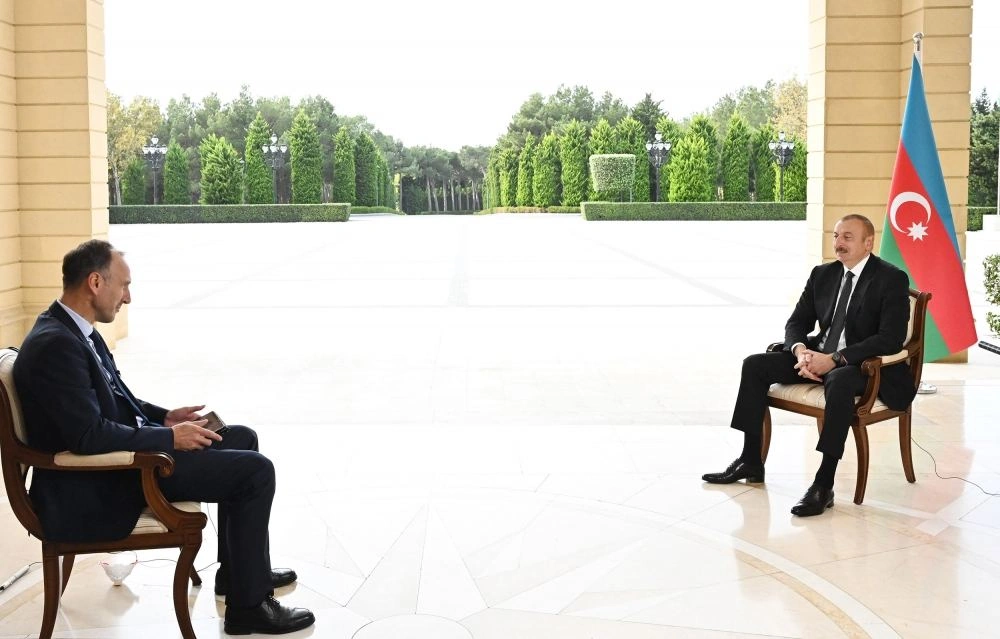
EBRD Head of Turkmenistan Eric Livny said this in an exclusive
interview with Trend,
outlining the Bank's priorities for expanding its operations in
Turkmenistan.
"Public-private partnerships (PPPs) have become an important
tool for mobilising private investment in infrastructure in many
EBRD countries," he said.
According to Livny, PPP structures can help governments access
private-sector expertise and financing while improving the
efficiency of project delivery and operation. At the same time, he
said the EBRD is not currently discussing any specific PPP projects
with the Turkmen authorities.
"At this stage, our engagement is focused on identifying
opportunities to support private-sector development directly,
strengthening cooperation with the banking sector and advancing
project preparation work in areas such as transport, sustainability
and municipal infrastructure," he noted.
Looking ahead, Livny identified several areas where broader use
of PPP structures could potentially support development in
Turkmenistan.
"If Turkmenistan were to consider broader use of PPPs, sectors
such as transport infrastructure, logistics facilities, municipal
services, renewable energy and water management could potentially
benefit from such an approach," he said.
Livny also stressed that successful PPP programmes require a
well-developed legal and regulatory framework, transparent
procurement procedures and a pipeline of commercially viable
projects.
"At present, the EBRD’s priority is to deepen cooperation in
areas covered by the five agreements signed during our President's
visit to Turkmenistan in late July and translate those into
concrete investment opportunities," Livny stressed.
He also addressed the country’s potential for investment in
railway infrastructure and logistics services along the
Trans-Caspian Transport Corridor, mentioning the recent visit to
Turkmenistan by EBRD President Odile Renaud-Basso.
"Transport connectivity was one of the key themes of Odile
Renaud-Basso visit and of her discussions with the Turkmen
authorities, including His Excellency President Serdar
Berdimuhamedow," he said.
According to Livny, Turkmenistan occupies a strategic position
in the Caspian region, connecting Asia and Europe. He added that
the country has significant potential to strengthen its role as an
important transit link along the Trans-Caspian Transport
Corridor.
"At this stage, discussions are focused primarily on railway
infrastructure and logistics services," Livny noted.
He said the memorandum EBRD signed with the transport
authorities of Turkmenistan provides a framework for exploring
opportunities to modernize sections of the national railway
network, improve freight handling capacity and enhance the
efficiency of logistics operations.
According to him, the EBRD also sees potential beyond physical
infrastructure, with customs procedures, border management and
other trade facilitation measures identified as areas that can
affect transport efficiency.
"Experience across the region shows that customs procedures,
border management and other trade-facilitation measures often have
as much impact on transport efficiency as investments in tracks,
terminals and rolling stock," Livny said.
"For this reason, our cooperation will also examine
opportunities to improve the "soft" infrastructure that determines
how efficiently goods move across borders," he added.
Livny stressed that it is still too early to identify individual
projects under the potential cooperation.
"It is still too early to identify individual projects, but we
see considerable potential for investments that can strengthen
regional connectivity, reduce transit times and improve the
competitiveness of the Transcaspian Corridor," he said.
Livny also explained which of the five memorandums signed in
July would be the first to lead to the implementation of investment
and financial projects.
"The agreement we expect to have the most immediate and
practical impact is the memorandum signed with the Central Bank of
Turkmenistan," he said.
According to Livny, the agreement creates a framework that will
allow the EBRD to resume direct financing of export-oriented
private companies with their own foreign-currency revenues.
"As a result, we expect the first concrete transactions to
emerge from our discussions with private businesses in sectors such
as manufacturing, agribusiness, logistics and export-oriented
services," Livny said.
He added that several visits by the bank’s banking teams are
already planned to identify potential investment opportunities and
advance project preparation.
"The second area, where we hope to move relatively quickly, is
cooperation with local financial institutions," he added.
According to Livny, the EBRD is exploring partnerships with
selected Turkmen banks that could support lending to small and
medium-sized enterprises while introducing international banking
expertise and trade-finance instruments.
Livny noted that the remaining memorandums covering transport,
sustainability and urban development also remain important,
although they are expected to require more extensive technical work
before developing into investment projects.
"They should therefore be seen as building the pipeline for
future engagement rather than generating immediate financing
operations," he said.
Livny outlined direct project financing could provide a
straightforward mechanism for supporting investment.
"The most straightforward approach is direct project financing,
where the Bank provides long-term loans alongside sponsors and
commercial lenders. The EBRD's participation can help reduce
perceived risks and provide comfort to other investors considering
entry into a new market," Livny said.
According to Livny, syndicated financing could further expand
the pool of private capital involved in projects by allowing
commercial banks and institutional investors to participate
alongside the Bank.
"We can also support projects through syndicated financing
structures, whereby part of an EBRD-financed loan is subsequently
shared with commercial banks and institutional investors. This
allows larger volumes of private capital to participate in projects
than would otherwise be possible," he said.
Livny also identified equity investments, trade-finance
instruments, guarantees and risk-sharing arrangements among the
tools that could be used to support investors.
"In addition, the EBRD can support investors through equity
investments, trade-finance instruments, guarantees and risk-sharing
arrangements where appropriate. Technical cooperation is often
equally important. By helping projects meet international
environmental, governance and operational standards, we can
increase their attractiveness to foreign investors and facilitate
access to international financing," Livny said.
Livny said the EBRD’s role would ultimately go beyond providing
its own funding.
"Ultimately, our objective is not simply to provide EBRD funding
but to act as a catalyst that helps attract additional
international capital and expertise to the country," he said.
Turning to the private sector, Livny said improving access to
finance for privately owned MSMEs is among the key objectives of
the EBRD’s planned engagement with Turkmenistan’s financial
sector.
"Improving access to finance for privately owned micro, small
and medium-sized enterprises is one of the key objectives of our
planned engagement with the financial sector," Livny said.
According to Livny, a first step could be establishing
partnerships with selected local banks that have a meaningful
presence in the SME segment.
"Through these partnerships, the EBRD could provide dedicated
credit lines targeted at export-oriented businesses and other
private enterprises with strong growth potential," he said.
Livny noted that access to finance is not always the only
challenge for private companies.
"We would therefore seek to complement financing with advisory
support to help companies strengthen management systems, improve
productivity, obtain international certifications and prepare for
expansion into export markets. Combining finance with advisory
services is one of the EBRD's most effective tools for supporting
SME development," Livny said.
The EBRD also sees significant scope for expanding the use of
trade-finance instruments, including guarantees and letters of
credit.
"We also see significant scope to expand the use of modern
trade-finance instruments, including guarantees and letters of
credit. These products can help businesses manage commercial risks,
reduce working-capital constraints and build relationships with
international suppliers and buyers," Livny said.
In the longer term, Livny said the EBRD aims to contribute to
the development of a more commercially oriented financial
sector.
"Our longer-term objective is to contribute to building a more
commercially oriented financial sector capable of serving the
evolving needs of Turkmenistan’s fast-growing private businesses,"
Livny said.
"The new Country Strategy is still under preparation, but the
broad direction of our engagement is already clear," Livny
said.
According to him, the priority is to expand support for the
private sector.
"Over the past decade, Turkmenistan has seen the emergence of a
number of competitive private companies in agriculture,
manufacturing, logistics and services. We would like to support
this process through direct financing, partnerships with local
banks and advisory services that help companies grow, innovate and
expand into export markets," Livny noted.
He said that the second priority is improving connectivity.
"Turkmenistan's geographic position gives it significant
potential as a bridge between Central Asia, the Caspian region, the
South Caucasus, the Middle East and South Asia. Investments in
transport infrastructure, logistics and trade facilitation can help
unlock this potential while strengthening regional integration,"
Livny said.
The bank's third priority is sustainability and the efficient
use of resources, he added.
"This includes work on energy efficiency, emissions reduction,
renewable energy opportunities and sustainable urban
infrastructure, particularly in areas such as water and waste
management," Livny said.
He noted that, to scale up the bank’s operations, its immediate
objective is to build a meaningful pipeline of private-sector
transactions.
"If the framework agreed during the EBRD President's visit is
implemented, and a strong portfolio of bankable projects emerges,
we would expect the scale of our activity in Turkmenistan to
increase progressively over the coming years," Livny said.
He added that the bank's long-term success would be measured by
its contribution to economic diversification, competitiveness and
international integration, driven by a more dynamic private
sector.
He also outlined the conditions by which the bank’s long-term
success would be measured.
"The ultimate measure of success will be our ability to support
a more diversified, competitive and internationally integrated
economy led by an increasingly dynamic private sector," Livny
said.
For reference, the European Bank for Reconstruction and
Development (EBRD) has been working with Turkmenistan since 1992.
Its engagement has focused on private-sector development,
cooperation with financial institutions and support for private
companies through financing and advisory services. The bank has
also identified sectors such as transport, logistics, agribusiness,
industry and commerce as areas with potential for further
private-sector investment.
According to the EBRD, the bank has financed 87 projects in
Turkmenistan, with cumulative investment reaching €322 million.
In July 2026, EBRD President Odile Renaud-Basso visited
Turkmenistan, during which the sides signed five memorandums of
understanding covering strategic cooperation for 2027-2032, the
banking sector, sustainable energy, environmental protection and
water resources, transport corridors, and Ashgabat’s participation
in the EBRD Green Cities programme. The documents are intended to
provide a framework for further cooperation.