BAKU, Azerbaijan, October 26. Uzbekistan and
Azerbaijan are strengthening cultural and scientific cooperation,
building on their centuries-old shared historical, intellectual,
and spiritual heritage, said Firdavs Abdukhalikov, director of the
Center for Islamic Civilization in Tashkent, Trend's correspondent reports
from the event.
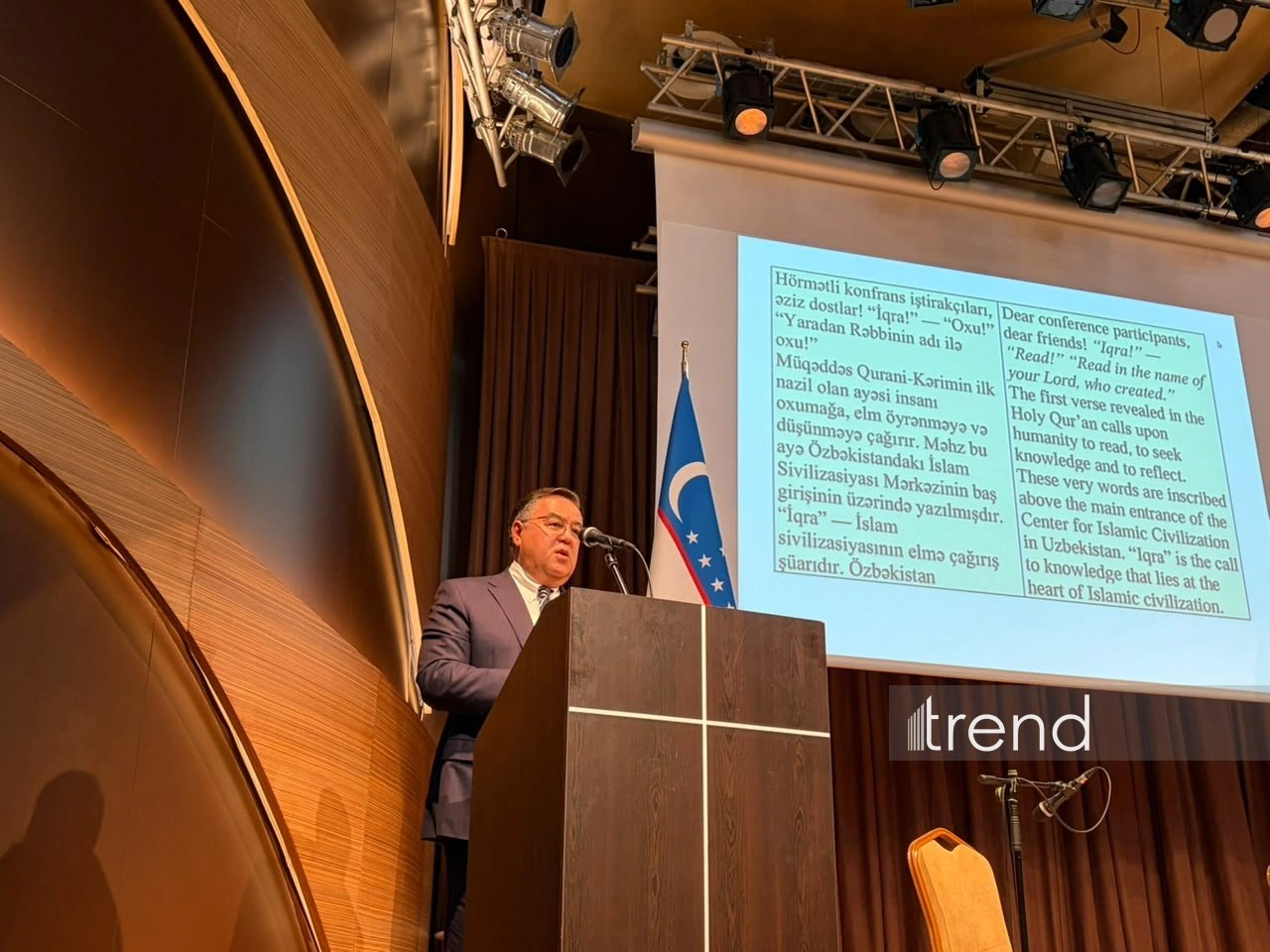
Speaking at the presentation of the Center for Islamic
Civilization and an international scientific conference in Baku,
Abdukhalikov emphasized the historical ties between the two
nations, which date back to the pre-Islamic era and were further
developed through Islamic science, astronomy, and literature. He
noted that the President of the Republic of Azerbaijan, Ilham
Aliyev, who visited the Center, spoke highly of this
initiative.
According to Abdukhalikov, these values reflect the common
principles that unite the Uzbek and Azerbaijani peoples. He also
drew attention to the ancient roots of bilateral ties, noting that
the ethical principles associated with the “Avesta” and the
Zoroastrian heritage – “Good thoughts, good words, good deeds” –
continue to inspire people today. Recalling his visit to the famous
“Ateshgah” temple complex in Baku, Abdukhalikov noted that this
historic landmark allowed him to once again experience the shared
spiritual and cultural roots of the two peoples.
“In the centuries that followed, Islamic civilization further
enriched these ties,” he said, emphasizing that over the centuries,
scholars had exchanged knowledge, manuscripts, and ideas.
As an example, Abdukhalikov cited the interaction between Ibn
Sina and his Azerbaijani student Bahmanyar, who continued his
teacher’s scholarly tradition.
According to him, a manuscript copy of Bahmanyar’s work
“Al-Tahsil” is preserved in Tashkent.
Abdukhalikov also noted the scholarly ties between the school of
Nasir al-Din al-Tusi in Maragheh and Ulugh Beg’s scientific center
in Samarkand. The astronomical traditions that took shape in
Maragheh were further developed in Samarkand thanks to new
observations, calculations, and the compilation of star
catalogs.
Another example of the intellectual ties between the two
peoples, he said, is their literary heritage. Nizami Ganjavi’s
“Khamsa” inspired the Uzbek poet Alisher Navoi to create his own
“Khamsa” in the Turkic language, and Navoi’s works, in turn,
influenced the Azerbaijani poet Kishvari. Abdukhalikov noted that a
manuscript is preserved in Tashkent that brings together the works
of Navoi and the Azerbaijani poet Muhammad Fuzuli under a single
cover. According to him, this is a vivid example of the literary
ties between the two cultures.
He also highlighted the historic “Bukhara” caravanserai in Baku,
which bears witness to the long-standing ties between the two
peoples.
Another striking example, according to Abdukhalikov, was the
friendship between the Azerbaijani patron of the arts Haji
Zeynalabdin Taghiyev and the Emir of Bukhara, Sayyid Abd al-Ahad
Khan. Both contributed financially to the construction of the Juma
Mosque in St. Petersburg, and the emir’s son, Sayyid Alim Khan,
continued to support this project.
“The generosity of Bukhara and Baku came together under one dome
in St. Petersburg,” said Abdukhalikov, emphasizing the enduring
significance of their philanthropic efforts.
He added that the National Museum of History of Azerbaijan
houses gifts presented to Taghiyev by the Emir of Bukhara. These
items also bear witness to their friendship.
According to Abdukhalikov, joint research by museums and
academic institutions in Uzbekistan and Azerbaijan could help
uncover new historical documents and artifacts, as well as present
the shared heritage of the two nations to a wider audience.
Speaking about the current state of bilateral relations, he
noted that the historical closeness between the two countries
continues to strengthen thanks to mutual trust and practical
initiatives by Uzbekistan’s President Shavkat Mirziyoyev and
Azerbaijan’s President Ilham Aliyev.
As an example, Abdukhalikov cited the joint opening by the two
leaders of the Mirza Ulugh Beg School in the Azerbaijani city of
Fuzuli. According to him, the fact that the school bears Ulugh
Beg’s name, while the city itself is named after the outstanding
poet Fuzuli, holds special symbolic significance.
“This is how history meets the present,” Abdukhalikov noted,
adding that the legacy of outstanding historical figures can
inspire the younger generation to pursue knowledge and achieve
scientific success.
He emphasized that preserving and jointly studying their shared
historical heritage creates a solid foundation for further
expanding cultural, educational, and scientific cooperation between
Uzbekistan and Azerbaijan.