BAKU, Azerbaijan, October 24. The
Azerbaijani Army launched a counter-offensive operation, later
called the "Iron Fist", on September 27, 2020, in response to the
large-scale provocation of the Armenian armed forces along the
frontline.
The 44-day second Karabakh war ended with the liberation of
Azerbaijan’s territories from nearly 30-year Armenian occupation
and the restoration of territorial integrity.
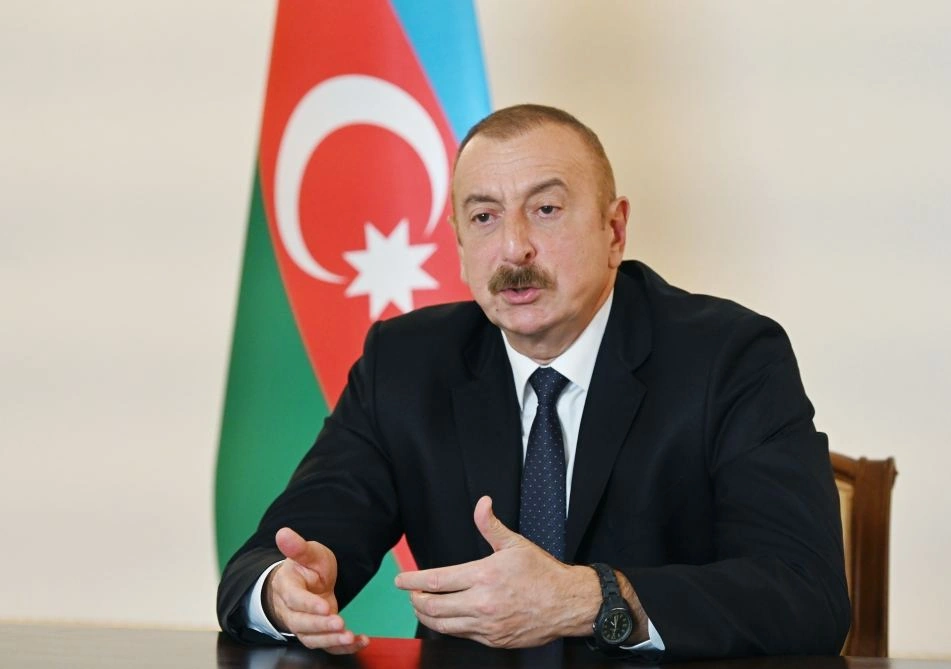
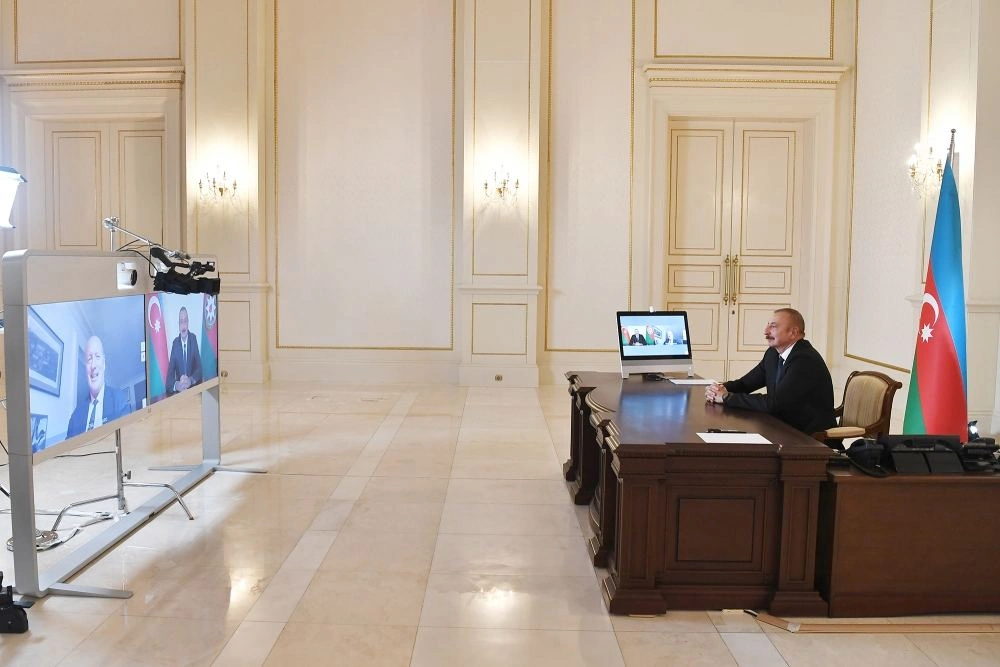
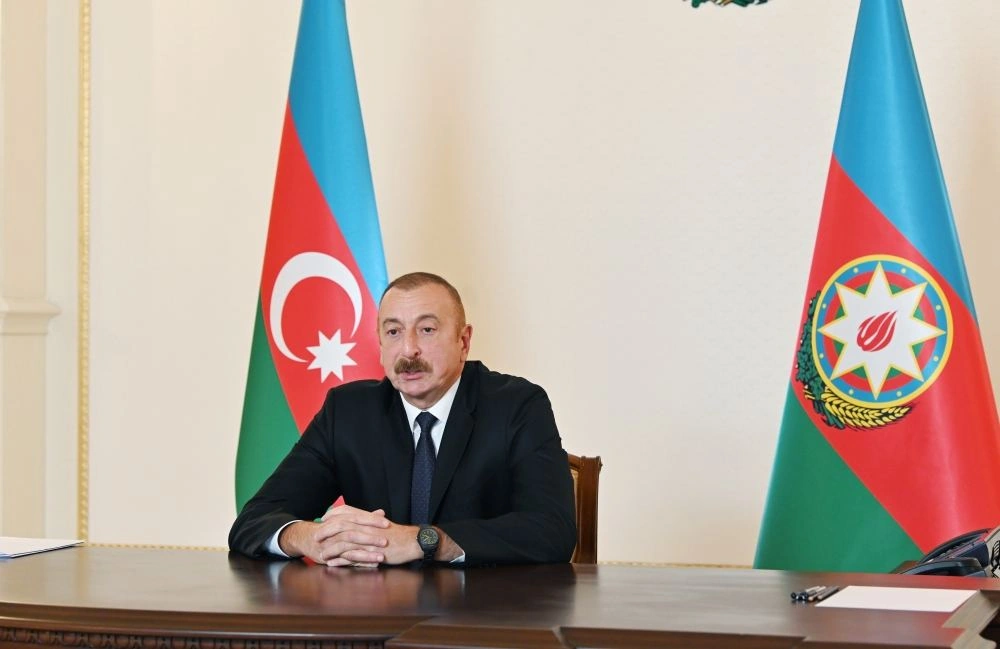
President of the Republic of Azerbaijan Ilham Aliyev has given
an interview to the French Le Figaro newspaper.
Trend presents
the interview.
-My first question would be Mr. President, why did you
launch an offensive on September 27 against Nagorno-Karabakh? What
are the political objectives of this military attack?
-We did not launch military attack on Nagorno-Karabakh on
September 27th. It was Armenia who launched a military attack on
Azerbaijan, and in the first hours of this military attack we had
victims, among civilians and among our military servicemen. This
was the 3rd military provocation by Armenia against Azerbaijan,
within 3 months. First, they attacked us on the state border
between Armenia and Azerbaijan, far away from the Karabakh region.
And by unanimous opinion of international observers it was Armenia
who launched an attack on us. They wanted to occupy new
territories. they wanted to take control over the strategic energy
infrastructure which situated several kilometres from our state
border with Armenia. As you probably know, Trans Adriatic Pipeline
is almost completed. And the Southern Gas Corridor project is not
only a project of energy security of Azerbaijan but also of Europe.
We think that one of the goals of Armenia was to take control of
that pipelines and to blackmail us, and maybe European consumers.
They got a serious response. We pushed them back. But
unfortunately, next month, in August, they send the sabotage group,
which planned to commit acts of terror against Azerbaijanis. The
head of the sabotage group was detected by our military people,
military servicemen, and he gives evidence. So, it is a deliberate
attempt to disrupt negotiations and to attack Azerbaijan. As far as
political goals of Armenia, which they pursued launching the
attack, was to keep the status quo unchanged, to put the blame for
this escalation on us, to disrupt negotiations completely, and to
involve third countries and to internationalize the conflict. We
only gave them adequate response, as a result of that we liberated
and continue to liberate part of the internationally recognized
territory of Azerbaijan.
-Azerbaijan has the mission to be a hub not only on
energy pipelines but also on internet, fiberglass cables. And there
is Azerbaijani company called Neqsol who want to be the connection
between Europe and Central Asia, for internet. Do you think that
this project is still possible or not to have directly through
Azerbaijan in Internet from Europe, to Central Asia?
-We as you correctly mentioned became already the regional hub
for not only for energy, but also for transportation. We are now
providing important transportation network for our partners across
the Caspian in the eastern part of the Caspian Sea and Europe. Our
investments in infrastructure resulted in creation of a very broad
international cooperation format on transportation. Of course,
everything started with the energy infrastructure, oil and gas
pipelines going through Azerbaijan already became very important
source of energy security. And with respect to the oil pipelines we
already transit oil from Central Asia, through Azerbaijan to
Europe. With respect to the internet connection, we invest largely
into IT sector, internet penetration in Azerbaijan is about 80
percent. 80 percent of our population are internet users. And we
have very developed private companies in this area. Therefore, the
company which you mentioned as far as I know is a private company,
which has its own agenda, and which invested in the region. And I
think their target is to implement commercially viable project. And
definitely, Azerbaijan from geographical point of view and point of
view of infrastructure today is very important regional actor.
-My question now is can you describe us what is after
more than one month of war? where is the front? How are the current
military operations?
-It is less than one month, and during this one month as a
result of a very successful counter-attack, Azerbaijan managed to
liberate part of the occupied territories, cities and villages and
every day we report about new cities and villages which have been
operated. It was not easy, because during the 30 years of
occupation Armenia built on the occupied territories very solid
engineering constructions. So, it was not easy to cross the line of
contact. But we did it in different directions, in the north, in
the south. And this demonstrates the high level of capacity,
capability of Azerbaijani Army, and we defeat Armenia on the
battlefield. And they have to run away from us. So, we already
restored the international border with Iran. More than 130 km of
this border was under occupation. So, we did a lot on the
battlefield and this continues. Armenia two times violated the
ceasefire. If they didn’t violate the ceasefire, first on the 10th
of October brutally violated it launching a ballistic missile on
the sleeping city of Ganja and second time on the 17th of October,
today the clashes would have stopped and political solution would
have prevailed. That’s our position. If they don’t stop, we will
continue to liberate our lands.
-They bombed Ganja because there was a couple of Turkish
F-16 fighters and one of these Turkish f-16 fighters shut down
Armenian plane. That’s why they said they bombed
Ganja.
-This is fake news. I think that everybody now understands that
was fake news by Armenia. Turkish F-16 are here because they were
participating in the joint military training just before the
clashes started. And they are on the ground. They are not in the
air. Armenian SU-25 hit the mountain. They tried to pretend as if
it was hit by the Turkish F-16. But that was in the first days of
the conflict. It was in September. But they launched an attack on
Ganja with ballistic missile on the 10th of October, first. Second,
ballistic missile’s launch was made from the territory of Armenia.
And you know, big countries can monitor it clearly. They know from
where it is launched and what is a task for the missile? The task
was to hit civilians. They hit the area of Ganja where people live.
So, that was an act of international terror, that was another
reflection of the war crime policy of Armenia. These attacks on
Ganja, cannot be justified. And they will be responsible for
that.
-By accepting the intervention of Turkey and the arrival
of Syrian fighters from Turkey, aren’t you afraid of turning local
conflict into a regional war?
-First of all, Turkey is not involved in the conflict at all.
There is not a single evidence of Turkish involvement. From the
first hours of Armenian attack on Azerbaijan Turkey, Turkish
president and other high-ranking officials expressed and continue
to express strong political support to Azerbaijan, support to the
norms and principles of international law, support to the
implementation of the United Nations Security Council resolutions
which demand immediate and unconditional withdrawal of Armenian
troops from our territories. So, this is first. Second, there are
no foreign fighters on Azerbaijani soil. This is another fake news.
It was spread by some officials, in some countries. But so far,
more than 20 days after the clashes started we didn’t get any
single evidence neither from France nor from Russia. Because the
French and then Russian officials made this statement and we asked
for evidence. We asked for proofs. Only words, no evidence, no
proofs. And another thing is that we don’t need any foreigners to
fight with us. Because we have a regular army of 100 thousand
people. We have modern equipment. We have motivated people who were
suffering from occupation for 30 years. We did not even announce
full mobilization. If we need additional people on the ground we
will recruit more. Therefore, this is another attempt to present
Azerbaijan as an aggressor, and also attempt by Armenia to diminish
the capacity of Azerbaijani army which is beating them on the
ground.
-Mr President, you said you have very modern equipment,
it is true. You have all kinds of drones some coming from Turkey
but also efficient kamikaze drones coming from Israel Harop. So, is
the help of Israeli military equipment very important for you, and
allow you to make military breakthrough?
-We buy military equipment from many countries. And our biggest
supplier of military equipment is not Turkey and Israel, it is
Russia. But unlike Armenia, from Russia we buy weapons, we pay for
them. Armenia gets weapons from Russia free of charge. We also buy
weapons from Iran, from Ukraine, from Belarus, and of course, we
can afford to buy modern weapons which today help our army to
restore our territorial integrity. Our territorial integrity is
being restored by us. But any country in our region is buying
weapons. Not many countries in the world can supply themselves 100%
with military equipment. So, there is nothing strange about that.
And of course, we pay for the weapons. We buy good ones and of
course they help us on the ground. But liberation of territories is
not by drones. Liberation of territories is by soldiers. By people
who there on the ground are doing their job.
-Iran has complained that fighting during a military
operation took on the border. Did you settle this dispute with
Iran? Did you talk to the Iranian leaders?
-Yes, we did. And as far as I know, Iranian leaders also talk to
Armenian side. Because the clashes were taking place just by the
river Araz, close to the border with Iran, and by accident, some of
the weapons crossed the border. But today we announced that we
cleaned completely the Azerbaijani-Iranian border from Armenian
occupants. Therefore, no more clashes take place there, and there
will be no more inconvenience for our brothers across the river of
Araz in Iran.
-What is the best possible mediator to bring out to this
war? Is it Russia? Is it the best possible mediator?
-We have three mediators. They have a mandate from OSCE-Russia,
France and United States. For 28 years they are trying to mediate.
And trying to help parties to find the solution without any
success. These three countries are at the same time members of the
UN Security Council, permanent members. These three countries
adopted those resolutions which I referred to, which demand
withdrawal of Armenian troops. But unfortunately, they did not put
enough international pressure on Armenia to liberate the occupied
territories and to comply with the United Nations Security Council
resolutions. Therefore, after the Armenian military attack, we had
to defend ourselves, and had to restore justice by force, what we
are successfully doing. And among these three mediators, each of
them is important and I observe, and I see and I know that on the
issue of Nagorno-Karabakh they have very rare unanimous approach.
It is probably the only issue where their interests coincide.
-What kind of land you want to take back and then be
ready to stop this war Mr. President?
-We are ready to stop today. I was telling that since the 10th
of October, when in Moscow both sides agreed on ceasefire. And I
said: "the sooner the military part of the solution of the problem
is over the better." We want to move on negotiation table. But
unfortunately, Armenia brutally violated ceasefire and launched an
attack on Ganja. And on the 17th of October they violated ceasefire
two minutes after ceasefire was efficient. Therefore, if they stop
today we will stop and then, the rest will be done by diplomats. If
they do not stop, we will go until the end to liberate all the
occupied territories.
-So this is your plan. This is Azerbaijan’s plan to get
out of the conflict.
-Yes. If they stop now and behave in a constructive way, if they
publicly commit to the basic principles elaborated by France,
Russia and the United States which Azerbaijan is committed to,
then, of course everything will stop and we will go back on
negotiation table. By the way, I am in this process for 17 years. I
worked with two former Armenian presidents and we made not a big
progress, but we made progress. We were meeting regularly. There
have been regular meetings in Moscow, in Paris, in Washington. But
after Mr. Pashinyan came to power, he actually did everything in
order to destroy negotiation process not only by his statements,
but by his military provocations. And since he came to power for
already two years or more, there is no process. Therefore, I think
the political settlement is possible. But Armenian government
should understand that they are not now in a position to dictate,
because status quo no more exists, line of contact no more exists.
We created a new reality on the ground. And they have to take that
into account.
-What is your vision about the future of
Karabakh?
-I expressed it many times publicly. And I can tell you now.
Also, I delivered certain messages through mediators, through Minsk
Group co-chairs to previous Armenian government how we see the
future. We see Karabakh as a prosperous, safe, secure area of
Azerbaijan where people live in peace and dignity, where
Azerbaijani and Armenian communities live side by side. The area
which we plan to develop as we did in all other parts of
Azerbaijan. I can tell you that we have very substantial economic
achievements. We have very low level of poverty, it is about five
percent. In Armenia it is close to 50 percent. Also very low level
of unemployment. Before the pandemic it was around 5 percent, now
it is seven. But in comparison with Nagorno-Karabakh which is
endemic, it is day and night. So, we can provide much better life,
for Armenians who live there, for Azerbaijanis who will return
there. And I am sure that the two nations, two peoples will
reconcile, because in the 21st century it is not possible to
isolate yourself to commit ethnic cleansing and try to transform de
facto situation into secession. It is not possible. No one
recognized Nagorno-Karabakh so far, including Armenia itself. I am
sure no one will recognize it. Therefore, the best way for the
future of Karabakh, not only Nagorno-Karabakh, but all the Karabakh
is a big region of Azerbaijan, is to live in peace in harmony, and
to try to become good neighbors again-Armenians and Azerbaijanis.
This is my plan.
- I remember that in the beginning of 1990s there was an
anti-Armenian pogrom in Baku. That’s why Armenians do not trust
they can live, they are afraid for their lives to live in
Azerbaijani territory.
-Conflict started after separatists in Nagorno-Karabakh,
sponsored by nationalists in Armenia launched a secession plan to
secede from Azerbaijan. And they could not do it from legal point
of view at the time of the Soviet Union. So, they started pogroms
in the territory of Nagorno-Karabakh and in the territory of
Armenia. The first victims of the war and clashes were Azerbaijanis
from Nagorno-Karabakh. There have been 40 thousand Azerbaijanis who
lived in Nagorno-Karabakh, primarily in Shusha and also in the
capital Khankandi who were ethnically cleansed completely. Then,
250 thousand Azerbaijanis who lived in Armenia, many of them were
killed and all of them were ethnically cleansed, expelled. What
happened in Baku, in those time which you mentioned is a dark page
of our history. But, those clashes were taking place everywhere-in
Erevan, in other Armenian cities, in Nagorno-Karabakh. Therefore,
this should not be a kind of a reason why people cannot reconcile.
In Europe how many times France and Germany had wars? How many
times you know other countries had wars? We had World War II which
costed lives of 30 or 40 million people. But after twenty years,
western Germany and Soviet Union became on good terms. And now
nobody remembers that. This is how it should happen in the
civilized world. The problem is in Armenia, they cultivate hatred.
They cultivate historical hatred against Turkey, against
Azerbaijan. Former president of Armenia Kocharyan publicly said
that Azerbaijanis and Armenians cannot live together. But look. How
they live together for instance, in Georgia? In some Georgian
villages Azerbaijanis and Armenians live side by side. In Russia it
is the same. In Azerbaijan we have thousands of Armenians who live
in our country. Why it is not possible in Nagorno-Karabakh. I think
that the wounds of the war must be healed by political wisdom, by
political will. And after this active, hot phase of the conflict
stops, both sides need to invest largely in order to do everything
to heal these wounds.
-This is my last question. Aren’t you afraid Mr.
President that after a while President Erdogan of Turkey will stop
his support and his policy in Caucasus to focus on Northern
Cyprus?
-Turkey and Azerbaijan are brotherly countries. And our
brotherhood have been tested in many circumstances. And in this
particular case, Turkish President expressed publicly strong
support to Azerbaijan. He said that Azerbaijan is not alone. Turkey
is side by side. So, this is a very strong political support and we
are very grateful for that. This is first thing. Second, what I
want to say that what we are doing on the battlefield we do
ourselves. Yes, with modern weapons, with modern equipment but it
is Azerbaijani soldiers and officers who liberate our motherland.
Our relations with Turkey have a great history but even brighter
future. Turkey as a country which is the only country in the world
having a border with all the three republics or countries of
Southern Caucasus- Azerbaijan, Georgia, and Armenia, has, I think,
a legitimate right to be involved in this process. Because as a
neighbor, as a country which can provide and provides stability,
predictability for the region and as a country whose agenda is very
clear they defend international law. International law says that
our territories are under occupation. So, what wrong do they do?
They just demand international law to be implied. Armenia doesn’t
want to do it. They want to keep our lands for more than thirty
years under occupation by illegal settlement of Armenians from
Lebanon, by military operations against Azerbaijanis, by destroying
our historical and religious heritage. Turkey’s role is very
positive. And after the war with Armenia stops, and political
settlement is enforced, I am sure the role of Turkey will be very
important and very positive.
-So, you don’t think that Turkey has a plan to erase
Armenia in order to have a direct connection to the Turkish people
of Central Asia.
-No, this is again, Armenian phobias, and Armenian provocations.
In the peaceful plan which I was discussing with leaders of Armenia
before Pashinyan came to power, there was a clear reference to
communications. After the peace agreement is signed, all
communications are opening, including communication between
Nakhchivan Autonomus Republic of Azerbaijan and the mainland of
Azerbaijan. And thus, Turkey and Azerbaijan and Central Asia will
have a land connection. Today we don’t have it. But Turkey still
has connections through Azerbaijan. We built couple of years ago
Baku-Tbilisi-Kars railroad. So, Turkish goods through Georgia,
Azerbaijan, Caspian go to central Asia and backwards. But the road
from Turkey, Nakhchivan, Armenia and Azerbaijan is shorter. So, it
is not the fact that Turkey does not have this connection. And as
you say, somebody thinks that they will erase Armenia to have it.
They have it. We have it. We will have another one. But it is again
part of the peace plan. All communications will be open. And I
think that Armenian government should not try to frighten its
population with Turkey. And should stop this hatred towards the
Turkish and Azerbaijani people.
-How is your relationship currently with Georgia, who is
another Christian nation in the Caucasus region?
-Yes, with Georgia our relations are excellent. We call each
other strategic partners. Azerbaijan is the first or second largest
investor in Georgia, and the first or second largest taxpayer. I am
saying first or second because one year it is Turkey, another year
it is Azerbaijan. And we have a trilateral format of cooperation
between Turkey, Georgia and Azerbaijan. We had presidential
summits, ministerial meetings, including defense ministers, foreign
ministers, economy ministers. We have all our major transportation
and energy communication going through Georgia. We have a big
Azerbaijani community in Georgia close to 300 thousand people.
Therefore, relations are excellent. And I think it could be a good
example, like our relations with Turkey, our relations with Georgia
are good examples of good neighborhood. By the way, the fact that
Georgia is Christian and Azerbaijan is Muslim does not make any
difference. We do not look at this region from this point of
view.
-You don’t take religion into account when you do
projects.
-No, religion is separated from the state. According to our
constitution, Azerbaijan is a secular country. We respect our
religion, we respect religions of all other nationalities who live
in Azerbaijan. And I think the best indicator of religious harmony
in Azerbaijan would be the words of His Holiness, head of the Roman
Catholic Church Pope Francis. When he was in Baku several years
ago, he made a public statement highly praising Azerbaijan’s role
in intercultural and interreligious dialogue. All the
representatives of different religions in Azerbaijan live in peace
and harmony, including Armenians. In the center of Baku, there is
an Armenian church which has been restored by us and protected by
our government. But our mosques on the occupied territories have
been destroyed. And Armenians keep pigs in our mosques. Just recent
videos were on internet. In Zangilan region, after liberation of
one village, it was on internet how pigs walk in our mosque. So,
Azerbaijan is a tolerant and a secular country and will continue to
be like that in the future.
-Thank you. It was a very good interview Mr.
President.
-Thank you.