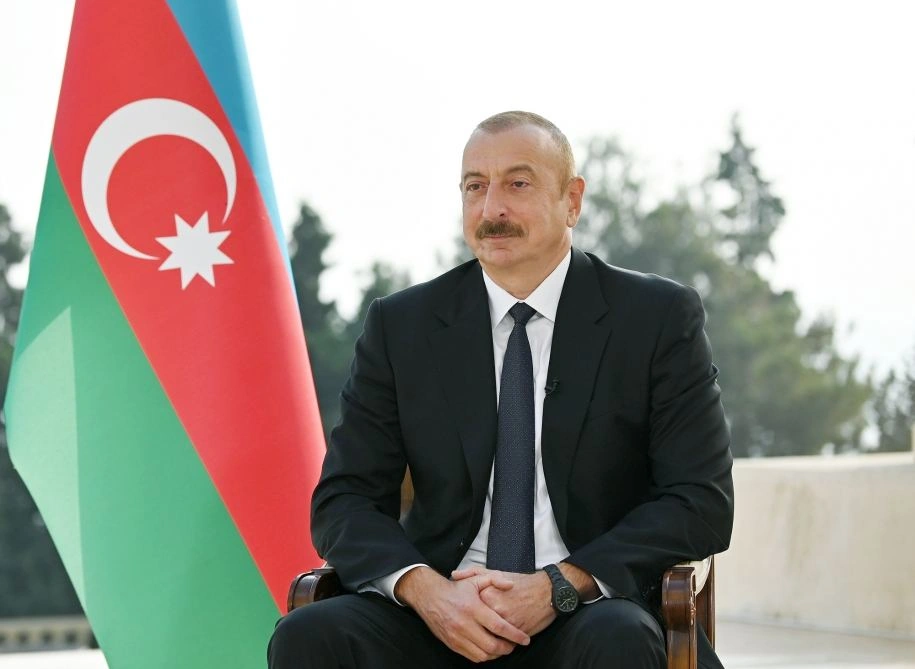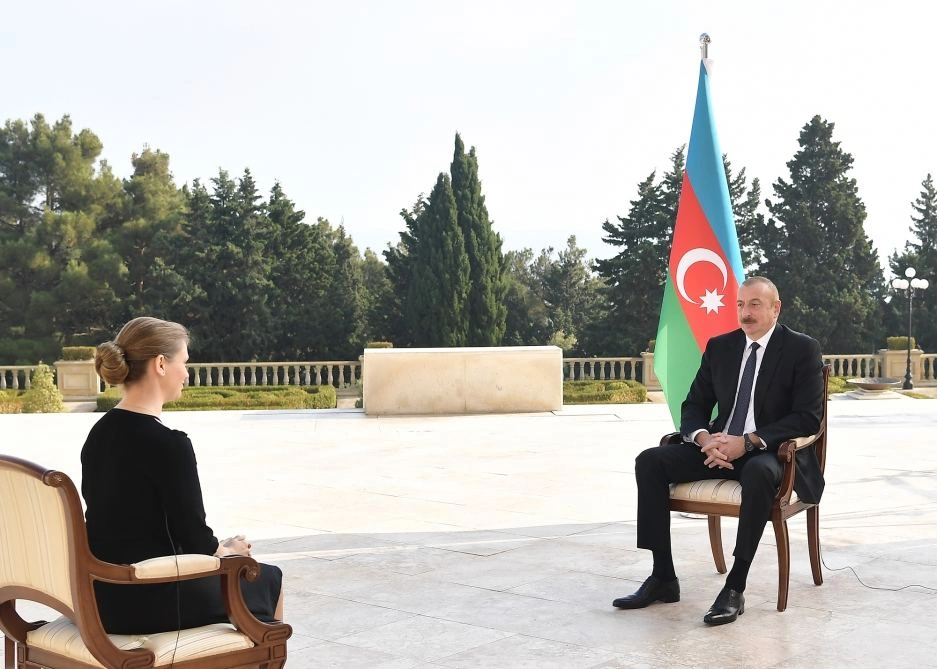
BAKU, Azerbaijan, October 19. President of the
Republic of Azerbaijan Ilham Aliyev has given a video interview to
the Russian TASS news agency.
Trend presents
the video interview.
- Good afternoon. We are in Baku today to meet with
President of Azerbaijan Ilham Aliyev. My name is Yulia Sharifulina
and, on behalf of TASS, I will ask the President several questions
on the situation around Nagorno-Karabakh.
- Hello, Mr. President.
- Hello.
- Thank you for agreeing to receive us. I understand
that you have recently given several interviews to the media but
the situation is changing fast and we observe it literally every
day. We would like, of course, to dwell more on some basic issues,
which, perhaps, are beyond time and which will help our audience to
better understand the position of your country. We all witnessed
the 11-hour negotiating marathon in Moscow. Do you think it is
still possible to return to the fulfillment of the achieved peace
or has it failed completely?
- We remain true to the commitments within the framework of
contacts with our partners. From the very beginning and in the
process of negotiations on the settlement of the conflict, we have
always relied on international law, on our adherence to the
resolution of the conflict by peaceful means, including the
commitments Azerbaijan took upon itself after the talks in Moscow,
which we aspired to and were going to implement. Unfortunately,
Armenia flagrantly violated the ceasefire. Less than 24 hours after
the talks, the city of Ganja was attacked. Residential areas of the
sleeping city of Ganja were targeted deliberately. After the first
attack – and there were two of them – the death toll was very high.
In other words, Armenia violated the ceasefire in a defiant manner.
Thus, it demonstrated disrespect for mediators, disrespect for the
commitments it had assumed after such long negotiations in Moscow.
Prior to that, after the terms of the ceasefire for the exchange of
bodies, prisoners and hostages had been agreed, Armenia had also
violated the ceasefire on the battlefield. However, this seemed
insufficient for them and they attacked the city of Ganja. In fact,
two days ago, they did the same and again at night. This is a very
heinous crime. This is international terrorism. The unanimous
condemnation of this bloody crime by the world community means that
they will not get away with it. The UN Secretary General, the
European Union and many countries at the national level have
condemned this act of international terrorism.
It is not our fault that the situation is still in the hot
phase. I have repeatedly said that Azerbaijan is committed to the
principles of settlement. These principles have been developed over
the many years of negotiations. I have confirmed in my speeches and
in recent contacts with the media that if Armenia acts
constructively in the process of negotiations, we are ready to
suspend military operations as early as tomorrow. However, the
statements we have been hearing from Yerevan completely contradict
the fundamental principles developed by the OSCE Minsk Group. The
Armenian leadership has recently made very dangerous statements
that effectively refute the fundamental principles. In principle,
all the activities of Armenia’s new leadership are aimed at
disrupting the process of negotiations. Not to undermine this
process, but to disrupt it. I have already talked about their
numerous statements, provocative actions and attacks on
Azerbaijan’s civilian population. Therefore, if the Armenian side
finally realizes that the path of military provocations leads them
to disaster, we are ready to suspend military operations and
resolve the issue at the negotiating table.
- Would your country agree to the need for an urgent
military meeting, as Russia says? If so, what format and with the
participation of what parties could this meeting be
held?
- You know, the political will of the leadership of Armenia and
Azerbaijan is paramount here. There is political will on our side.
I confirm our position again today. And I confirm it when we have
announced the liberation of 13 more settlements in the occupied
territories, when the Armenian army is essentially suffering a
defeat, when Azerbaijan demonstrates its advantage on the
battleground. Nevertheless, not wishing to continue the bloodshed
and wishing to save people’s lives, we are ready to resolve this
issue by political means.
With regard to military-to-military contacts, the fundamental
principles explicitly define this, and we are committed to the
fundamental principles I have already mentioned. I think there is
no point in repeating – it is the return of the territories
occupied by the Armenian side, negotiations on the future of
Nagorno-Karabakh, the return of refugees and internally displaced
persons to their places of origin, including Nagorno-Karabakh,
Shusha. All of this is written in fundamental principles, and the
Armenian side agreed to all of this at different stages. Therefore,
the question you have just asked is covered in the fundamental
principles at the end of the agreement – when all the issues
related to de-occupation have been settled, the presence of foreign
peacekeeping forces is envisaged. But since the key issues
requiring settlement were not agreed on, the parties did not
approach this issue. Therefore, there was no clear understanding of
who these forces would consist of, what international organizations
and what countries would be represented there. Therefore, all this
has not been discussed. One thing was clear: the composition and
location of these peacekeeping forces should be agreed upon by
Azerbaijan and Armenia. This has not been defined either.
Therefore, there is no line of contact today, the status quo has
been removed, we removed it ourselves and did it within the
framework of statements by the presidents of Russia, the United
States and France, the repeated statements by the heads of state
that the status quo was unacceptable. We were hearing these
statements but did not see their implementation. Therefore, we
implemented it ourselves. So there is no status quo and there is no
line of contact. How can some military observers be deployed there
technically and where exactly can they be deployed? After all, the
situation on the battlefield changes every day. So there will be
some foreign observers but where will they stand – on mountains, in
valleys, on bridges? So all this requires a very detailed study.
This is also a huge risk for those who deem it necessary to send
their military contingent there. So all this must be agreed upon:
composition, mandate, timing, goals. Of course, all of this should
be done within the framework of the fundamental principles, which,
as I said, are accepted by us and rejected by the Armenian
side.
- But if the situation does require it, will your
country agree to the introduction of Russian military observers?
And if not Russian, what other countries could take part in this
mission and what countries would you strongly object
to?
- You know, Russia, like the United States and France, is a
co-chair of the OSCE Minsk Group, and within the framework of this
mandate, the countries have very close interaction with each other.
During the hot phase of the conflict, I observe both in the Western
and Russian media that the Nagorno-Karabakh issue is probably the
only issue where there are no disagreements between these
countries. And perhaps this is actually the case. Wherever we look,
there are sanctions, confrontations, claims, etc., and they are
also mutual. Therefore, of course, I am sure that this issue should
be agreed upon within the framework of the co-chairmanship format
among these countries and, after it is agreed upon, it should be
presented to the parties. So it was all stated in the fundamental
principles. After all, it is not us who should determine who the
peacekeepers, or observers, as they prefer to be called now, will
be. This will be a proposal from the co-chairs of the OSCE Minsk
Group, and Azerbaijan and Armenia, for their part, can either veto
this or that country or agree to it. Therefore, I do not think that
a unilateral decision would correspond to the spirit of cooperation
among the three co-chairing countries in determining any kind of
military contingent. And most importantly – where? This is the
question. The point is not whether Azerbaijan would or would not
agree. We need to know the mandate: who is the sponsor, what are
the functions, location and activities? Are they going to stand on
the mountains or in an open field and watch who shoots first? This
is dangerous in the first place. Secondly, the way it is described
to us, they will be there to observe who breaks the truce. But even
if they determine who breaks the truce, what next? Will these
people be held accountable? Will there be criminal cases?
Therefore, first of all, it is necessary to determine the order
for the implementation of fundamental principles. The Armenian side
through its prime minister must clearly reaffirm its commitment.
However, the Armenian side represented by the prime minister talks
about everything but this. Within the framework of our parallel
contacts with representatives of the Russian media, I clearly
stated that we are committed to the fundamental principles that
imply de-occupation, joint residence of the Armenian and
Azerbaijani population in their places of residence, the return of
Azerbaijanis to Shusha and other settlements of the former
Nagorno-Karabakh autonomous region. The Armenian prime minister
only spoke about self-determination. So if he does not accept this
and makes statements like the one he made earlier, saying that
"Karabakh is Armenia, full stop", as well as other
counterproductive statements that essentially disrupted the process
of negotiations, then are we being offered? To return to the status
quo which lasted 30 years and did not yield any results? If the
Armenian side says that they recognize the territorial integrity of
Azerbaijan, secondly, they are committed to the fundamental
principles, thirdly, they agree to the withdrawal of troops from
the occupied territories, then we can discuss the issue of
observers. I think it can be agreed on quite quickly. But when this
is not the case, what we are being offered? To stop? Not to
continue the de-occupation of our territories? We are offered to
make a concession to Armenia, a unilateral concession, while
nothing is being offered in return. This is not fair. I believe
that this is a wrong approach in relation to Azerbaijan. Let the
Armenian side say, let the prime minister of Armenia, who loves to
talk a lot and what he says often costs his country dearly, say:
yes, there will be de-occupation, there will be withdrawal. I also
suggested that they should provide a timetable for the withdrawal
from the occupied territories. But then, realizing that it was
technically impossible to do this within the framework of one-day
negotiations in Moscow, we moved away from this position.
Nevertheless, we did not hear the Armenian side say that it was
ready to withdraw troops from the occupied territories. As soon as
this happens, the issue of the so-called observers can be
considered.
- If we talk about consistency in principle, would
Azerbaijan agree to start a settlement with a phased transfer of
seven districts to Azerbaijan, but keeping the Lachin corridor with
Armenia until the final status of Karabakh is
determined?
- You know, all this is stated in fundamental principles, and we
have accepted it. Our position has always been very constructive,
we have always said that yes, we proceed from the understanding
that there should be contacts between people, and the Lachin
corridor is a part of fundamental principles. At the same time, the
fundamental principles also state that all communications are to be
opened. This includes not only the Lachin corridor but also the
communications between the main part of Azerbaijan and Nakhchivan,
and the Armenian side is to provide security guarantees for this
corridor. Communications on the border between Armenia and
Azerbaijan are to be opened. It was also envisaged that Armenia
would have unhindered ground access to the territory of the Russian
Federation, which it is not without now but it would be much more
convenient to do this through Azerbaijan. In this case, it would
not depend on weather conditions, snowfall in the mountains, etc.
So all this is part of a compromise package which envisaged
de-occupation of Azerbaijani territories, the return of Azerbaijani
refugees to all the lands they were expelled from – not only to
seven surrounding districts but also to the territory in
Nagorno-Karabakh. Before the start of the conflict, Azerbaijanis
accounted for 25 percent of the entire population there. And, of
course, unhindered access between Nagorno-Karabakh and Armenia
through the Lachin corridor. We reaffirm this position.
- Mr. President, it is no secret that Russia has
expressed concern over reports on the transfer of militants from
the Middle East to the conflict zone, in particular from Syria and
Libya. How can you comment on this?
- I have repeatedly said in my public remarks that such concerns
are unfounded. So far, we have not been provided with any facts
from any side. After all, such statements were made not only by
Russia but also by France, and we asked for specific facts,
concrete evidence that would prove that we have invited terrorists
here. So far, apart from words, no facts have been provided. Not to
me as President, not to the heads of our secret service, not to the
leaders of the Ministry of Defense – not a single fact. If there
are such facts as this is being declared, why isn't this provided
to us? They refer to some newspaper publications, but you can write
whatever you want now. Therefore, this is not exactly the approach
we accept and approve. This is first. Secondly, as I have already
said, the Azerbaijani army has proved its combat effectiveness both
on the battlefield and in terms of technical capacity. We have
practically destroyed most of Armenia’s military-technical
potential located in the occupied territories. I have provided
these figures. More than 230 tanks have been destroyed mainly by
drones but also by modern anti-tank warfare systems – the
self-directing Spike missiles. I do not conceal that. As of
yesterday, we captured 36 tanks as booty. A huge amount of other
equipment has been destroyed, including the most modern
anti-aircraft missile systems "S-300" – in fact, not just one
launcher. About 40 anti-aircraft missile systems "OSA", "TOR"
installations, which should actually work against drones, but the
drones have destroyed them. Did terrorists do that? Have they come
from somewhere in Syria? Today, when our army is liberating
territories, where are they? Who saw these terrorists? These are
our soldiers and officers. We have 100,000 soldiers in the regular
Azerbaijani army, not counting the reservists. We did not even
announce mobilization. What for? We do not need that. We have
announced a partial mobilization. I do not want to provide any
figures of how much we have attracted, but we mainly use them for
monitoring and control over the already liberated territories. We
are not letting reservists into battle. We are using them in the
territories we have liberated in order to prevent sabotage attempts
of the Armenian side. So there are no facts and there is no need.
There are only gossips, rumors. Frankly speaking, I regret that
this is being circulated. Thus, an attempt is made to cast a shadow
on Azerbaijan. On the other hand, we understand the Armenian side’s
humiliation. It had been boasting and bragging of its invincible
army all these years, but when we drove them out of our lands so
fast that they fling up their heels, of course, they want to
imagine that this is not done by the Azerbaijani army but some
terrorists or some other countries.
Not a single country is involved in the conflict on our side.
There are no terrorists on our side. As for the opposite side, the
Armenian side, we have conveyed to the Russian side our concerns
that during the active phase of the confrontation a huge amount of
weapons has been transferred from Russian cities to the territory
of Armenia. We have data, we have flight maps, we have the listing
of weapons. All this was brought to the attention of the Russian
side. This, of course, raises a lot of questions and bewilderment
in our society. Therefore, the situation is like this. If
necessary, we can also publish the list of supplies Armenia has
received from Russia during this time, specify what transport
vehicles were used to deliver them, and which airlines delivered
them. These were mostly illegal supplies. We have officially
applied to ICAO. The Ministry of Foreign Affairs of Azerbaijan has
appealed to ICAO. We have provided information about the transport
vessels of certain companies. In fact, there have also been media
reports that lethal weapons are being delivered to Armenia under
the guise of humanitarian cargo and cargo of the Ministry of
Emergency Situations. Since both Georgia and Iran have closed their
airspace for military cargo, such smuggling methods are used. We
suggested to the Russian side that this was being done by means of
smuggling because it is hard for us to believe that Russia, a
co-chair of the OSCE Minsk Group and a country that must maintain
neutrality, just like France and the United States, is arming the
Armenian side during the active phase of the conflict. According to
our information, large Russian entrepreneurs of Armenian origin are
involved in this scheme. Well-known arms dealers who are under
international sanctions are also involved. Our appeal to the
Russian side was, among other things, aimed at sorting out this
issue. Because if Russian weapons are smuggled and paid for in
cash, then we need to figure out how this can be possible. These
are the concerns we have, and our concerns are based on facts. As
for the so-called terrorists, these are just words.
-Ilham Heydar oglu, in the past 26 years the world could
not understand what the final agreement between Armenia and
Azerbaijan on Karabakh might look like. How do you see this, and
are any concessions still possible for the sake of
peace?
- You know, I want to say again that although the Minsk Group
co-chairs have not achieved any result and are rightly criticized
by the Azerbaijani public for that, I have to say as a person who
has been dealing with this issue almost on a daily basis for the
last 17 years and spending a huge amount of my time on finding
solutions that the Minsk Group has been trying. It was providing
proposals and did not stay idle. Therefore, I reject such unfounded
accusations. This is not the case. During my contacts with the
previous leadership of Armenia, with the previous two presidents,
we took major steps forward. We made progress in agreeing on issues
that seemed completely impossible to agree on. This was all based
on the desire to achieve a result, the desire to reach a settlement
through a compromise. It is a different matter though that at a
certain stage, when we came too close to a settlement, the Armenian
side took a step back. This is also a fact although they have
always tried to blame us for this. But at the last moment they
refused to return Kalbajar and Lachin. The other five districts had
been agreed upon long ago and we were already discussing when
Kalbajar and Lachin would be returned. So we were discussing the
timing. Neither me nor the Minsk Group had any doubts that this
issue had been resolved. I think the former co-chairs of the Minsk
Group who were involved in this at the time can confirm this. But
then the Armenian side took a step back, and the issue of
transferring Kalbajar and Lachin hung in the air. In other words, a
mechanism was proposed that involved these two districts forever
remaining under Armenian control, which I categorically could not
agree to.
Therefore, returning to what you asked, the Minsk Group has
created a basis for a settlement. It consists in the de-occupation,
the return of refugees, the opening of communications, the joint
residence of the Azerbaijani and Armenian communities, which fully
complies with the norms of both international law and human
morality in general. Because when one of the Armenian presidents
spoke about ethnic incompatibility of Armenians and Azerbaijanis,
he once again demonstrated his fascist essence. Then how can
Azerbaijanis and Armenians live together in Russia, have a common
business and mixed families there? How can Armenians and
Azerbaijanis live together in some Georgian villages and celebrate
both Muslim and Christian holidays? How do thousands of Armenians
live with dignity in Azerbaijan as our citizens? Therefore, such
theses of fascist nature did not contribute to a settlement, of
course.
So all the fundamental principles I have talked about plus the
opening of communications form the basis. The Minsk Group co-chairs
support the Azerbaijani position. But the current Armenian
leadership took a different path. The prime minister said that not
a centimeter of land would be given to Azerbaijan. They have
published maps of the so-called "Nagorno-Karabakh republic", which
also included seven districts outside Nagorno-Karabakh. They have
changed all the names of our cities and our villages. What we saw
on the battlefield – it was not easy to break through these defense
lines they had been building for 30 years – we saw that they were
not going to give up these territories. Because so much had been
invested there, so much had been invested in engineering
communications and fortifications! This did not at all mean that
they were going to leave these lands. When the hot phase of the
conflict ends, we will provide full information about what they had
built there.
Therefore, I want to say once again that full responsibility for
what is happening now lies squarely with Pashinyan. This is someone
who not only happened to come in power by chance, but also brought
a lot of suffering and grief to the Azerbaijani and the Armenian
people. He is a foster child of Soros. This is a person who, in his
previous life, has always opposed Armenia’s cooperation with
Russia. His party was called "Exit" – exit from the CSTO, exit from
the EurAsEC. Pashinyan's team is almost entirely made up of
representatives of non-governmental organizations funded by the
West – the Soros Foundation, Amnesty International, Transparency,
Human Rights Watch, Freedom House. People represented in Armenian
government today used to throw eggs at the Russian Embassy and
chanted slogans like "Get out, Russian invaders". Therefore, to be
honest, I am surprised that a certain part of the Russian political
establishment supports this criminal terrorist regime. The fact
that they hit the sleeping city of Ganja twice with ballistic
missiles and deliberately targeted residential areas in order to
kill as many people as possible is a bloody crime. They are being
brought to account for this crime on the battlefield, and if they
don’t change their minds, their end will be very deplorable.
Therefore, returning to your question, we are committed to the
fundamental principles. We believe that a settlement is possible,
but for this to happen the Armenian side must, before it is too
late and while it is only on its knees before us, accept these
principles and move the conflict from the hot phase to the stage of
political settlement.
- In conclusion, it would be logical to ask if are you
ready to come to Moscow to meet with your counterpart from Armenia
with the mediation of the Russian Federation?
- You know, I have been to Moscow many times. In this case, I
have not received such an invitation, so this question is not for
me. President Vladimir Vladimirovich Putin personally and Dmitry
Anatolyevich Medvedev before him have repeatedly held trilateral
meetings between the leaders of Armenia and Azerbaijan. But ever
since power in Armenia passed into the hands of the conditional
Soros, such contacts have ceased. Russia has always played an
important role in the settlement of the conflict, and I have spoken
about this. There are objective reasons for this – both historical
and geographical in nature. And also because Russia has been active
in our region for many decades and there is a high level of
interaction. Therefore, we are ready for any contacts. In fact,
when the suggestion was made to organize a meeting of foreign
ministers, we agreed immediately. After all, this also speaks of
our position. Then the Azerbaijani army had already successfully
liberated a part of strategic territories. The conflict had already
been under way for more than 10 days and it was quite clear to
everyone who was capable of doing what. So it was not too difficult
to guess the further course of developments. Despite this, we did
not vide time or refuse. We said – yes, we are ready. And I said
when speaking with the President of Russia that I was sending our
minister. By the way, the Minister of Foreign Affairs was in Geneva
at the time. He was negotiating with the Minsk Group. During the
hot phase, our minister was in Geneva while the Armenian minister
never got there although he should have been there too. Therefore,
we are always ready to meet in Moscow or elsewhere in order to put
an end to the confrontation but also to find ways of settlement. We
also want peace but, unlike Armenia, we want territories that
rightfully belong to us.
- Mr. President, thank you for your
answers.
-Thank you.