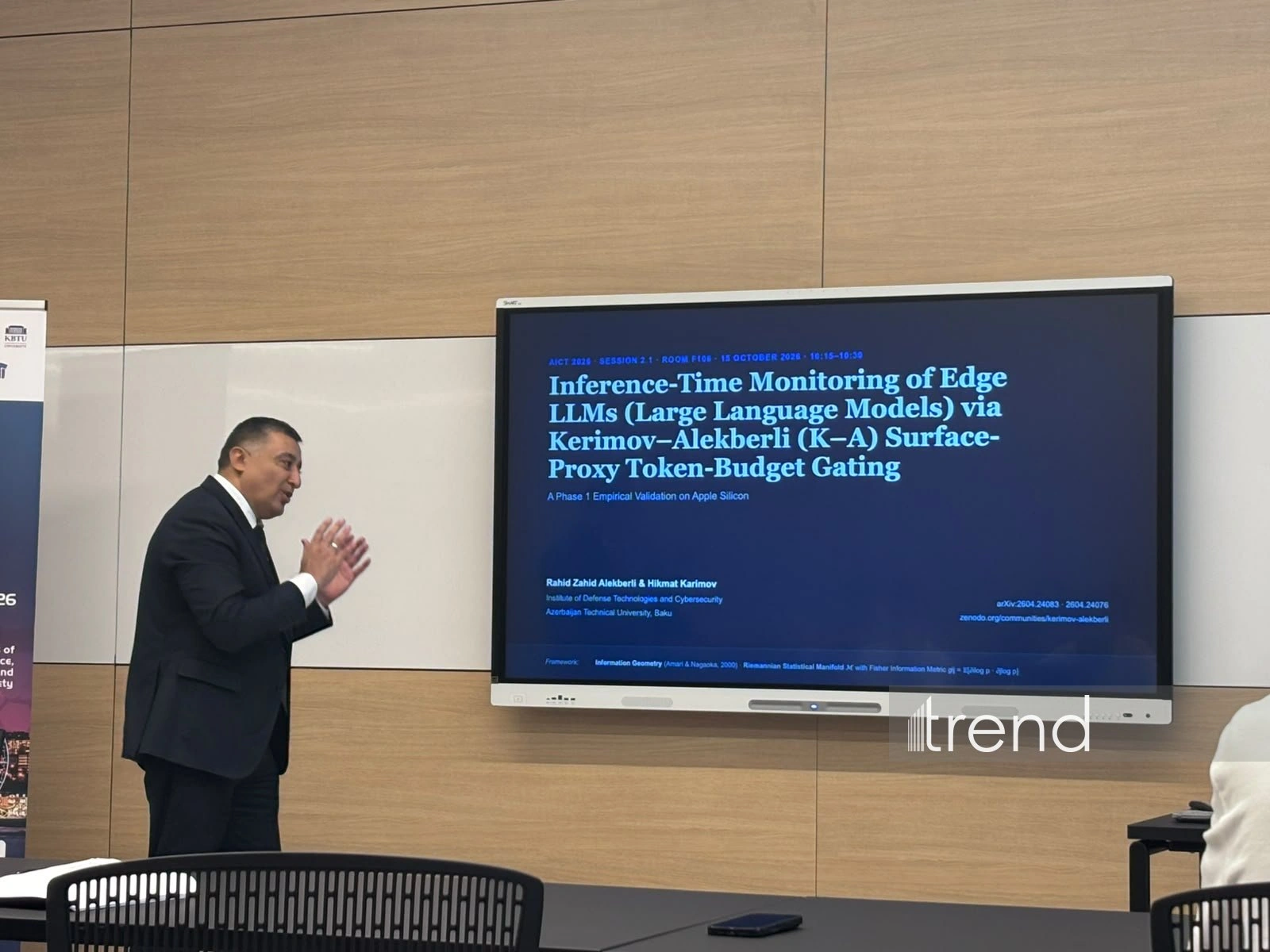
BAKU, Azerbaijan, October 15.
Azerbaijan Technical University is developing an approach to detect
"hallucinations" in large language models (LLMs) by utilizing
several indicators, including response generation time and
temperature fluctuations in graphics processing units (GPUs), said
Executive Director of the Institute of Defense Technologies and
Cybersecurity at Azerbaijan Technical University, Rahid Alakbarli,
during the 20th IEEE International Conference on the Application of
Information and Communication Technologies (AICT2026) in Baku on
Thursday, Trend’s
correspondent reports from the event.
According to Alakbarli, the proliferation of large language
models and chatbots has brought about the issue of
"hallucinations", instances where artificial intelligence (AI)
generates inaccurate or erroneous information. This raises concerns
regarding the reliability of such systems, particularly when
applied within the defense industry.
"We have concluded that without proper management of large
language models, we cannot place our trust in AI," he noted.
To investigate this issue, researchers are analyzing how large
language models respond to queries, which includes measuring
temperature changes in GPUs while questions are being
processed.
Alakbarli explained that, much like humans who require more time
to think when addressing complex issues, the researchers are
exploring whether similar patterns exist in the operation of large
language models, and whether these patterns can be used to identify
potential hallucinations.
He said that the study employs five theoretical approaches to
evaluate model performance, including metrics based on Fisher
information, Kullback-Leibler divergence, and methods derived from
information geometry.
Alakbarli added that the research also accounts for response
generation time, the number of tokens used, and various performance
indicators related to the GPUs.
He emphasized that an increase in the graphics processor's
temperature can be attributed not only to the specifics of request
processing but also to other computational factors, including an
increased workload. Therefore, this metric is considered in
conjunction with other data.