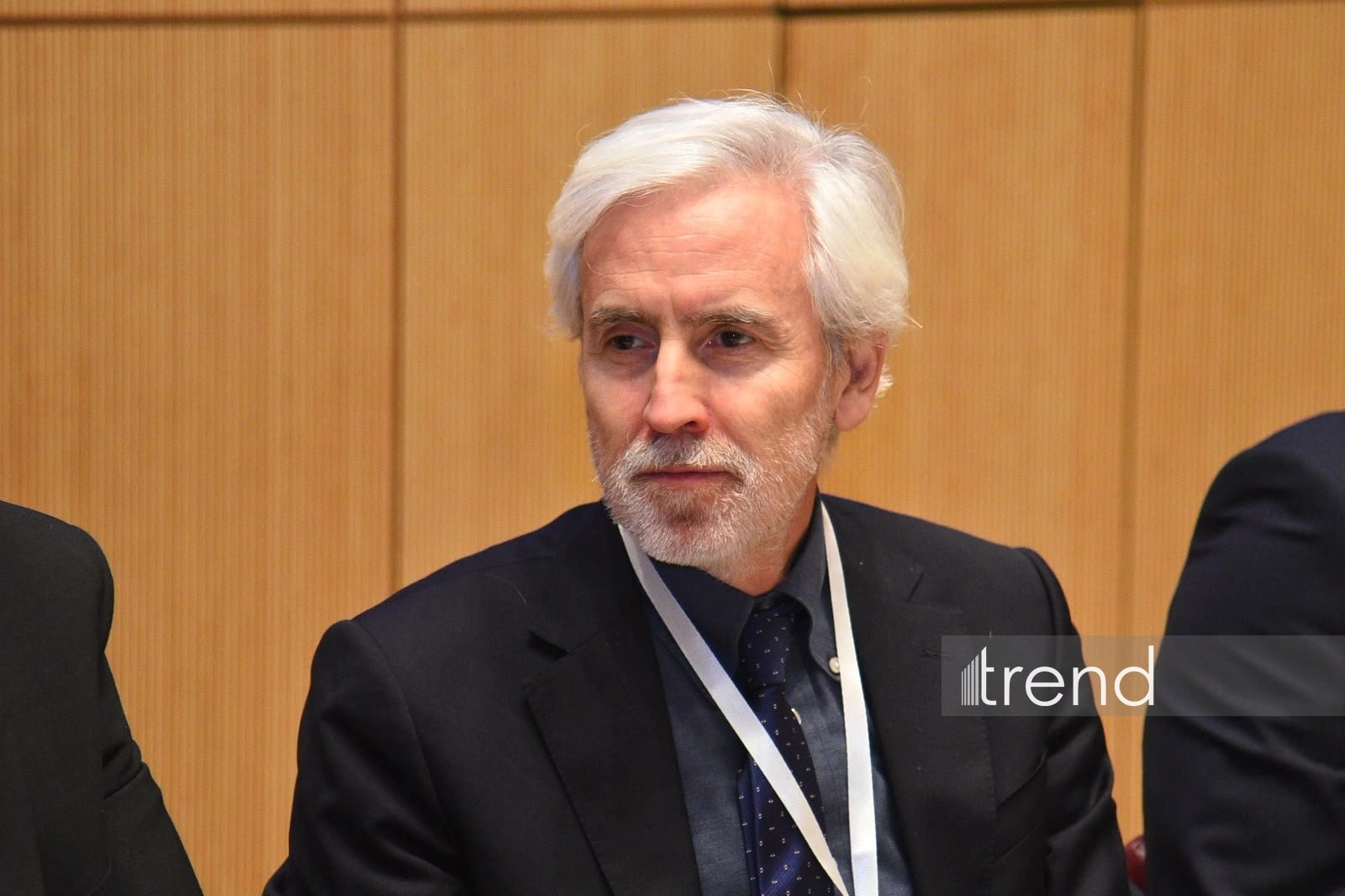
BAKU, Azerbaijan, October 14. The use of
artificial intelligence (AI) in engineering education should not
replace analytical thinking or an understanding of physical
processes, and engineers must remain accountable for the results of
using AI, Aldo Canova, a representative of the Department of Energy
at Italy’s Polytechnic University of Turin, said at the opening
ceremony of the 20th IEEE International Conference on Application
of Information and Communication Technologies (AICT2026) in Baku,
Trend’s correspondent
reports from the event.
“It is important to maintain an analytical approach. In my
applied electromagnetics courses, I teach students analytical
methods, even through simple examples. This is necessary primarily
to ensure that they have a solid understanding of physics,
fundamental equations, and mathematical models. This will enable
them to formulate appropriate prompts for artificial intelligence
and have the tools to verify its results,” he said.
According to Canova, without such an understanding, students may
accept AI-generated answers without critically assessing them or
checking their accuracy.
He also emphasized the importance of engineers taking
responsibility when using AI in their professional activities.
“When students graduate from university and start designing a
bridge or a power plant, they can continue to use artificial
intelligence to perform certain tasks. However, they must
understand that they, as engineers, are responsible for the
results, not artificial intelligence. AI is not accountable,”
Canova noted.
He added that students should view AI as a tool while
recognizing their own responsibility for the results of its
application.
The 20th IEEE International Conference on Application of
Information and Communication Technologies (AICT2026) is being held
at ADA University in Baku. Azerbaijan is hosting the conference for
the seventh time, and this year’s event marks the 20th anniversary
of the AICT series under the slogan “20 Years of Connecting
Science, Technology, and Society.”
The event is jointly organized by ADA University, relevant IEEE
units in Azerbaijan, the Polytechnic University of Turin, George
Washington University, Nazarbayev University, United Arab Emirates
University, Tashkent University of Information Technologies,
Kazakh-British Technical University, Tbilisi State University,
Georgian Technical University, SDU University, the Nikola Tesla
Institute of Electrical Engineering, and the Alessandro Faedo
Institute of Information Science and Technologies.
The conference aims to facilitate knowledge exchange in
information and communication technologies and discuss the sector’s
latest developments. It brings together researchers, academics, and
industry representatives.