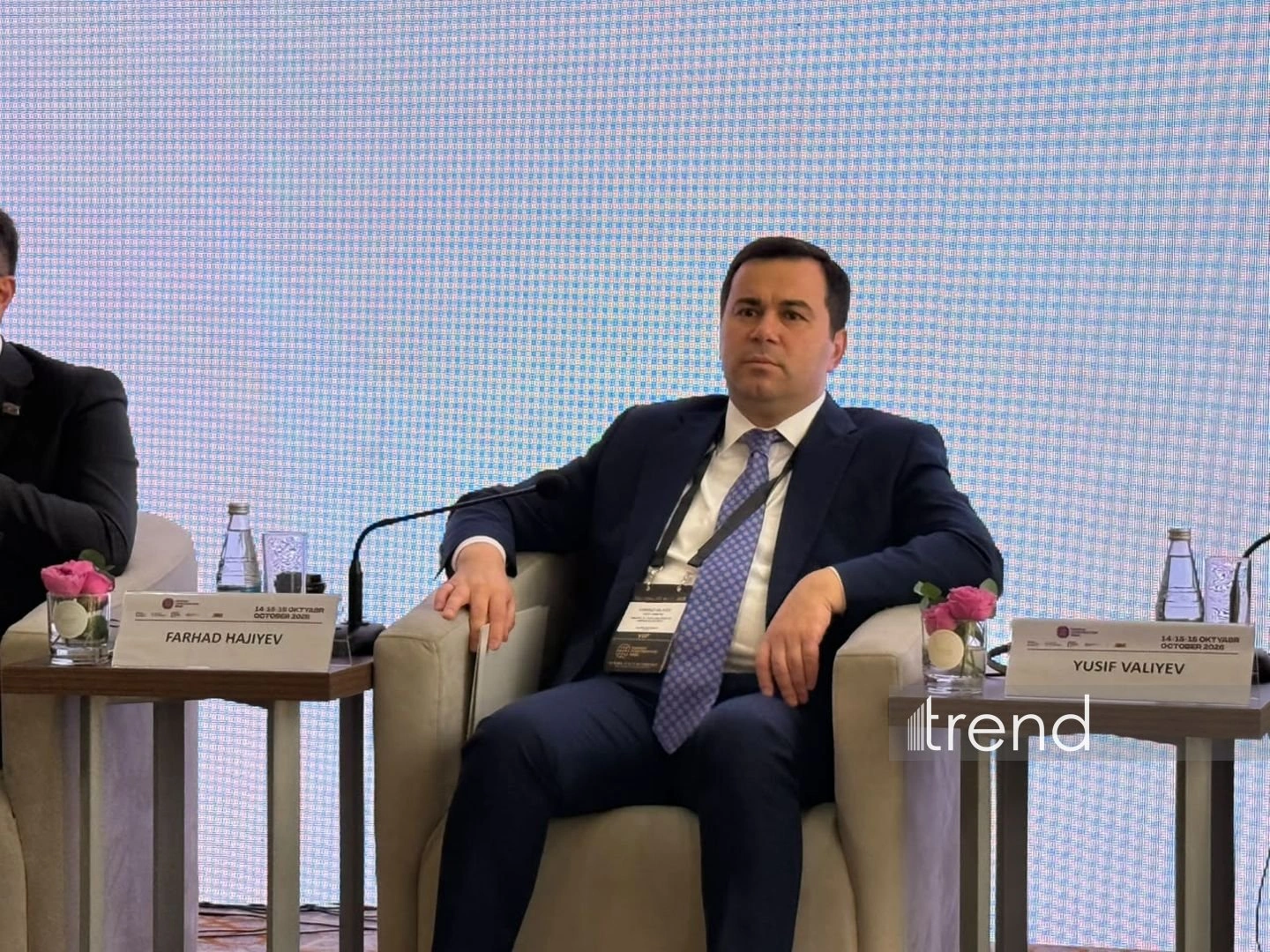
BAKU, Azerbaijan, October 14. Four major sports
facilities are being built in Azerbaijan’s liberated territories to
promote youth development and encourage young people to engage in
sports. These include the Imarat Stadium in Aghdam, a stadium in
Khankendi, and sports infrastructure in Fuzuli and Zangilan, Deputy
Minister of Youth and Sports Farhad Hajiyev said at a panel session
titled “Youth in Karabakh’s Revival: Initiatives and
Opportunities,” held as part of the Rebuild Karabakh exhibition
during Caspian Construction Week, Trend’s correspondent reports from the event.
He said Karabakh had become one of the state’s priority areas.
In this regard, involving young people in discussions on the
region’s revival was a logical approach, as Karabakh’s future
development depended on today’s youth.
Hajiyev noted that Khankendi had now become a genuine city of
young people. Although Mingachevir previously held this status, the
large number of students and young people in Khankendi was now a
source of particular joy. According to him, Khankendi and Karabakh
as a whole were experiencing a new spring.
The deputy minister called on everyone to visit the liberated
territories, saying that such visits evoked unique emotions and a
profound sense of pride.
Hajiyev emphasized that the Ministry of Youth and Sports
operated within the framework of the tasks set by the state and was
responsible for implementing relevant decrees, orders, and programs
signed by the president. In this regard, the part of the state
program outlining socioeconomic development priorities through 2030
that focuses on human capital development was particularly
important.
According to him, numerous events were being held in Khankendi
and other liberated territories under this program. Some of these
initiatives were aimed at integrating the local population. The
ministry was also seeking to organize international events in these
territories wherever possible, with a target of holding
approximately one in every three international events there.
Hajiyev recalled that in 2024, Khankendi was named the Youth
Capital of the Organization of Islamic Cooperation member states,
and several international events were held in the city that
year.
He said the organizers sought to recruit young volunteers
primarily from among local residents, while giving preference to
young people from Karabakh when selecting participants. This
approach helped promote their integration into society and provided
opportunities for personal development.
The deputy minister noted that sports were another key area of
the Ministry of Youth and Sports’ work, adding that sports played
an important role in maintaining physical health and mental
well-being. Four major sports facilities are currently under
construction in the liberated territories.
According to him, the historic Imarat Stadium is being built in
Aghdam, while renovation work at the stadium in Khankendi is
nearing completion. Hajiyev recalled that a football match was held
at the Khankendi stadium in 2023 in the presence of Azerbaijani
President Ilham Aliyev, with the team of the Karabakh Central Army
Sports Club also taking part. The stadium is now undergoing a
complete renovation. In addition, large sports complexes are being
built in Fuzuli and Zangilan.
“I believe that once these sports facilities become operational,
our young people will make active use of them, because a healthy
mind resides in a healthy body,” the deputy minister said.
Hajiyev also highlighted the various youth programs currently
being implemented in Karabakh. He welcomed a proposal by Member of
Parliament Shahin Seyidzade to establish a special grant program
for young people living in the region.
The deputy minister said that when he and Seyidzade worked at
the Youth Foundation, a grant program for individuals had been
implemented, and this work was continuing. In his view, the
Karabakh Revival Foundation could also contribute to such
initiatives, helping integrate local young people. The Ministry of
Youth and Sports was ready to play an active role in this
process.
He also stressed the importance of winners of the “Yukselish”
competition working in Karabakh. According to the deputy minister,
several competition winners were already working in the region,
which was a source of pride for them.
Hajiyev noted that one of the winners, who had worked for an
international organization, had recently moved to Karabakh
University. Despite previously working at an international
organization in central Baku, the individual had decided to teach
at Karabakh University, pursue educational activities, and serve as
a program director.
The deputy minister described this as an example demonstrating
that the “Yukselish” competition had been the right choice. He said
that people’s values could not be measured solely in material
terms, as moral values were also important.
According to him, participants representing various institutions
were actively providing support. The “Yukselish” team had visited
Karabakh several times with competition winners and implemented
projects in the region. A forum for competition winners is also
planned to be held in Karabakh by the end of this year.
Hajiyev emphasized that the main goal was to keep Karabakh a
constant priority and ensure the active participation of people
living in the region, particularly young people, in ongoing
initiatives.
He said participation in the competition was voluntary and no
one could be forced to take part. Nevertheless, he said, it was
desirable for people living in Karabakh to participate actively in
such competitions. The possibility of holding a separate
competition for university students in the future, aimed at
identifying those with the strongest leadership potential, could
also be considered. The deputy minister expressed hope that
Karabakh University would play an active role in this process.
At the end of his remarks, Hajiyev said he believed the Rebuild
Karabakh exhibition would become a regular event and could
eventually be held in Karabakh itself.
“I believe this exhibition will become an annual tradition and
one day may be held in Karabakh as well. I believe that day is not
far away,” the deputy minister added.
Caspian Construction Week has opened in Azerbaijan, bringing
together events covering construction, Karabakh’s reconstruction,
engineering and utility systems, the plastics and polymer
industries, road infrastructure, and public transport.
The event is being held at the Baku Expo Center from October 14
to 16 and includes four international exhibitions, alongside
another international exhibition dedicated to road infrastructure
and public transport.
Caspian Construction Week serves as a platform for companies
representing various industries to showcase their products and
solutions, bring together sector participants, and establish
professional contacts. The event covers several areas, ranging from
construction materials and heating and ventilation equipment to
solutions for Karabakh’s reconstruction, the plastics and polymer
industries, road infrastructure, and public transport.
The exhibitions held during the week provide local and
international companies with opportunities to present their
products and technologies, follow market developments, and discuss
potential cooperation with prospective partners.
Alongside the exhibitions, Caspian Construction Week features
panel discussions, innovation sessions, and business presentations
on various topics.
The program also includes bilateral business-to-business (B2B)
and business-to-government (B2G) meetings for exhibitors and
invited companies. These meetings are designed to help companies
discuss cooperation opportunities with one another and with
relevant institutions.
Over three days, Caspian Construction Week brings together the
construction, engineering, industrial, reconstruction,
architecture, and transport sectors. The exhibitions and business
events give companies an opportunity to showcase their products and
technologies, follow industry developments, and establish new
partnerships.