
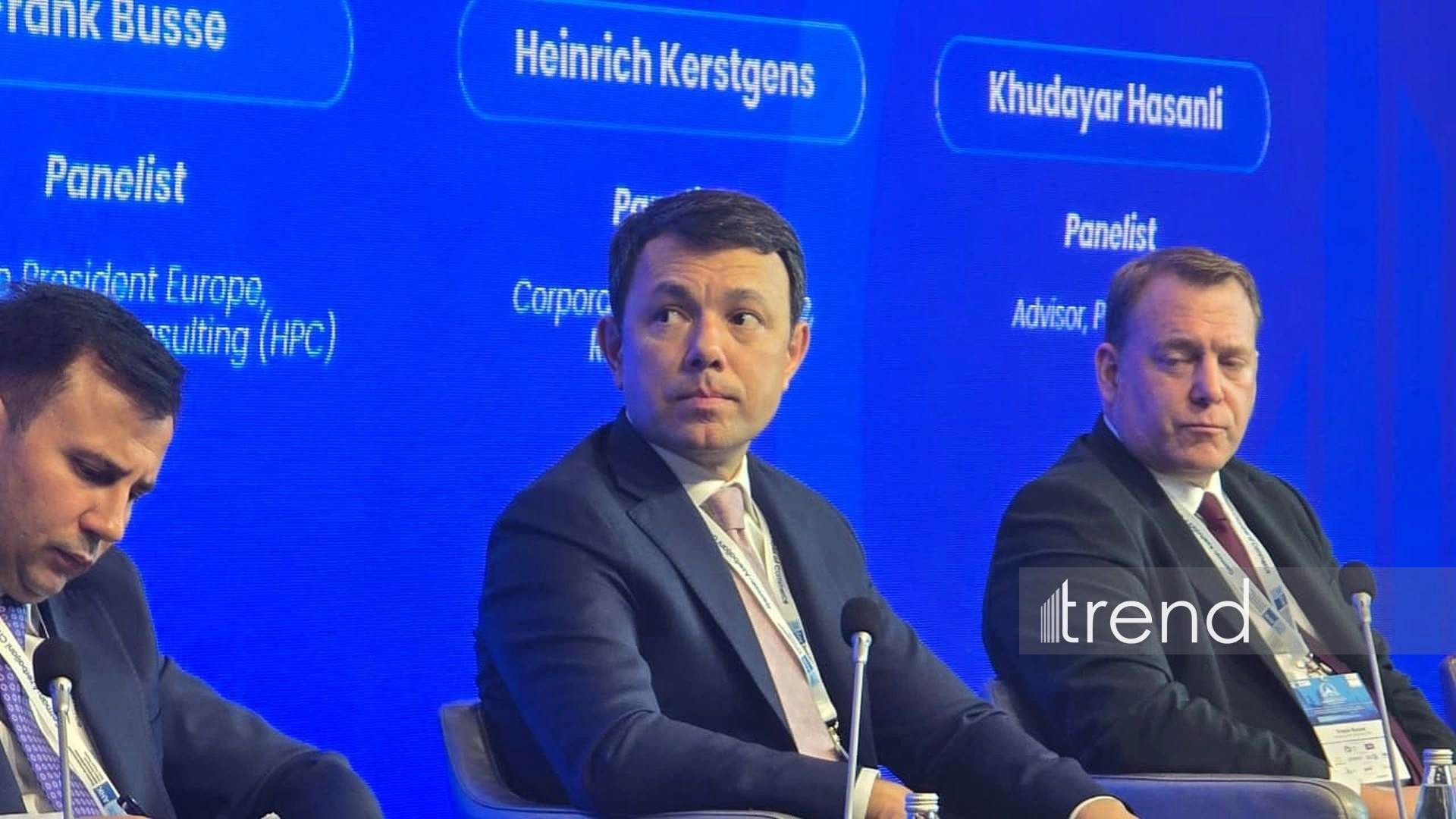
BAKU, Azerbaijan, October 6.
The integration of the digital systems of the Middle Corridor
countries will be ensured, Head of the Transport Policy Department
of Azerbaijan's Ministry of Digital Development and Transport,
Fariz Aliyev, said at the German-Azerbaijani Strategic Partnership
and Connectivity Conference held in Baku on Tuesday, Trend's correspondent reports from the
event.
According to him, to transform the Middle Corridor from a
collection of national transport systems into a fully integrated
international transport corridor in the coming years, it’s
essential to integrate digital systems and strengthen
coordination.
He noted that the development of the Middle Corridor should not
be limited solely to investments in railways, ports, and other
physical infrastructure.
"We must also address issues such as digital systems, the
harmonization of procedures, efficient border-crossing points,
coordinated operations, and stronger institutional cooperation,"
Aliyev noted.
According to him, two key areas require focus in the development
of the Middle Corridor: ensuring the interoperability of digital
systems and improving the coordination of operations across the
corridor.
Aliyev said that Azerbaijan is establishing a national digital
"single window" system covering import, export, and transit
operations.
"This system will help increase efficiency, eliminate redundant
and superfluous processes, and provide cargo owners with
visibility, tracking, and forecasting capabilities at the corridor
level," he said.
The department head noted that national digital "single window"
systems also exist in other countries participating in the Middle
Corridor. According to him, one of the next key tasks is to ensure
the interoperability of these systems.
“Countries such as Kazakhstan, Georgia, and Türkiye have their
own national digital ‘single window’ systems. We must ensure that
these systems can read and understand one another. Therefore,
ensuring digital interoperability is a priority issue,” Aliyev
emphasized.
He noted that a cargo owner or customer using the Middle
Corridor evaluates the efficiency of the corridor as a whole,
rather than focusing on operations within individual countries
along the route.
“The corridor’s customer looks at the corridor in its entirety,
not at the individual countries. Consequently, our approach must be
based on strengthening coordination at the corridor level,” he
remarked.
Aliyev stressed that to fully unlock the potential of the Middle
Corridor, it is essential to continue cooperation on harmonizing
legal and technical procedures, advancing digitalization, and
coordinating operations among the participating countries.
“For us, the issue is not merely about increasing transit
figures. Our long-term vision is to transform the country from a
transit nation into an economic hub. We must not simply transport
cargo; we need to create added value for the goods and processes
involved and evolve into a regional economic center. This will
strengthen Azerbaijan’s real export potential,” Aliyev added.


