
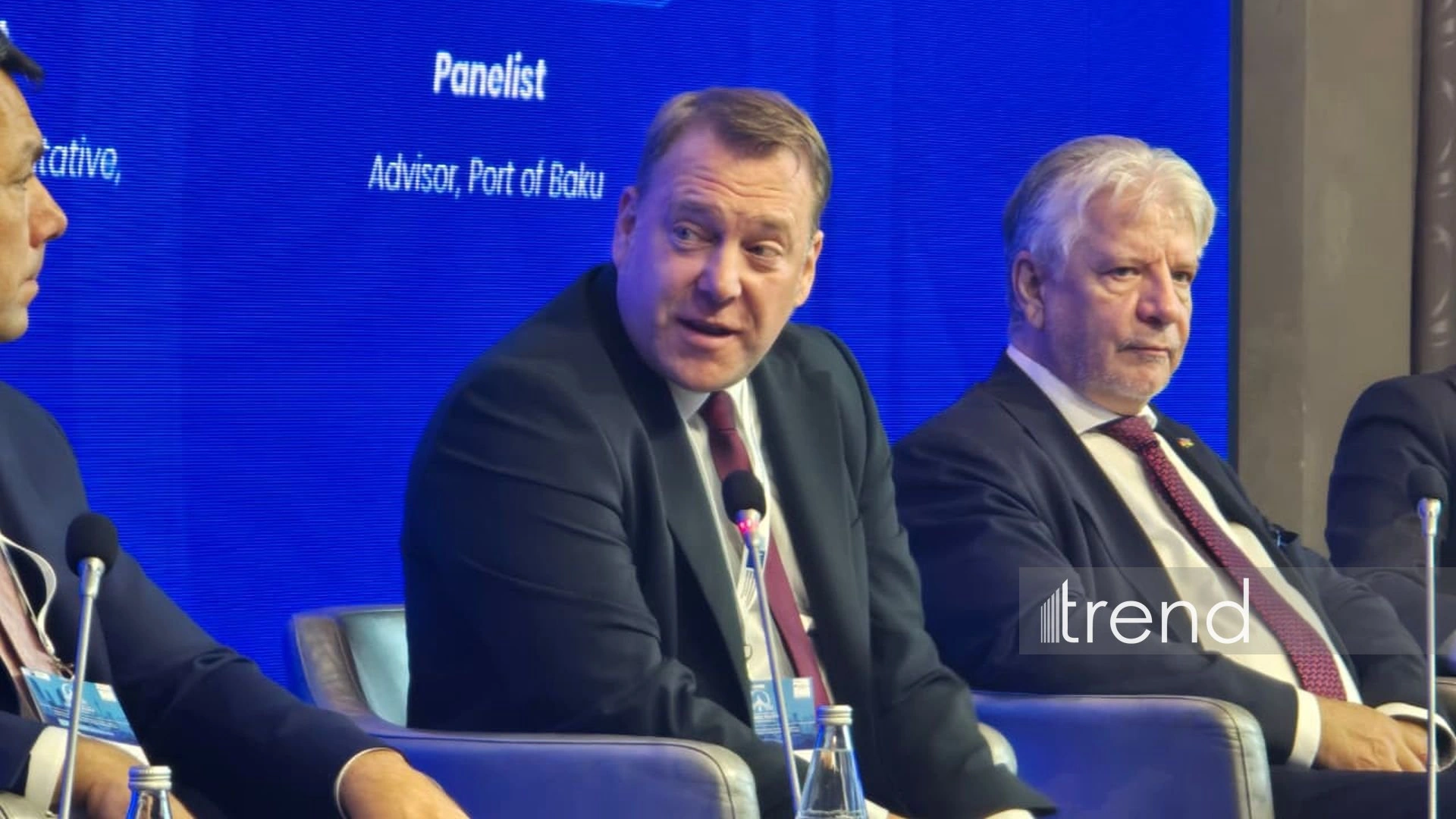
BAKU, Azerbaijan, October 6.
The capabilities of existing Caspian ports should be expanded, and
coordination and operational efficiency should be improved along
the Middle Corridor for its development, instead of building
additional ports on the sea, Vice President for Europe at Hamburg
Port Consulting (HPC), Frank Busse, said at the German-Azerbaijani
Strategic Partnership and Connectivity Conference held in Baku on
Tuesday, Trend's
correspondent reports from the event.
According to him, Transport and logistics companies in the
Caspian region, such as Azerbaijan Railways, the Port of Baku,
Rhenus, and Silk Way, are interested in developing freight
transport along the Middle Corridor.
"We have the funding, the technology for digitalization, and the
know-how regarding this process. What we need now is execution.
Sustainable growth and reliable, stable development must be ensured
along the corridor," said Busse.
The HPC representative noted that, at this stage, there is no
need for the construction of additional ports on the Caspian
Sea.
"We don't need additional ports on the Caspian Sea. However,
existing ports must compensate for certain shortcomings of the
Middle Corridor compared to the Northern Corridor," he
emphasized.
Busse noted that the Northern Corridor once handled up to 1.5
million containers of cargo. In contrast, the Middle Corridor faces
challenges such as disruptions at various ports and within railway
systems, as well as issues arising from differing railway gauge
standards.
"This must be offset by high-capacity railways and ports. We
have heard about the development plans for the Baku port. Similar
development needs to take place at every port, and all of this must
be carried out in a coordinated manner," the company official
noted.
According to him, the development of the ports of Aktau, Kuryk,
and Turkmenbashi must be aligned with the development of the Baku
port. At the same time, Black Sea ports and railway connections via
Türkiye must also be taken into account in the overall development
of the corridor.
"Development is good, but it must be coordinated. I believe this
is one of the key takeaways from the discussions," he added.
The HPC representative said that large-scale investments are
planned along the Middle Corridor. According to him, the total
volume of planned investments for the corridor amounts to billions
of euros.
"Everyone is ready for this; everyone wants to move forward. We
simply need to make it happen. Currently, there are only a few
major logistics companies actively operating along the corridor,
and I believe there is room for more," he said.
Busse added that the development of the Middle Corridor has
generated significant interest within the logistics and port
industries. "We are a consulting firm based in Germany with a staff
of approximately 100, specializing in the development of port and
rail terminals. We currently receive inquiries almost every week
regarding the preparation of projects along the Middle Corridor.
These cover a wide range of areas, from terminal development to
equipment procurement and the implementation of IT systems," he
noted.
According to the HPC representative, a comprehensive software
project linked to the opportunities created by the Middle Corridor
has also been developed for Georgia.
"There is currently significant momentum and opportunity
surrounding the Middle Corridor. I believe we must capitalize on
this in a sustainable, purposeful, and coordinated manner," Busse
emphasized.


