
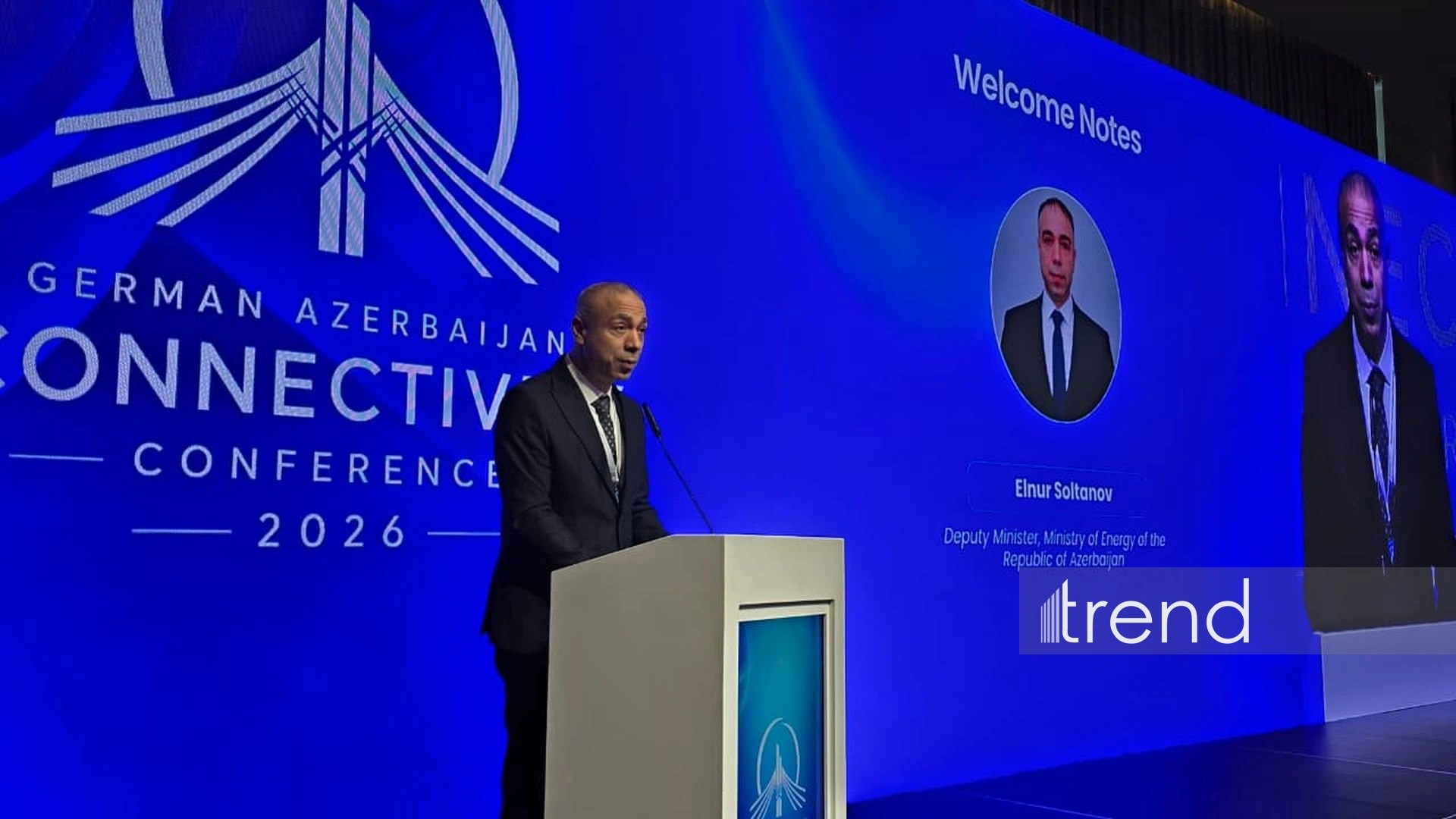
BAKU, Azerbaijan, October 6.
The time has come to establish a new framework for energy
cooperation between Azerbaijan and Germany, Azerbaijan’s Deputy
Minister of Energy Elnur Soltanov said at the German-Azerbaijani
Strategic Partnership and Connectivity Conference held in Baku on
Tuesday, Trend's
correspondent reports from the event.
He noted that the conference, held at a time when the global
energy and trade architecture is being reshaped and the strategic
importance of the Middle Corridor as a key East-West link is
growing, serves as a vital platform for advancing the
Azerbaijan-Germany partnership in the fields of energy,
infrastructure, and investment.
"The vision of the President of the Republic of Azerbaijan,
Ilham Aliyev, integrates regional security, economic development,
and energy policy through strategic connectivity; it brings the
South Caucasus and Central Asia closer together within a unified
geopolitical and geoeconomic space and imbues the historic Silk
Road with new significance," Soltanov explained.
According to the deputy minister, this approach facilitates not
only the development of the Middle Corridor but also its
transformation into a crucial energy route.
"In this context, green energy connections linking Azerbaijan,
the South Caucasus, Central Asia, Türkiye, and Europe, as well as
the TRIP perspective, are shaping the energy dimension of the
Middle Corridor," he noted.
Soltanov recalled that the signing of the Joint Declaration on
the strategic agenda for the Azerbaijan-Germany partnership, as
well as the document regarding the establishment and operation of
the Azerbaijan-Germany Business Council, which took place during
President Ilham Aliyev's official visit to Germany this July, has
elevated bilateral relations to a new level.
According to him, these documents have provided additional
momentum for expanding cooperation in the energy sector,
particularly in the field of green energy.
"For many years, Azerbaijan has been a reliable oil supplier to
Germany. Since 2026, natural gas has also added a new dimension to
our energy partnership. Currently, German companies such as Uniper,
SEFE, and VNG purchase Azerbaijani gas," the Deputy Minister
said.
Soltanov noted that the main priority for the period ahead is to
develop the partnership in areas such as renewable energy, energy
interconnectivity, energy efficiency, and the broader energy
transition.
"Azerbaijan's offshore wind energy potential of 157 gigawatts in
the Caspian Sea, the 8-gigawatt wind and solar energy projects
planned by 2032, and Central Asia's vast renewable energy resources
and strategic electricity interconnections create significant
opportunities for Europe's energy security and energy transition,"
he emphasized.
The deputy minister noted that Azerbaijan aims to deliver this
potential to European markets via several complementary routes.
These include the Caspian-Black Sea-Europe Green Energy Corridor,
the Central Asia-Azerbaijan Corridor, as well as westward
connections to Türkiye and Europe through Georgia and Nakhchivan.
According to him, TRIP also creates additional potential in this
regard.
Soltanov noted that the Caspian-Black Sea-Europe Green Energy
Corridor, with a capacity of 4 gigawatts, has already moved beyond
the feasibility study stage.
"The final investment decision for the project is expected to be
made in 2029, with phased commissioning scheduled to begin in
2032," he mentioned.
The deputy minister invited German companies to participate in
the Investment and Partnership Forum on the Green Energy Corridor,
to be held in Baku on October 22.
"We invite German companies to join the Investment and
Partnership Forum on the Green Energy Corridor, taking place in
Baku on October 22. This will provide an opportunity to explore the
project's technical, financial, and commercial prospects, as well
as to participate in its implementation as investors and strategic
partners," Soltanov pointed out.
He emphasized that a powerful synergy could be created by
combining Germany's financial capabilities, advanced technologies,
and industrial expertise with Azerbaijan's energy potential,
strategic geographic location, and expanding regional connectivity
networks.
"By combining Azerbaijan's energy potential, strategic position,
and growing regional connectivity with Germany's financial
capabilities, advanced technologies, and industrial expertise, we
can forge a more productive and long-term partnership," the deputy
minister said.
Soltanov expressed confidence that the conference would make a
significant contribution to translating the strategic agenda agreed
upon between Azerbaijan and Germany into concrete energy projects,
investments, and new energy connections.
"Taking the aforementioned issues into account, we believe the
time has come to establish a new framework for energy cooperation
with Germany," the deputy minister added.


