BAKU, Azerbaijan, October 1. The signing of the
Joint Declaration in Washington on August 8, 2025, and the
initialing of the peace agreement demonstrated that, after decades
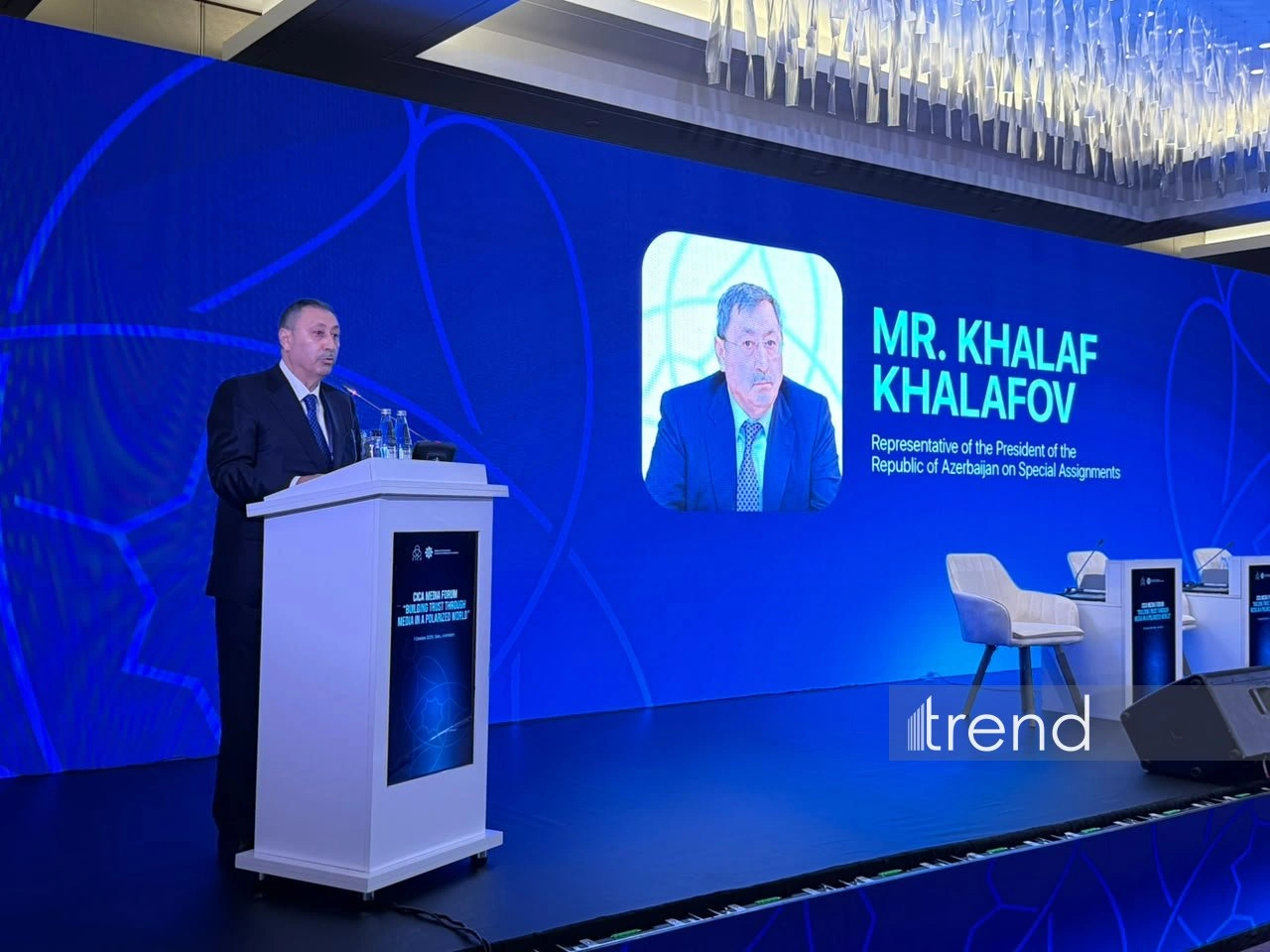
of conflict, it is possible to build trust, said Khalaf Khalafov,
Special Representative of the President of Azerbaijan, at the CICA
Media Forum on the “Building Trust Through the Media in a Polarized
World,” on Thursday, Trend’s correspondent reports from the event.
He noted that the system of international relations is currently
undergoing a profound transformation. Rising geopolitical tensions
and violations of fundamental principles of international law,
including sovereignty and territorial integrity, are seriously
straining the global security system.
Khalaf Khalafov noted that in addition to terrorism, separatism,
extremism, cyber threats, and disinformation, risks related to
food, energy, water, and climate security are also global in
nature.
“At present, joint efforts aimed at strengthening mutual trust
among states, the peaceful resolution of conflicts based on
international law, and the cessation of bloody wars ongoing in
various regions of the world serve as extremely important goals,”
Khalafov said.
He emphasized the need to take joint steps, based on the central
role of the UN, to prevent threats aimed at violating the norms and
principles of the world order and international law.
“International law remains the only reliable guarantee for
establishing and developing a just world order,” Khalaf Khalafov
stated.
The presidential representative noted that Azerbaijan had
suffered the serious consequences of Armenia’s military aggression
for more than 30 years but had restored the country’s territorial
integrity and sovereignty based on the norms and principles of
international law.
According to him, Azerbaijan thereby ensured compliance with the
UN Security Council resolutions on the military conflict.
Khalaf Khalafov noted that, following the Second Karabakh War,
the President of Azerbaijan, Ilham Aliyev, proposed to the Republic
of Armenia that a lasting peace be established in the region and
took all practical steps to advance the peace process.
“Today, it is extremely important that the Republic of Armenia
and the Armenian people properly assess their responsibility for
this history and take all necessary steps to establish peace based
on legal obligations,” he added.
Khalafov noted that CICA is an important platform that promotes
open dialogue in Asia based on the principles of consensus and the
sovereign equality of states, and that strengthens trust among
countries and fosters multilateral cooperation.
He noted that during its chairmanship of CICA, Azerbaijan made a
significant contribution to human capacity development, the
transformation of the forum into an international organization, and
the expansion of sectoral cooperation, as well as to strengthening
trust and cooperation within the CICA region.
Khalaf Khalafov noted that during his chairmanship, the CICA
Women’s Council and the CICA Finance Committee were established,
and a partnership network of leading universities from CICA member
states began operating.
According to him, discussions were held on the updated draft
text of the CICA Charter, and high-level consultations are
continuing as part of the organization’s transformation into an
international body.
The Special Representative of the President of Azerbaijan noted
that during this period, large-scale events were held in the areas
of economic cooperation, climate and water security, empowering
women and youth, education, media, tourism, transportation,
logistics, and analytical dialogue.
“These events have created the conditions for fostering a more
dynamic, inclusive, and results-oriented environment for
cooperation within the CICA framework,” said Khalaf Khalafov.
He emphasized that Azerbaijan will continue its efforts to
strengthen mutual trust and multilateral cooperation within the
CICA framework.
Khalaf Khalafov noted that the 7th CICA Summit will take place
on October 15 in Baku.
“I am confident that today’s discussions will enrich our common
agenda with new ideas ahead of the summit and will also contribute
to further strengthening relations between media organizations of
member states,” he said.