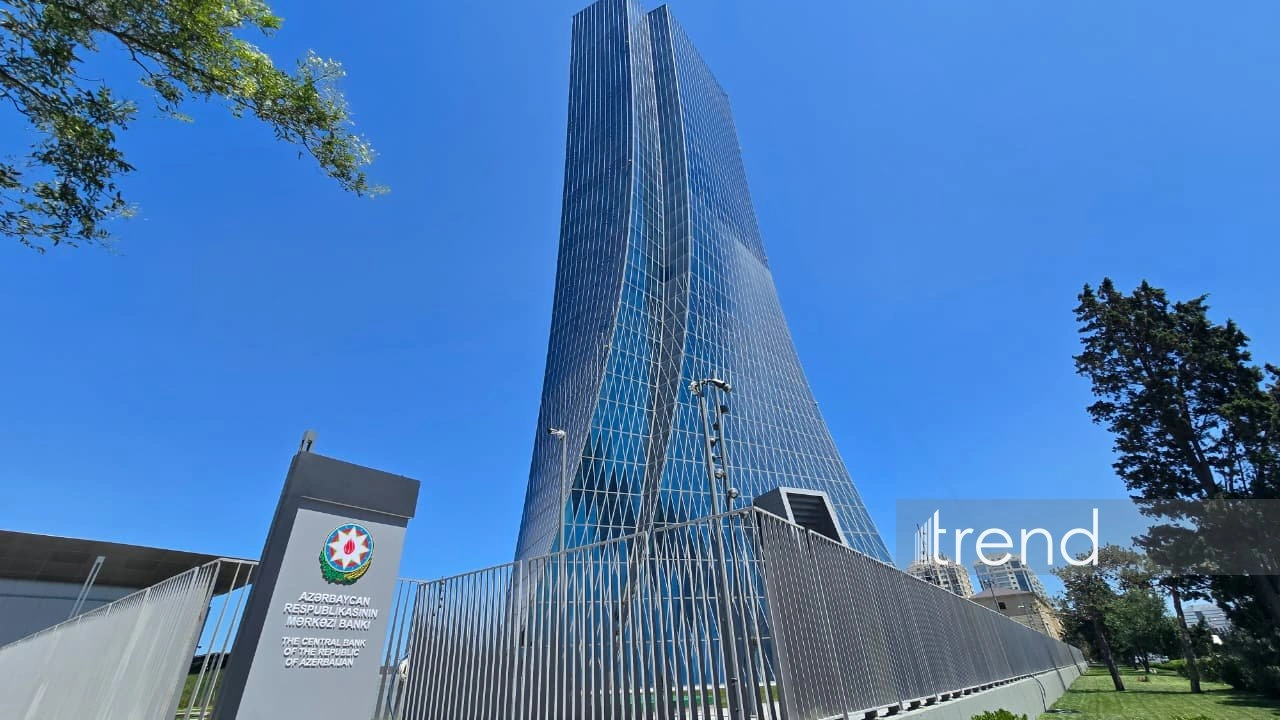
BAKU, Azerbaijan, September 23. The Central
Bank of Azerbaijan (CBA) kept its key rate unchanged at 6.5% and
the upper bound of the interest rate corridor at 7.5%, while
cutting the lower bound by 0.5 percentage points to 5%, the CBA
said.
The decision on the parameters of the interest rate corridor
took into account actual and projected inflation trends,
developments in the foreign exchange market, changes in the banking
sector’s liquidity position and recent trends in global monetary
conditions.
The reduction in the lower bound of the interest rate corridor
is aimed at encouraging trading in the interbank money market amid
excess liquidity in the banking sector. The widening of the
corridor is expected to encourage banks to conduct more active
transactions among themselves by reducing the CBA’s participation
in the money market.
Meanwhile, keeping the upper bound of the corridor and the key
rate unchanged is aimed at stabilizing inflation expectations.
Annual inflation remains within the target range and is moving
in line with the projected trajectory under the baseline scenario.
Twelve-month inflation stood at 5.7% in August 2026, down 0.1
percentage points from July.
Annual price growth was 7.2% for food, alcoholic beverages and
tobacco products, 5.0% for paid services and 3.7% for non-food
products. Annual core inflation stood at 5.1%.
The CBA’s forecast that annual inflation will remain within the
target range over the medium term remains unchanged.
In the period so far this year, supply has significantly
exceeded demand in the foreign exchange market, both in the cash
and non-cash segments.
During the first eight months of 2026, foreign exchange offices
purchased $673 million more in cash foreign currency from customers
than they sold.
The dollarization rate of deposits held by resident individuals
fell by 3.7%age points over the past 12 months to 25.8% in July
2026.
Amid a sharp decline in demand and an increase in supply in the
foreign exchange market, the CBA conducted foreign currency
purchases. Over eight months, the CBA’s foreign exchange reserves
increased by 32.9% to $15.3 billion, reaching a record high.
External sector indicators remain favorable. According to
customs statistics, Azerbaijan recorded a positive foreign trade
balance of $10.4 billion in January-August 2026.
According to preliminary data, the balance of remittances — the
difference between inflows and outflows — amounted to $751 million
in January-August, up 74.1% from the same period last year.
Amid higher global energy prices and continued positive trends
in non-oil and gas exports of goods and services, the CBA’s
forecast for the current account surplus at the end of 2026 could
be revised upward.
Excluding funds held as required reserves, the banking sector’s
structural liquidity surplus — the difference between the CBA’s
liabilities to the banking system and its claims on banks — reached
6.3 billion manats ($3.71 billion) at the end of August, increasing
2.2 times compared with December last year.
In this environment, benchmark rates in the unsecured money
market have tended to decline somewhat. The average daily AZIR rate
stood at 6.39% in July 2026, 6.28% in August and 6.02% in the
period of September through the date of the report.
Monetary policy instruments are applied taking into account
developments in financial markets and liquidity indicators in the
banking system.
The CBA mainly uses seven-day deposit operations to manage
liquidity. These operations accounted for 70.8% of the
sterilization portfolio under open market operations at the end of
August.
At the same time, the volume of the CBA’s note portfolio
increased more than fourfold by the end of August compared with the
end of last year.
No significant change has been observed in the balance of
inflation risks since the previous meeting.
Against the backdrop of global geopolitical uncertainty, the
risk of higher energy and food prices, as well as the pass-through
of these increases to domestic prices from major trading partners,
remains significant.
The extent of this pass-through will depend, among other
factors, on movements in the nominal effective exchange rate of the
manat.
Going forward, the likelihood of changes to the CBA’s inflation
forecasts will depend mainly on the scale at which these risks
materialize. Under current fiscal and monetary policy conditions,
domestic demand is not expected to increase inflationary
pressures.
For the remainder of the year, decisions on the interest rate
corridor will continue to take into account the inflation outlook,
the dynamics of key macroeconomic indicators, developments in the
foreign exchange market and changes in banking sector
liquidity.
Given uncertainty in the global environment and the intensity
with which these developments may be transmitted to the domestic
economy, macroeconomic forecasts will continue to be considered
under several scenarios.
The decision will take effect on September 24, 2026.
The schedule for announcing monetary policy decisions in 2026
has also been revised. The announcement of the next decision on the
parameters of the interest rate corridor, along with the related
news conference, has been moved from November 4 to October 29,
2026. A meeting with experts is also planned for the same day.