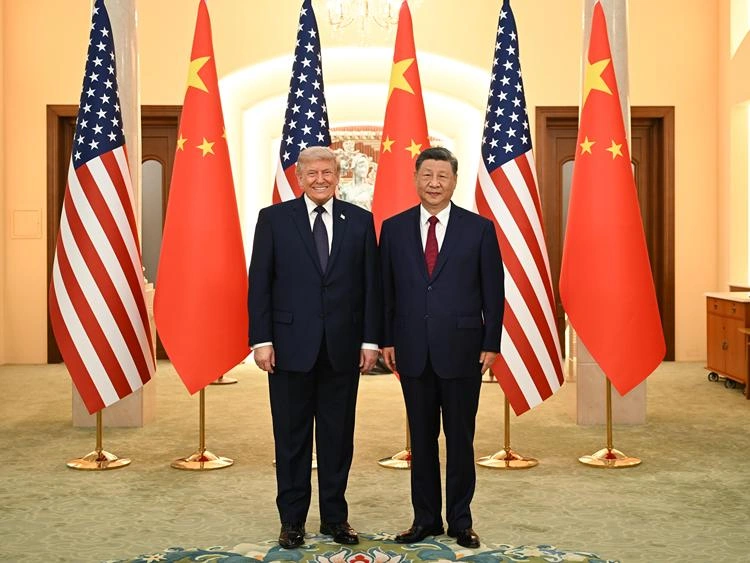
Chinese President Xi Jinping is set to travel to Washington for
a state visit and a high-stakes meeting with U.S. President Donald
Trump.
With the upcoming visit, the two presidents are expected to
complete reciprocal visits within months. The trip will be Xi's
second state visit to the United States following his first in
2015.
More than a decade on, the world's most important bilateral
relationship has followed a bumpy course. How Beijing and
Washington manage ties -- and find room to work together -- is
increasingly consequential for both countries and the world.
NEW VISION
In May, as Xi hosted Trump in Beijing, he opened their talks
with three questions:
"Can China and the United States overcome the Thucydides Trap
and create a new paradigm of major-country relations? Can we meet
global challenges together and provide greater stability for the
world? Can we build a bright future together for our bilateral
relations in the interest of the well-being of the two peoples and
the future of humanity?"
The questions were raised against the backdrop of years of
turbulence in bilateral ties, from trade disputes to tech curbs. Xi
has repeatedly stressed the need to find the right way for the
world's two major countries to get along.
The Beijing summit gave renewed momentum to that effort. Xi and
Trump have agreed on a new vision of building a constructive
China-U.S. relationship of strategic stability over the next three
years and beyond.
"It marks the first time in more than a decade that China and
the United States established a consensus about how to define the
relationship that leaders on both sides broadly recognize," said Da
Wei, director of the Center for International Security and Strategy
at Tsinghua University.
For a while now, China-U.S. relations have moved forward along
the track charted by the two leaders. "Head-of-state diplomacy is
the anchor of China-U.S. relations," Chinese Foreign Minister Wang
Yi said on Thursday in a phone call with U.S. Secretary of State
Marco Rubio in preparation for the upcoming summit.
Since Trump's re-election, Xi has maintained contact with him
through various means, like face-to-face meetings and phone calls,
sometimes in a casual format.
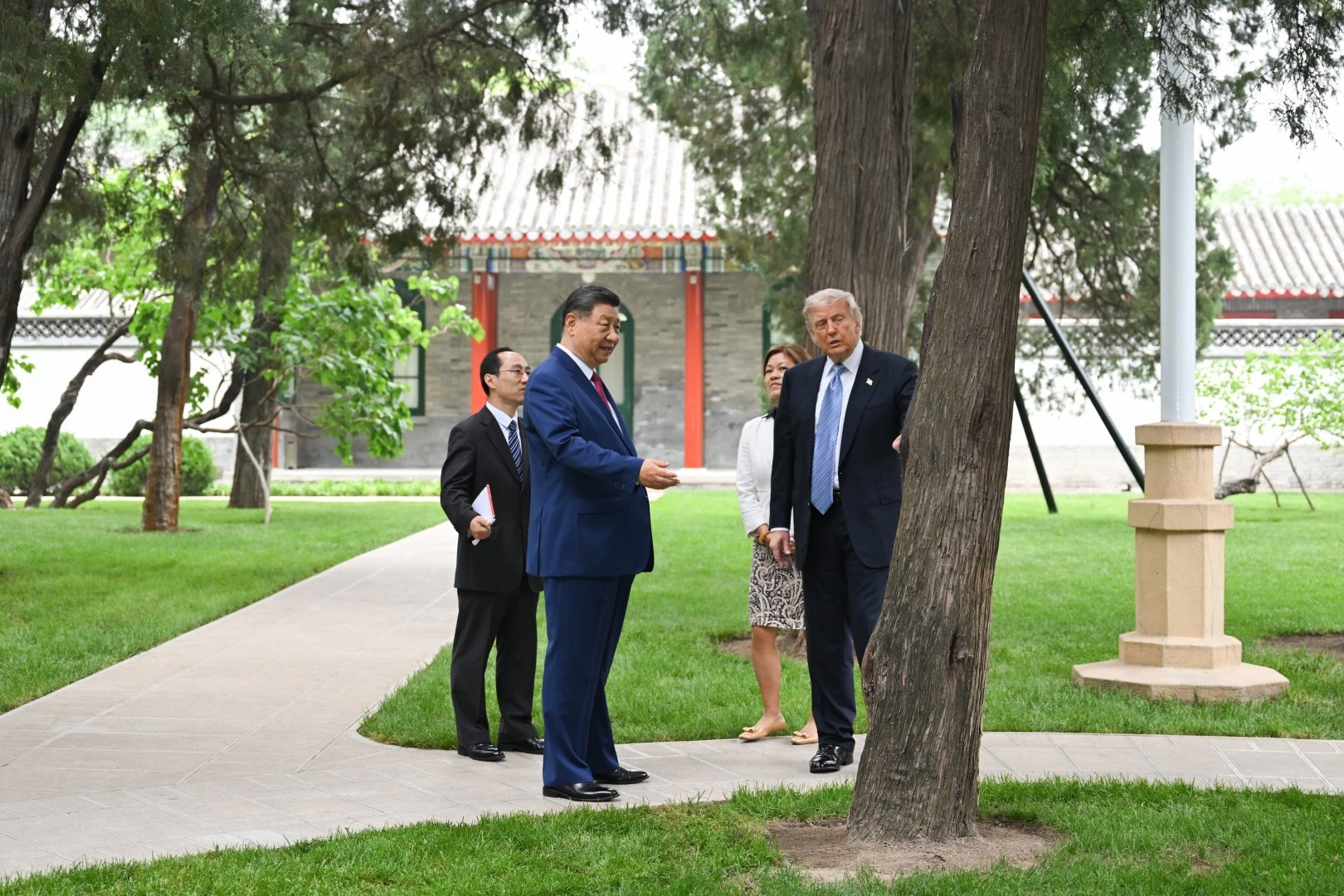
During the May visit, Xi invited Trump to Zhongnanhai, the
leadership compound in central Beijing, for a private meeting -- an
invitation extended to few foreign leaders.
Xi and Trump strolled in the garden, chatting and pausing now
and then to admire the towering ancient trees and Chinese roses in
full blossom.
"While President Trump hopes to make America great again, I am
dedicated to leading the Chinese people toward national
rejuvenation," Xi said later as the two leaders sat down for a
conversation over tea.
He urged both sides to keep to the right direction, steer clear
of disruptions and promote the steady development of bilateral
relations.
Such moments away from the formal meeting table have become a
feature of Xi's encounters with Trump, providing a more personal
setting to learn about each other's countries and perspectives.
Similar interactions stretch back to Xi's first meeting with
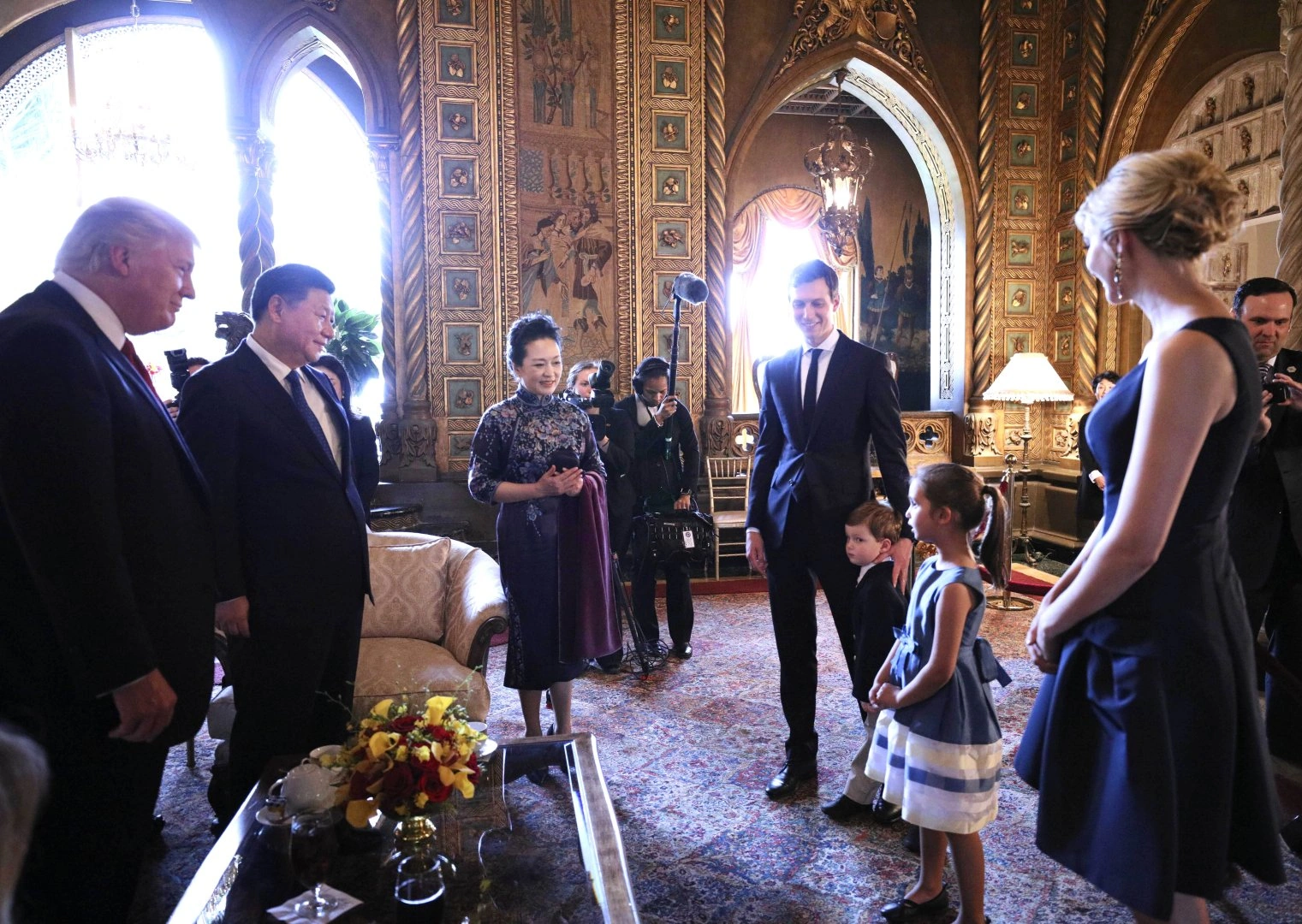
Trump in 2017. At Mar-a-Lago, Trump's private estate in Florida, Xi
presented him with a piece of Chinese calligraphy bearing an
ancient saying: "A nine-story tower rises from a heap of earth; a
journey of a thousand miles begins with a single step."
The message carried a metaphor for the relationship Xi hoped the
two countries could build. He told Trump that the two leaders could
rally those in both countries who shared the goodwill and
enthusiasm for advancing China-U.S. relations, and build the
edifice of the relationship one story at a time -- making it
stronger, taller and more glorious.
BALLAST
Economic and trade relations should continue to serve as the
"ballast" and driving force for China-U.S. relations, rather than a
stumbling block or a point of friction, Xi told Trump in Busan,
South Korea, in 2025. Xi has often likened China-U.S. relations to
a giant ship, for which ballast is critical to staying on course
through rough waters.
Following the surge of U.S. tariffs in 2025, Beijing responded
with resolute countermeasures while continuing negotiations with
Washington in an effort to manage their differences. By the time Xi
and Trump met in Beijing, their economic and trade teams had
reached "generally balanced and positive outcomes."
The dialogue has continued since, with their latest round of
talks, which were candid, in-depth and constructive, concluded in
New York on Sunday.
There is no winner in a trade war, Xi has repeatedly stressed,
both in his exchanges with Trump and on the international stage.
"Facts will prove that decoupling and cutting off supply chains
will not hold back our development process, and espousing 'small
yard, high fences' will only box oneself in and divide the world,"
Xi said at the just-concluded BRICS summit in New Delhi.
That message also lay at the center of Xi's outreach to the
American business community. In March 2024, he met with
representatives from U.S. business, strategic and academic
communities in Beijing. He told the gathering that the respective
success of China and the United States is an opportunity for each
other.
During the May visit, Xi sat down with Trump in the Great Hall
of the People in Beijing alongside more than a dozen executives
from some of America's most preeminent companies, including Apple,
Nvidia, Tesla and Boeing.
Trump introduced the business leaders to Xi one by one,
underscoring the weight he attached to the delegation.
"Each side, the United States and China, has a big stake in
constructive strategic stability," said Robert Lawrence Kuhn, a
U.S. scholar and longtime observer of China.
From artificial intelligence and climate change mitigation to
public health and counter-narcotics, there are plenty of issues
that China and the United States are both involved in, he
added.
Rather than expecting Washington and Beijing to suddenly work
together perfectly, Kuhn said, the more immediate objective should
be to prevent disputes over tariffs, critical minerals, and other
issues that could lead to further escalation.
BRIDGING THE PACIFIC
"Friendship, which derives from close contact between the
people, holds the key to sound state-to-state relations," Xi has
said. For him, the foundation of China-U.S. relations was laid by
the two peoples.
Upon the official announcement of Xi's U.S. visit on Monday, his
recent reply to American university students was made public. In
his letter, Xi encouraged them to foster greater mutual
understanding and affinity between people of the two countries, and
to promote the steady and sustained development of bilateral
relations.
When China-U.S. relations were at a low ebb, Xi cast his eyes
toward the future -- young people. The youth, he believes, carry
the future and hope of this relationship.
During his 2023 trip to San Francisco for the APEC leaders'
meeting, Xi announced an initiative to invite 50,000 young
Americans to China for exchange and study programs over the next
five years. By May this year, that goal had been reached two and a
half years ahead of schedule.
Many participants have written to Xi, thanking him for the
opportunity to see China for themselves and forge friendships with
their Chinese peers. Xi, in turn, has encouraged young people from
both countries to become "envoys of friendship" bridging the
Pacific.
A 2026 Reagan Institute Summer Survey found that younger
Americans were significantly less likely to view China as a major
threat to the United States.
That emphasis on people-to-people bonds extends beyond the
younger generation. For decades, Xi has stayed in touch with his
old friends in Iowa, whom he first met during his maiden trip to
the United States in 1985, and corresponded with veterans of World
War II's Flying Tigers, recalling the bonds forged between the two
peoples during that time.
"We should build more bridges and pave more roads for
people-to-people interactions," Xi once said. "We must not erect
barriers or create a chilling effect."
Ahead of Xi's U.S. visit, another story of friendship across the
Pacific went viral online.
In 1999, American teacher Ronald Sakolsky donated 5,000 U.S.
dollars to support Chinese woman Yin Yuzhen's tree-planting efforts
to combat desertification in north China's Inner Mongolia. With the
funds, Yin went on to cultivate a forest of more than 50,000
trees.
When Sakolsky and Yin reunited in China in August, he was asked
what message he wanted to take home to the United States. His
answer was: "Bridge."
He said he believes the upcoming meeting between President Xi
and President Trump could help build that bridge.
"China is ready to rebuild the bridge," Sakolsky said. "Is
America ready? I believe so."
Xinhua News Agency