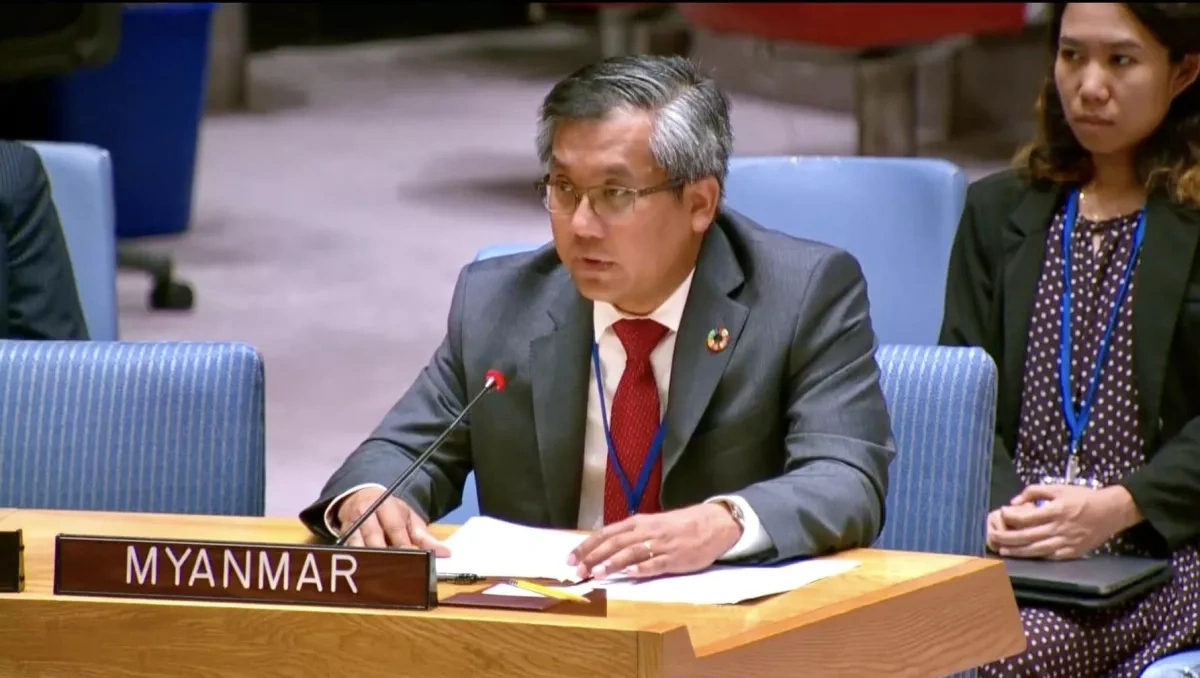
Myanmar has renewed its challenge to the legitimacy of its ambassador to the United Nations, accusing Kyaw Moe Tun of unlawfully continuing to represent the country more than five years after he broke with the military authorities following their 2021 coup.
Myanmar’s Foreign Ministry said Kyaw Moe Tun had been “dismissed from civil service” effective February 27, 2021, after refusing to follow government orders, committing treason and cooperating with “terrorist organizations,” according to a statement published by state-run local media on September 13.
A day before his dismissal, Kyaw Moe Tun made an emotional appeal during an address to the UN General Assembly, calling for the “strongest possible action” against the military takeover.
Appointed by the government of Nobel laureate Aung San Suu Kyi, the ambassador rejected the coup and broke with the country’s new rulers only weeks after they seized power.
The ministry has also accused him of misusing state funds and property, including the premises of Myanmar’s UN Permanent Mission in New York, and cooperating with the exiled opposition National Unity Government (NUG), which Myanmar’s military-backed authorities have designated as a terrorist organization.
“Kyaw Moe Tun’s continued representation of Myanmar at the United Nations does not constitute formal recognition of his legitimacy,” the ministry said.
“Rather, his continued status is merely a temporary arrangement, with the Credentials Committee’s decision deferred annually.”
The UN established a credentials committee this month to consider whether to accept Naypyidaw’s nominee for ambassador or allow Kyaw Moe Tun to remain in the post. He has rejected the military takeover and for more than five years has dismissed the authorities’ claims that he no longer represents Myanmar.
The nine-member committee includes the Bahamas, Belgium, Benin, China, Jamaica, Russia, Uganda, the United States and Vanuatu.
China and Russia are allies of Myanmar’s military-backed government, while the United States has imposed sanctions on dozens of its leaders, including former junta chief Min Aung Hlaing.
The dispute is not without precedent at the UN, where rival claims over diplomatic representation have emerged following changes of government.
A similar situation arose in Afghanistan in 2021 after the US-backed government was overthrown and the Taliban seized power. Afghan ambassador Ghulam Isaczai, who had been appointed by the ousted government, remained at the UN despite the Taliban requesting that another representative be accredited.
On December 21 of that year, the UN General Assembly adopted a resolution indefinitely postponing a decision over the competing claims to Afghanistan’s seat. Isaczai eventually left the post voluntarily in December, as Afghanistan’s UN mission faced growing logistical and financial difficulties that hindered its operations.
By Nazrin Sadigova