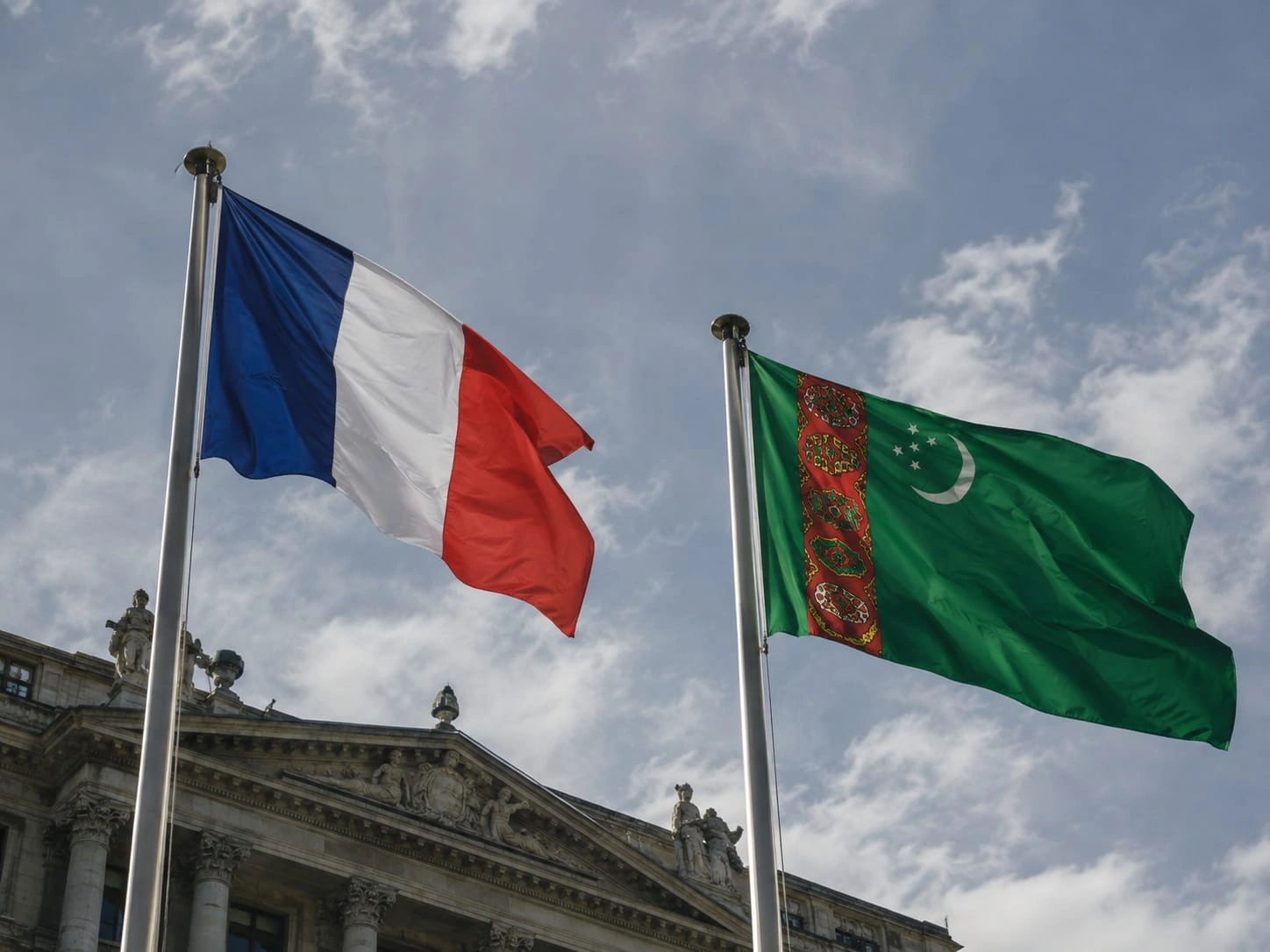
BAKU, Azerbaijan, September 11. Turkmen-French
relations have gained fresh momentum in recent months, with
economic cooperation increasingly assuming a prominent place on the
bilateral agenda. On September 4–5, a Turkmen delegation held a
series of meetings in Paris with representatives of leading French
companies and financial institutions, during which prospective
projects in energy, infrastructure, technology, and other areas
were discussed. The participants included Thales, Thales Alenia
Space, Airbus, TotalEnergies, Bouygues, Vinci Construction, as well
as Coface, UBAF, Société Générale CIB, Crédit Agricole, and
Rothschild & Co.
Following these engagements, on September 9, the President of
Turkmenistan, Serdar Berdimuhamedov, received France’s newly
appointed Ambassador, Alena Grand. During the meeting, the sides
reaffirmed their interest in further developing trade, economic,
and energy cooperation, as well as expanding engagement between the
private sectors of the two countries. Berdimuhamedov particularly
emphasized the potential for cooperation in the energy and
transport-logistics sectors.
The sequence of these engagements indicates an effort to further
broaden France’s existing presence in Turkmenistan, extending
cooperation to new industries, technologies, and instruments of
economic engagement.
The foundation for the current expansion of cooperation was laid
during the visit of Gurbanguly Berdimuhamedov, Chairman of the Halk
Maslahaty (Parliament) of Turkmenistan, to France in May 2025.
During that visit, the economic dimension of bilateral relations
was notably broadened, with the Turkmen-French Economic Forum
addressing not only the traditional areas of construction and
energy, where French companies have maintained a presence in
Turkmenistan, but also satellite technology, transport, water
resources, land cadastre, the chemical and pharmaceutical
industries, as well as green and hydrogen energy.
An important outcome of that visit was the emergence of concrete
projects beyond the construction sector, which has traditionally
anchored bilateral cooperation. Turkmenistan reached agreements
with French companies in satellite technology, land resource
management, water management and methane emissions monitoring.
Agreements with Airbus Defence and Space, IGN FI, SUEZ, Thales
Alenia Space and Kayrros in particular demonstrated that the two
sides now view French technology not merely as a tool for building
individual facilities, but as a resource for modernizing various
sectors of the economy.
The fact that the areas identified in 2025 are now gaining more
visible momentum can be explained not only by the natural
progression of bilateral dialogue. Turkmenistan has entered a new
investment cycle, triggered by the start of the fourth phase of
development at the Galkynysh gas field. As Trend previously noted
in its article "Inside Turkmenistan’s investment cycle: How Turkish
contractors anchor a new phase of economic expansion," the
scale of this project is capable of generating multi-year demand
not only in the gas sector, but also in construction, energy,
transport, industry and related fields.
In April 2026, Turkmenistan and CNPC signed an agreement on the
construction of facilities for the fourth stage of Galkynysh, which
envisages creating capacity of 10 billion cubic meters of gas per
year at a project cost of around $5.1 billion. For foreign
companies, what matters most is the subsequent multiplier effect of
such investment: a major energy project creates new opportunities
for contractors, equipment suppliers, engineering firms and
technology partners.
Against this backdrop, the economic agenda set out by Gurbanguly
Berdimuhamedov during his 2025 visit to France appears to be
finding a more favorable environment for practical implementation
roughly a year later. French companies are already established in
sectors set to see additional demand within the new investment
cycle, and the expansion of cooperation in technology,
infrastructure, energy and resource management positions them to
compete not only for individual projects, but for a role in the
broader chain of new investment now taking shape.