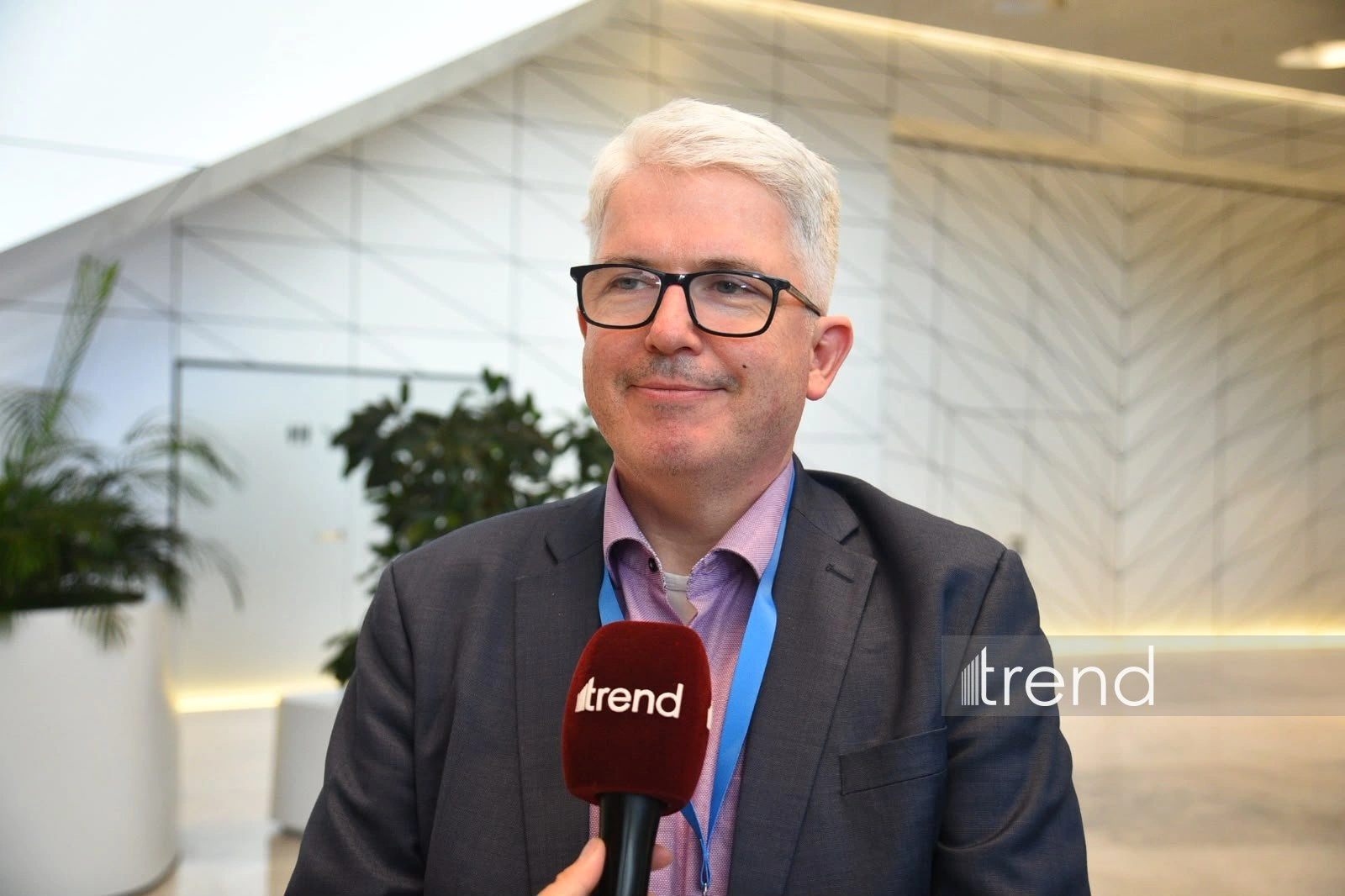
BAKU, Azerbaijan, September 9. Cross-border
connectivity, the Middle Corridor, will be among the key pillars of
cooperation between the Asian Infrastructure Investment Bank (AIIB)
and Azerbaijan, Conor Barry, senior economist at the Asian
Infrastructure Investment Bank (AIIB) said in an exclusive
interview with Trend.
"The key pillars for us and for the government will be transport
and cross-border connectivity, the Middle Corridor, enhancing more
supply chain resilience, and the role Azerbaijan plays in supply
chain resilience, connectivity between Asia and Europe,
connectivity between parts of Asia, and climate resilience within
Azerbaijan itself, and the enhanced role Azerbaijan can play in
wider green finance and renewable energy," he said.
Barry pointed out that the Middle Corridor is particularly
important, not just for Azerbaijan, but for the region as a
whole.
"And it's a core pillar for us, in particular, in difficult
geopolitical times that we face at the moment. As a multilateral
institution, we consider it quite important that we are seen as an
organization that's helping cooperation to happen, both in
transport infrastructure, but also in energy infrastructure, and
creating green electricity market between Azerbaijan and its
neighbors is an important initiative that we want to be part of,"
he explained.
He went on to add that AIIB is very client-driven.
"We're not coming in as the AIIB with our fixed priorities for
Azerbaijan. We're working in partnership with what the government
of Azerbaijan wants to deliver for the people of Azerbaijan. We try
and match that with our overall strategies and our overall
direction that we feel is useful for infrastructure, and that looks
at cross-border connectivity, green infrastructure, digital-enabled
infrastructure. But this is driven by the areas which the
government of Azerbaijan wishes to develop infrastructure within
the country, rather than driven by what AIIB feels is the right
form of infrastructure for a given country," added Barry.
AIIB’s climate finance strategy and opportunities for
Azerbaijan
He pointed out that AIIB's climate finance touches on a whole
range of different sectors.
"It's not a simple individual project. We have our overall
corporate strategy of going beyond 50% of all of our financing
being climate finance. We're well beyond that in achievement and
now we're looking at 70%. I think our next shift is to ensure that
is not just a quantitative number, but that's having a qualitative
impact, and ensuring that it is climate resilient. We're enhancing
resilience of countries, which is a bigger challenge than just
decarbonization. It cuts across a wider range of sectors and
touches on different aspects of vulnerability, pre-existing
vulnerabilities that are present within countries. The core part of
our partnership is working with countries, identifying what their
exposure is to climate risk, identifying what hazards they're
facing, where there's vulnerability, and how infrastructure can
help address that vulnerability," said Barry.
The senior economist noted that the Bank has done quite a few
renewable entry projects, mainly large-scale solar projects within
Azerbaijan.
"And we think this will be an ongoing opportunity for private
investment. Our aim here is to ensure that we're getting more,
mobilizing more private capital, so that the country can rely not
just on its own resources and its own lending with us, but that
we're acting as a multiplier to get more private capital, both
domestic private, also mobilizing international private capital for
renewable energy and electric mobility," he said.
Development of multi-year investment
program
Barry noted that in general, with AIIB's approach towards
country programming is a partnership with the country.
"We don't fix a deadline and a timeline for agreement of that.
We don't require to have a multi-year rolling work program in order
for us to invest in a country. We've been investing in Azerbaijan
for over 10 years now without the multi-year rolling work program.
We'll develop that program and it will give clarity to both sides
as to priorities, but that also isn't a fixed endpoint where we say
we've agreed this rolling work program and we don't invest other
activities. If you see our multi-year rolling work plans in other
countries where we have agreed them, if then priorities change with
government or a new issue comes up, or a new project needs
financing, that's added to the multi-year rolling work program.
It's not viewed only as this is the only things that we finance for
a given country. In that sense, agreeing that and having a final
deadline for it is not the most important. It just sends the signal
of the level of cooperation that the Bank and the country will have
over the years into the future," he concluded.