BAKU, Azerbaijan, September 7. Azerbaijan is
working on an action plan under its National Hydrogen Strategy,
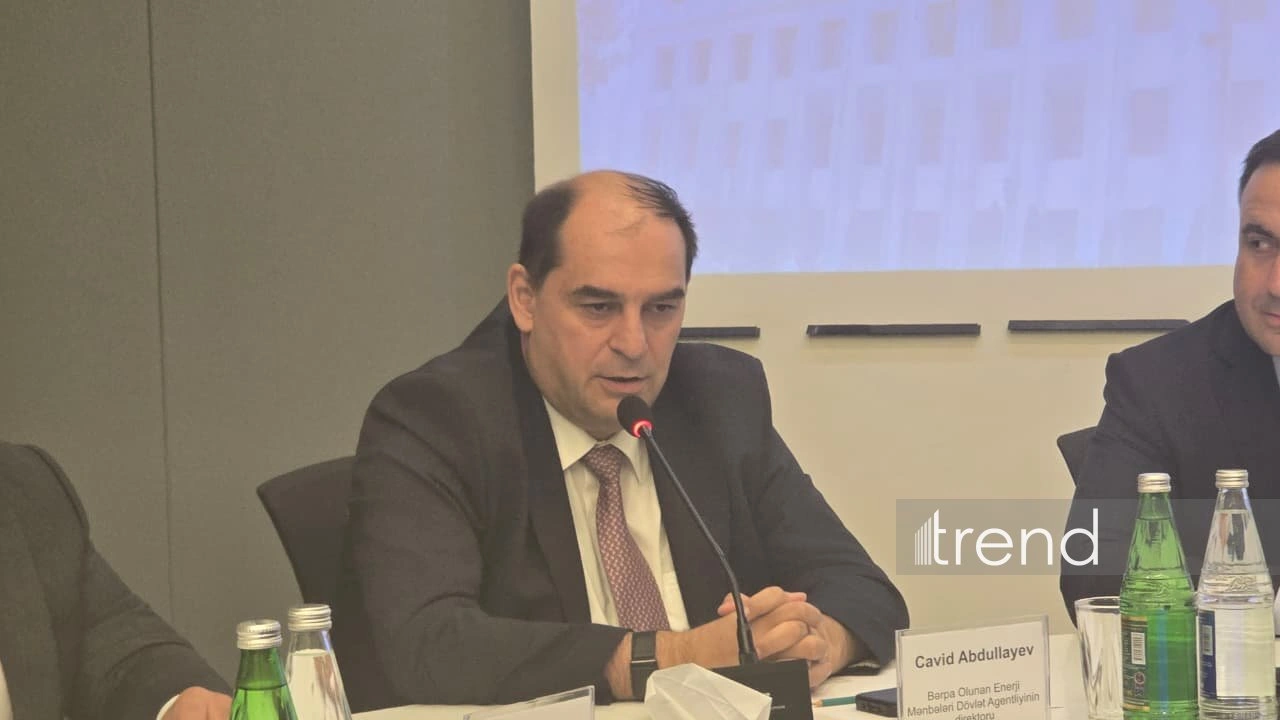
Javid Abdullayev, Director of the Azerbaijan Renewable Energy
Agency, said, Trend's correspondent reports from the event.
Abdullayev made the remarks while speaking at the opening of a
modern renewable energy laboratory at Azerbaijan State Oil and
Industry University (ADNSU).
He said a number of issues related to the development of a
hydrogen economy in Azerbaijan remain unresolved.
“Questions related to the future are quite serious, and there is
currently no definitive answer to them. The main reason is that the
hydrogen economy does not yet exist,” Abdullayev said.
He said further research is needed to determine how efficient it
would be to convert electricity into hydrogen for storage and then
use that hydrogen to generate electricity again.
“For example, we are talking about converting electricity into
hydrogen and using it as a storage system. But we need to determine
where and in what form it can be applied, as well as how efficient
it would be to use the energy converted into hydrogen to generate
electricity again,” he said.
Abdullayev also acknowledged a degree of skepticism surrounding
hydrogen energy.
“I can say that there is some skepticism on our side as well.
However, we are working in this direction step by step,” he
said.
According to Abdullayev, Azerbaijan is studying various areas
related to hydrogen, including sustainable aviation fuel.
“Sustainable aviation fuel and other areas are quite
interesting. Our colleagues have recently spent a week in Germany,
at German universities and relevant institutions,” he said.
Abdullayev said work was underway to prepare an action plan
under Azerbaijan’s National Hydrogen Strategy.
“In the coming days, with financial support from the European
Union, we are preparing a tender for the strategy and getting ready
to present our action plan. We will answer these questions
specifically in the action plan,” he said.
He noted that hydrogen production and exports had previously
been considered as part of interconnector projects.
“Previously, we considered hydrogen production and hydrogen
exports as part of our interconnector projects. Currently, hydrogen
production is being carried out in a limited number of countries
and geographical areas around the world. We are also trying to
assess its economic efficiency and potential,” Abdullayev said.
The agency director highlighted strong interest in hydrogen
energy in China.
“In China, this issue is being advanced with a very strong
initiative. China is also making major strides in renewable energy.
This approach shows that hydrogen production could become
economically efficient at a certain stage,” he said.
At the same time, Abdullayev said large-scale use of hydrogen
remains more of a long-term prospect.
“This is very much a question for the future, and we believe
that this issue will become clearer at the next stage,” he
said.
He also highlighted challenges arising from the integration of
renewable energy sources into the power grid.
“In a country like ours, integrating variable generation into
the power grid is not particularly easy. Operational issues and
even environmental problems need to be considered,” Abdullayev
said.
As an example, he cited the impact of bird migration on wind
turbines in the Khizi and Shurabad areas.
“For example, in Khizi and Shurabad, there is a problem related
to bird migration in front of the turbines, and the turbines are
shut down when birds arrive. Imagine that 70 megawatts of capacity
are removed from the system at that moment. How will you restore
this capacity in the system? You need to carry out certain
balancing measures,” he said.
According to Abdullayev, such situations caused by variable
renewable energy generation represent a major challenge for the
power system.
“This is a very serious issue for the power grid. Among the
problems created by variable generation, this is one of the main
and major challenges,” he said.