BAKU, Azerbaijan, September 4. The decision of
the European Union (EU) to introduce new trade concessions for
Armenian products may at first glance be presented as an economic
support measure, but the essence of the issue should be assessed
more broadly in terms of the competitive environment emerging in
the South Caucasus, the principles of European foreign trade
policy, and the influence of political factors on economic
relations: by temporarily suspending import duties on products that
account for about 80% of Armenia's exports, Brussels is giving
Yerevan a significant advantage in the EU market, and thus
rightfully raises the issue of equal competition for other
countries in the region.
Real scale of 80% concession
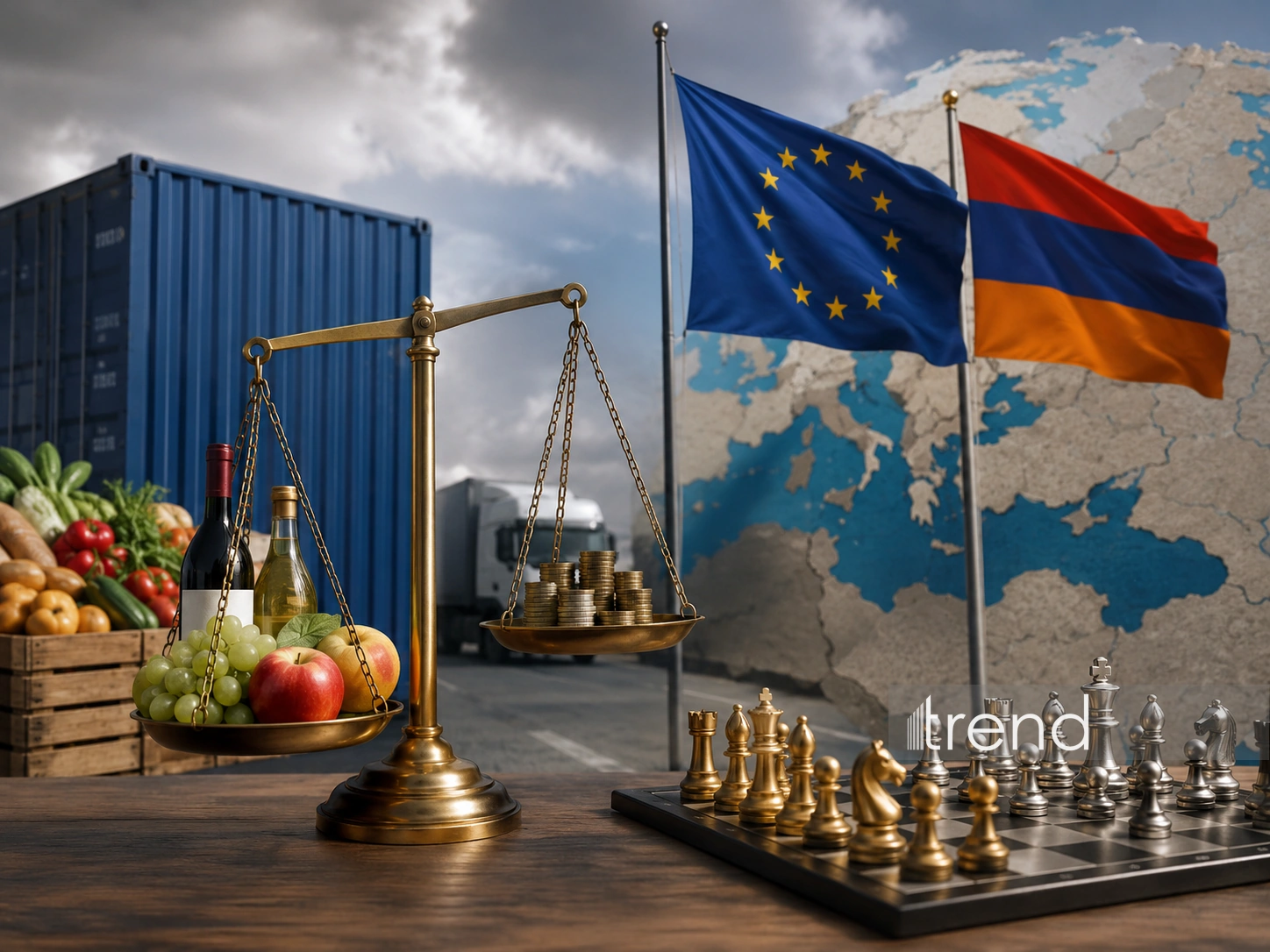
On September 2, 2026, the EU Council supported the European
Commission's proposal without changes, which envisages the
introduction of temporary trade liberalization measures for
Armenian goods. This decision allows for the liberalization of
about 80% of Armenia's exports to the EU. At this stage, we are
talking about the Council's position, and in order to quickly adopt
the regulation, the European Parliament also approved the proposal
without changes.
The measures must be applied within two years of the regulation
coming into force. The concessions cover a wide range of products,
including agricultural products, and tariff quotas are envisaged
for some agricultural goods. According to official EU data, the
products covered account for approximately 99% of Armenia's exports
of fresh fruit, vegetables and plants to Russia, and more than 91%
of its exports of beverages and alcoholic beverages. Brussels
justifies this step by supporting the Armenian economy and
diversifying the country's export markets. According to the EU,
recent trade restrictions imposed by Russia have affected Armenia's
exports and transit routes. One of the goals of the new mechanism
is to mitigate these effects and further strengthen trade relations
between the EU and Armenia.
It's here that assessing the issue solely in an economic
framework isn't enough.
Political background of economic
decision
The EU presents its decision as a response to the problems
facing the Armenian economy. However, the political context of the
decision is also quite clear. In a statement by the European
Commission on July 2, 2026, Ursula von der Leyen emphasized that
Armenia has chosen the path of reform and a closer partnership with
the EU, and announced that duty-free access for 80% of the
country’s exports was proposed, and an additional 52 million euros
in financing was envisaged.
This point shows that Brussels’ economic policy is not
completely separated from geopolitical priorities. It does not seem
accidental that new economic opportunities are being created for
Armenia against the backdrop of a change in its political course
and rapprochement with Europe. Here, an economic instrument is
being transformed into a means of strengthening political
partnership.
This approach itself can be considered a legitimate political
choice for the EU. However, the problem lies in the consequences
this choice has for other economic actors in the South Caucasus. If
economic relations are differentiated according to the level of
political proximity, rather than by uniform and uniform principles,
then it is not just about free competition.
Question of equal competition in South
Caucasus
Against the backdrop of countries that have been trying to
establish pragmatic and equal economic relations with the EU for
years, pursue independent economic policies, and invest heavily in
regional infrastructure projects, the creation of separate and
large-scale trade preferences for a specific state raises questions
in terms of regional competition.
Azerbaijan’s position is of particular importance at this point.
Azerbaijan has long been building cooperation with Europe in
energy, transport, logistics, investment, and other areas based on
mutual interests. The country’s regional transport and energy
infrastructure plays an important role in terms of Europe’s
economic and energy security. In such circumstances, the question
of how to protect the competitive opportunities of other regional
economic partners when a large-scale preferential regime is applied
to one country’s products is completely justified.
The point is not to object to Armenia gaining access to the
European market. The expansion of each country’s access to new
markets is a positive event from an economic perspective. The point
is that the application of the same criteria is of fundamental
importance for countries cooperating with the EU. Otherwise,
political advantages begin to determine the place of natural
competition in regional economic relations.
EU's Armenia policy deepens contradictions in region
Speaking about the issue, MP Mazahir Afandiyev told Trend that the EU
considers relations with Armenia as one of the important directions
of its policy in the South Caucasus.
According to the MP, various economic and political initiatives
are being put forward to ensure that Armenia remains an important
partner for the EU in regional policy. In this context, he focused
on the implementation of preferential sales of Armenian locally
produced products on the European market.
Afandiyev also considered the failure to take into account the
relevant standards and requirements set by international
organizations when exporting Armenian products to European markets
as a noteworthy point. According to him, such cases can be
considered, in a certain sense, as violations of the law and a
double-standard approach.
He announced that the uncertainty over the direction in which
Armenia's relations with its traditional partners will develop in
the new geopolitical realities may somewhat delay the formation of
Yerevan's final position on the TRIPP project and the taking of
practical steps in this regard.
The MP also highlighted the impact of the EU's increased
political and other support for Armenia against the backdrop of the
geopolitical confrontation with Russia on regional processes. He
emphasized that such an approach further deepens the existing
geopolitical contradictions in the South Caucasus and, as a result,
becomes one of the factors slowing down the process of ensuring
sustainable peace.
Non-tariff barriers and different approaches are a
problem
Access to the European market is not only about customs duties.
Phytosanitary, technical, and environmental standards, rules of
origin, and other non-tariff requirements can create a serious
procedural and bureaucratic burden for exporting countries. The
application of these standards is normally explained by consumer
safety, product quality, and market protection.
However, the problem is not in the standards themselves, but in
the absence of a unified approach to their application.
If strict technical, phytosanitary, and environmental
requirements for the products of one country act as the main
obstacle, while large-scale tariff concessions are provided to
another country against the backdrop of political rapprochement,
this raises the question of whether there are level-playing-field
rules. In other words, there is a concern that non-tariff barriers
serve more of a political filter function than an economic
standard.
Here, it's particularly important to stress that the EU’s
official decision does not mean that all requirements for Armenia
have been lifted. On the contrary, the preferential regime is
linked to certain conditions. Armenia must comply with the rules of
origin, continue administrative cooperation with the EU, not
introduce new trade restrictions on imports from the EU, and comply
with the core elements of the EU-Armenia Comprehensive and Enhanced
Partnership Agreement on democracy, the rule of law, and human
rights. In addition, safeguard measures are envisaged to protect
the EU market from possible negative impacts.
So, the issue is not about the complete elimination of technical
standards, but about the political and economic context in which
the preferential tariff regime will be established.
How sustainable “rescue”
mechanism?
For Armenia, the temporary suspension of duties does not
automatically prove that the country’s products fully comply with
European standards. Tariff concessions and product compliance with
quality and technical standards are two separate issues.
This mechanism can give Armenian exporters an additional price
advantage in the EU market. However, the emergence of this
advantage does not mean a fundamental change in the competitiveness
of products. If the opportunities lost by the economy in other
markets are compensated by new concessions, then it is possible to
see a transitional support mechanism here rather than long-term and
sustainable integration.
The fact that the EU itself calls the decision "temporary" is
also an important indicator of this. The duration of the
concessions is limited to 2 years, and they must be applied from
the date of entry into force of the regulation.
On the one hand, this demonstrates Brussels' intention to
provide operational assistance to the Armenian economy, and on the
other hand, it shows that there is no talk of long-term and
guaranteed market integration.
Two-year period and possibilities for political
influence
The two-year period also raises another question: to what extent
will a temporary economic concession depend on political
relations?
If the preferential regime granted to a country is tied to
certain political conditions, the economic advantage can also
become an instrument of political influence. In this regard, the
EU's concession can be seen not only as "market access," but also
as a mechanism that promotes the political direction of the
partnership. Brussels openly supports Armenia’s rapprochement with
Europe. EU officials emphasize that Armenia has chosen reforms and
closer cooperation, and link economic support to that political
course.
Such an approach may be politically advantageous for the EU, but
the precedent it sets is broader for the South Caucasus: if
economic advantages take the form of rewarding political choices,
the conditions of economic competition for states in the region are
no longer determined solely by market indicators.
Why Azerbaijan’s position
justified?
The logic of Azerbaijan’s objections or concerns is not about
Armenia gaining access to the EU market. The main issue is an equal
approach.
Azerbaijan acts as a partner that creates concrete economic
value in its relations with Europe. The transportation of energy
resources to Europe, the development of transport and logistics
corridors, regional connectivity projects and mutual investments
constitute the practical foundations of this cooperation. In such
circumstances, the differentiation of economic opportunities by the
EU in relation to the countries of the region based on political
criteria naturally raises questions.
The principles of free trade and equal competition are tested
precisely in such cases. In terms of the logic of free competition
declared by the World Trade Organization, it's important to
establish market access opportunities on transparent, predictable,
and non-discriminatory principles. If the opening of a market is
associated with political loyalty and geopolitical orientation, the
discussion about a protectionist approach in economic relations
becomes inevitable.
In this regard, the 80% concession that the EU wants to apply to
Armenia is not just a technical issue of economic relations in the
region. This decision also demonstrates what kind of partnership
model Brussels promotes in the South Caucasus.
Issue not Armenia, but the same rules
The EU may have a political goal to help Armenia overcome its
economic difficulties and gain new export markets, but at the same
time, it must ensure that other EU partners have equal economic
opportunities.
The two-year tariff concession, which covers approximately 80%
of Armenia’s exports, will not go unnoticed in the competitive
environment in the South Caucasus, especially since it applies to a
wide range of products, including agricultural products and
beverages. The fact that products covering approximately 99% of
Armenia’s fresh fruit, vegetables, and herbs exports to Russia and
more than 91% of its exports of beverages and alcoholic beverages
are included in this mechanism makes the practical scale of the
decision even clearer.
Azerbaijan’s position also proceeds from this reality: economic
cooperation in the region should not become a political reward
mechanism, and competition rules for countries participating in the
same market should be as uniform as possible.
Otherwise, even if the concept of "free trade" is formally
preserved, its essence may change in accordance with political
choices. This is an issue that affects the economic interests of
not only Azerbaijan, but the entire South Caucasus.
The main controversial aspect of the concession made by Brussels
for Armenia is precisely this: it is not about helping a country,
but about the principles of the assistance provision. If the main
criterion for partnership in economic relations is not market
principles, but geopolitical choices, then the demand for equal
competition for countries like Azerbaijan, which pursue an
independent economic and foreign policy, comes to the agenda quite
rightly and reasonably.