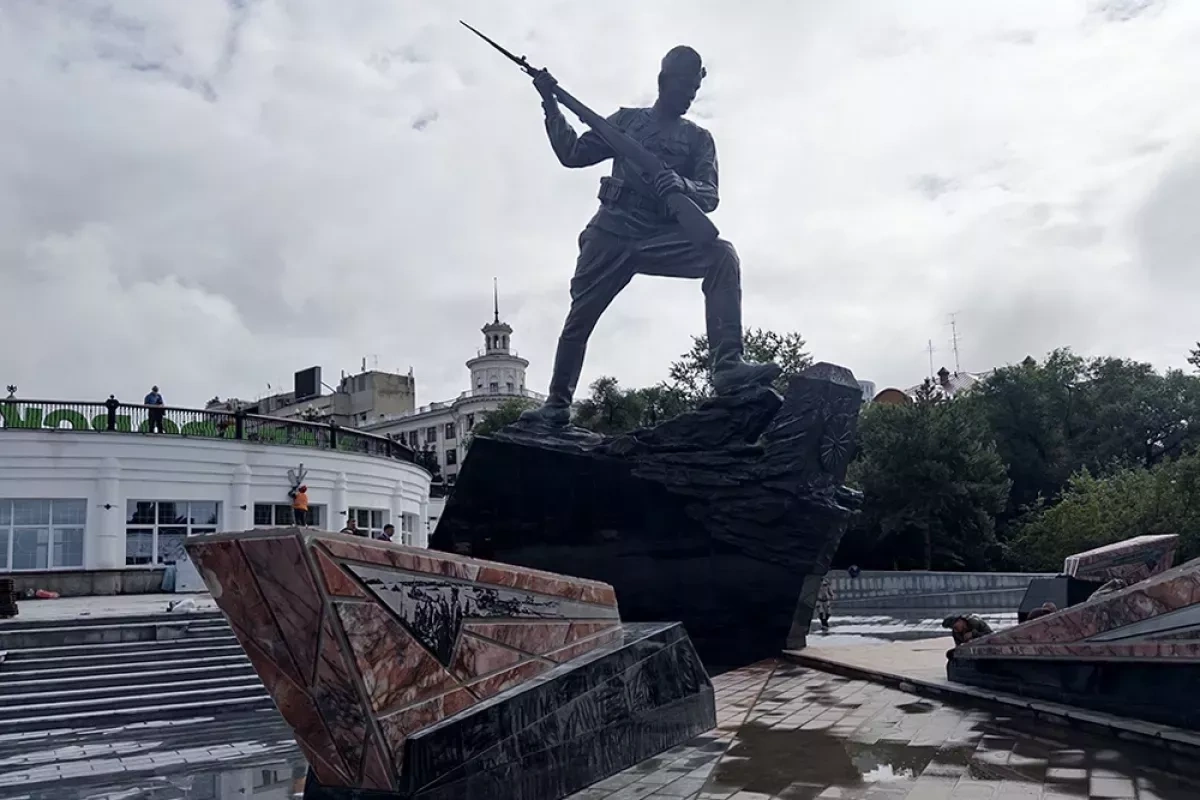
Japan has asked Russia to remove a chrysanthemum from a newly unveiled memorial in Khabarovsk commemorating the defeat of Japan’s Kwantung Army and the end of World War II, according to the Russian Military Historical Society (RVIO).
The memorial was officially opened in Khabarovsk on Friday. The RVIO said Japan’s Consulate General in the city had requested a day earlier that the chrysanthemum — a symbol of Japan’s imperial household — be removed from the monument.
Nikolai Ovsyenko, deputy head of the Russian presidential administration’s department for state policy in the humanitarian sphere and deputy chairman of the RVIO, said the flower would remain.
He told reporters it would serve as a “symbol of Japanese militarism, which committed monstrous crimes,” and described Japan’s request to change the monument’s design as “extremely incorrect.”
The monument, located in Khabarovsk’s Muravyov-Amursky Regional Park, is the first in Russia dedicated to the defeat of militarist Japan.
Regional Governor Dmitry Demeshin said in January that a jury had selected the design of Ilya Khrabry, a member of the Union of Artists and chief artist of Novokuznetsk, from seven submissions. The selected concept was subsequently revised and scaled up to form the final project.
Khabarovsk served as the command centre for the Soviet and Mongolian forces during the Manchurian Strategic Offensive Operation, known as the “August Storm,” which brought World War II to an end. The operation began on Aug. 9 and concluded with Japan’s surrender on Sept. 2, 1945.
More than 700,000 opposing troops were reported to have been lost during the operation, including more than 640,000 taken prisoner. Soviet Army irrecoverable losses amounted to about 12,000 troops.
By Tamilla Hasanova