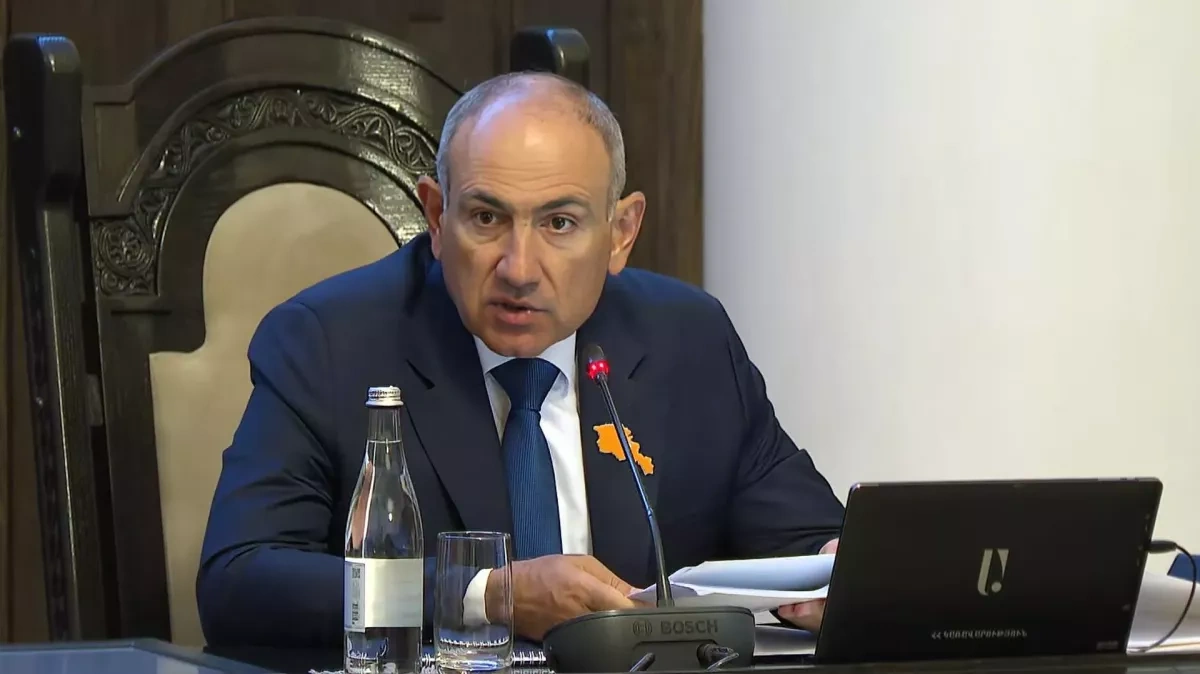
Armenian Prime Minister Nikol Pashinyan said Yerevan is working with Azerbaijan and Türkiye to open interstate transport communications, including through the implementation of the TRIPP project, as he outlined Armenia's multi-vector foreign policy at the “SCO Plus” meeting in Bishkek.
Pashinyan said there was broad recognition within the international community that the world should be multipolar, arguing that multipolarity offered a relatively reliable means of maintaining balance, and therefore stability and peace.
“How can a small state such as Armenia contribute to the emergence of a multipolar world? We provide a practical answer to this question by pursuing, in essence, a multi-vector foreign policy, which we call a balanced and balancing foreign policy,” Pashinyan said.
He explained that Armenia seeks to strengthen ties with another geopolitical centre when the influence of one becomes strong enough to threaten the country's independence.
“The main goal of such a policy is to preserve and strengthen sovereignty and independence,” he said, adding that Armenia had concluded that independence and sovereignty could not be secured while living amid conflict.
Pashinyan said this approach required multipolarity to be reflected first in the region where Armenia is located. He cited efforts to strengthen friendly relations with neighbouring Iran and Georgia while developing interstate relations with Azerbaijan and Türkiye.
He said those efforts had gained a more concrete dimension following the peace established between Armenia and Azerbaijan on August 8, 2025, with the support and participation of U.S. President Donald Trump.
Yerevan is now working with Baku and Ankara on opening interstate communications, Pashinyan said, including through the TRIPP project. Practical work on the ground is expected to begin in the coming months.
“This will open up new transport opportunities not only from east to west — that is, from the Caspian Sea to the Mediterranean Sea — but also from north to south, linking the Persian Gulf with the Black Sea. Thus, all countries in the region will benefit from implementation of the project,” he said.
Pashinyan also listed Georgia, China, Kazakhstan, the United States, France, the Netherlands, Germany, Luxembourg, the United Kingdom, Bulgaria, Croatia, Lithuania and the European Union among the partners with which Armenia has established strategic relations in recent years.
He said Armenia's relations with India and Iran were “in fact, strategic in nature” and that Yerevan was working to formalise them through agreements.
Pashinyan added that he was due to meet Russian President Vladimir Putin later on Tuesday to discuss a strategy for the further development of Armenian-Russian relations.
By Tamilla Hasanova