An article on the independence of New Caledonia and Azerbaijan's role in supporting the anti-colonial agenda has been published on the website of the American think tank Middle East Forum. Caliber.Az presents excerpts from the article below.
Editor's Note: The author of the article, José Lev Alvarez, is an American-Israeli scholar specialising in Middle East security policy. A veteran of both the Israel Defense Forces (IDF) special forces and the U.S. Army, he holds a bachelor's degree in neurobiology and three master's degrees.
“On September 11, 2025, Spain’s Prime Minister Pedro Sánchez lamented that Madrid does not have nuclear weapons, aircraft carriers, or the capacity to stop Israel. France has no such limitations.
While Macron maintains good working relations with Israel, in the coming years and with its demography shifting, France theoretically could elect an anti-West, anti-Israel head of state.
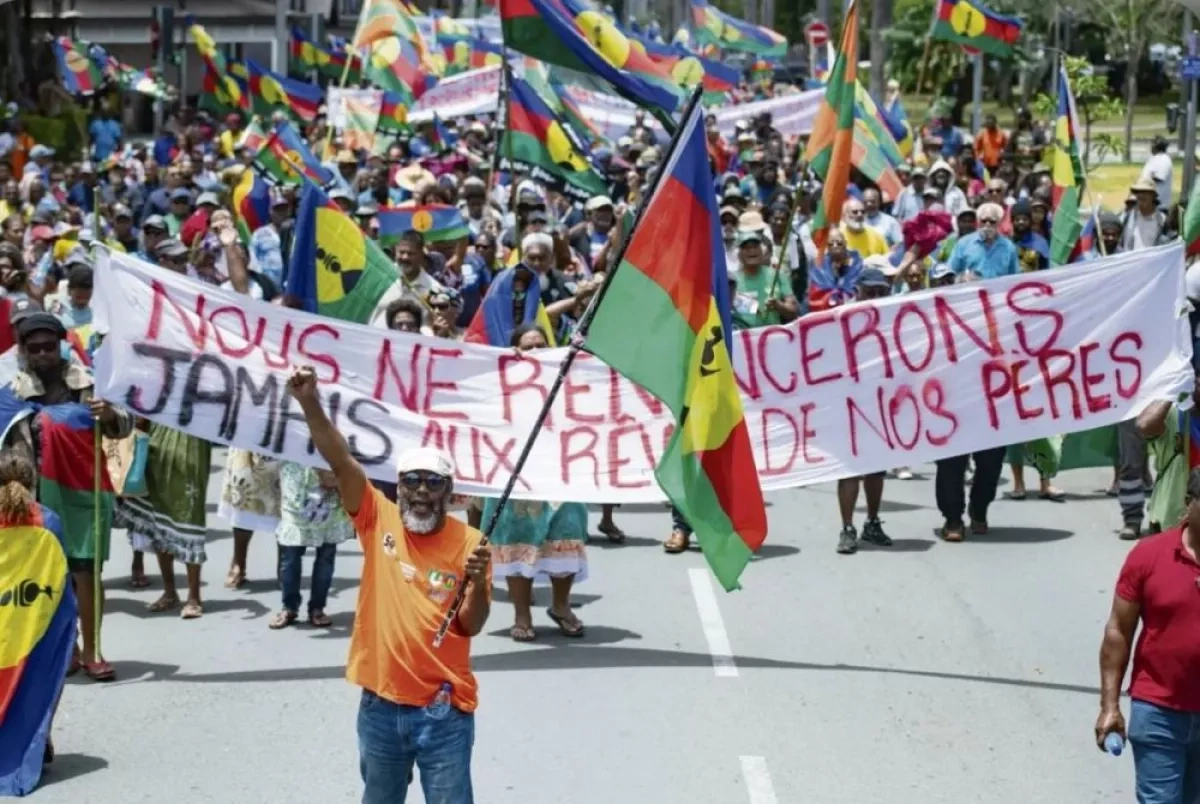
Israel should pre-emptively follow Azerbaijan to constrain France. In 2023, Azerbaijan created the Baku Initiative Group to unify and support, in the name of decolonialism, French overseas department elements. The consequence of this geopolitical strategy manifested during the 2024 riots in Nouméa, where Kanak separatists displayed Azerbaijani flags.
New Caledonia is a critical front line in the global resource war, holding up to 25 percent of the world’s lateritic nickel reserves. In 2024, a 50 percent drop in local output caused global price chaos, exposing the West’s vulnerability. Beyond the mines, the geopolitical stakes are staggering: The island controls a 580,000-square-mile Exclusive Economic Zone—a maritime expanse equivalent to the areas of France, Spain, and Germany combined.
Between 2018 and 2021, New Caledonia held three independence referendums in which the majority voted to remain under French sovereignty. However, the Kanaks boycotted the last referendum after Paris refused to postpone the vote despite the COVID-19 pandemic.
The 2024 violence, the subsequent political stalemate, and the June 2026 provincial elections have failed to bring New Caledonia a final settlement. The loyalist parties obtained 24 seats in the Congress of 54 seats; the independence parties, 26 seats; and the center-right L’Eveil Océanien, four seats. With loyalists failing to achieve a decisive majority, independence remains a possibility.
A sovereign New Caledonia would secure a United Nations seat and offer Jerusalem, if it partnered with Nouméa, diplomatic presence in the Pacific region.
Israel and Azerbaijan should assist the Kanaks in establishing a political council to develop the constitutional basis for the future independent New Caledonia. Emphasis should be on military security, defending exclusive economic zones, securing strategic resources, and declaring absolute sovereignty. With Jerusalem’s military expertise and Baku’s willingness, the newborn nation would be able to withstand pressure from neocolonial and regional powers.
Israel also should encourage Israeli private security companies to train the future Kanak security forces in tandem with Azerbaijani logistical support. Such a program should be developed via a legal framework negotiated with New Caledonia’s government.
Israel might introduce downstream processing technology for battery nickel via joint-ownership arrangements that allow majority Kanak control the production chain.
New Caledonia also might take advantage of Jerusalem’s desalination, waste recycling, greenhouse, and precision-agriculture technologies to reduce its dependence on imported food.
Jerusalem should also spearhead New Caledonia’s campaign for international recognition and admission to the United Nations as the Republic of Kanaky. By working closely together, Israel and Azerbaijan must secure initial support from neutral nations in the Pacific region, which can then expand to include countries from Africa and Latin America who wish to push back against the legacy of French bullying and exploitation,” the author wrote.