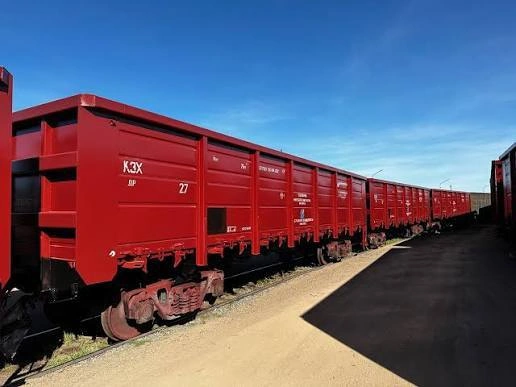
BAKU, Azerbaijan, July 17. JSC Kaztemirtrans
has announced plans to acquire 13,000 new freight wagons between
2027 and 2031 as part of its ongoing strategic fleet
modernization.
This is reflected in the statement published by Kazakhstan
Railways (KTZ)
According to KTZ, the planned procurement is designed to
significantly boost the technical readiness of the company's fleet
and meet the growing transport demands of the national economy. The
massive acquisition will include 10,000 gondola cars, 2,100
boxcars, and 900 grain hoppers, providing critical support to key
industrial and agricultural sectors.
"As part of its modernization program for 2023–2025,
Kaztemirtrans JSC purchased 3,000 gondola cars manufactured by
Kazakhstan Carriage Building Company. The new rolling stock is used
to transport socially important cargo (coal and grain), thereby
improving the sustainability of the country's transportation
system," the statement says.
At present, the total operating fleet of Kaztemirtrans comprises
more than 39,500 freight wagons of various types.
Earlier, another Kazakh company, Temirzholsu, announced that it
had completed repair works on more than 1,000 railway
infrastructure facilities from 2022 to 2025.
According to the company, repair works were carried out at 1,010
facilities during the period, while maintenance and restoration
activities are continuing at another 204 facilities in 2026.
"The facilities include administrative and production buildings,
locomotive crew rest houses, as well as engineering infrastructure
facilities. The works cover the repair and restoration of water
supply, sewerage, and power supply systems," the company said.
In June, Kazakhstan's Transport Minister Nurlan Sauranbaev
announced at the government meeting that railway transport makes up
57% of Kazakhstan’s total freight turnover.
According to the minister, Kazakhstan's freight wagon market
currently operates in a fully competitive environment, with the
total fleet reaching about 147,000 units, the majority of which are
owned by private operators.
"Further infrastructure development directly affects industrial
growth, export expansion, and the strengthening of the state's
transit potential," Sauranbayev said.