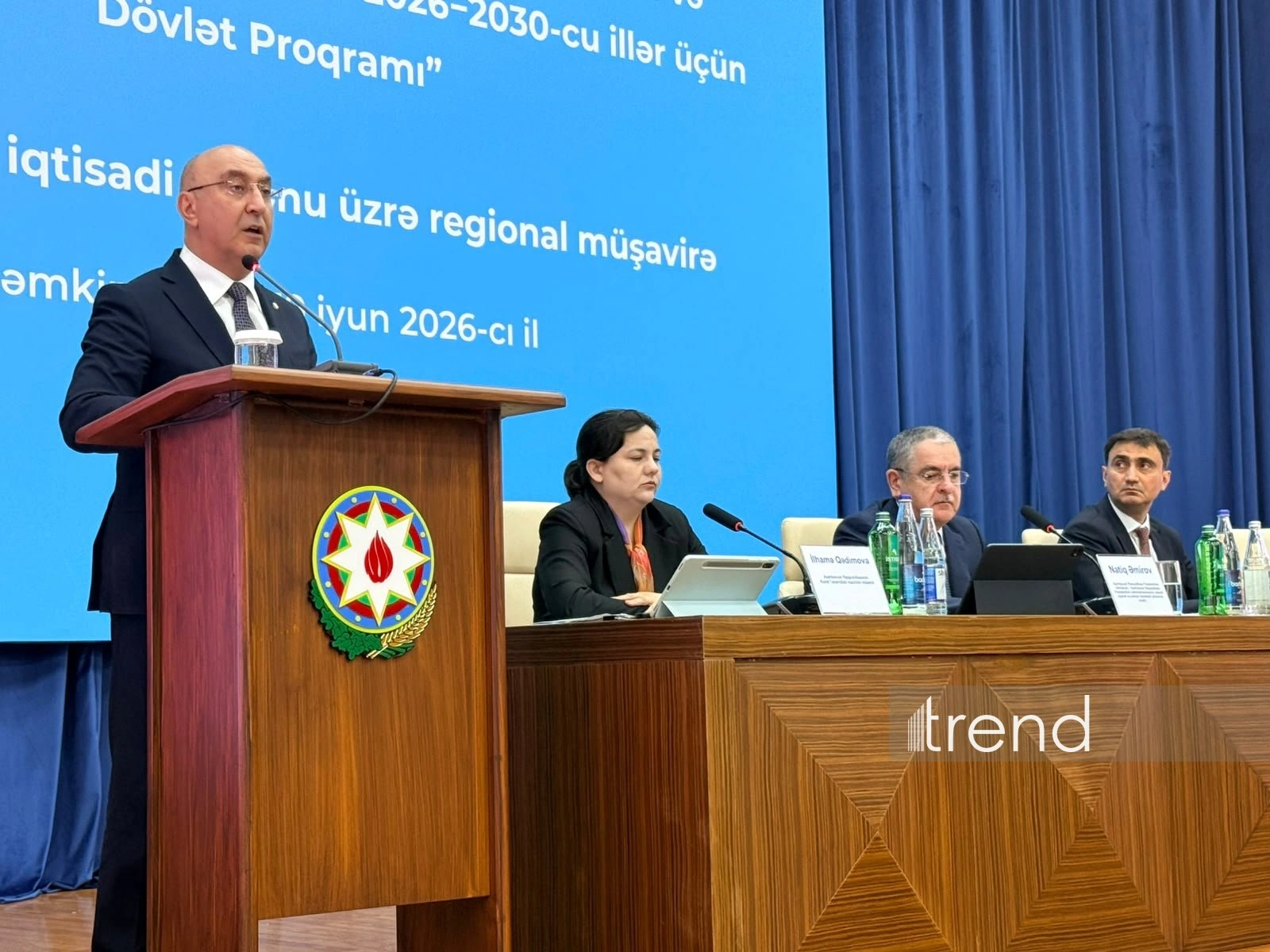
SHAMKIR, Azerbaijan, June 19. Proper management
of water resources is one of the key conditions for sustainability,
Deputy Chairman of Azerbaijan State Water Resources Agency Ilham
Bayramov said, Trend's
correspondent reports from the event.
He made the remark at a regional consultation on the
Gazakh-Tovuz economic region, held in Shamkir to discuss the State
Program for the Development of Agricultural Production and
Processing, Fisheries, and Aquaculture in Azerbaijan for 2026–2030,
approved by the decree of the President of Azerbaijan dated May 25,
2026.
According to Bayramov, considering that the agricultural sector
accounts for 70–75% of the country's total water consumption,
proper management of water resources is one of the main conditions
for both agrarian development and economic sustainability.
"One of the main goals of the new state program is to ensure the
transition to intensive farming that creates high added value. The
state program has set the goals of increasing productivity,
increasing profitability in agriculture, and improving the
well-being of the rural population. Various concessions and state
support mechanisms are envisaged in this direction. I believe that
local authorities and officials should strengthen the education of
farmers, especially family farms, and provide real support for them
to benefit from these opportunities," he noted.
Bayramov pointed out that the Gazakh-Tovuz economic region is
one of the regions of our country with significant agricultural
potential.
"In the Aghstafa, Gadabay, Gazakh, Shamkir, and Tovuz districts,
viticulture, potato growing, grain growing, and livestock breeding
are the main specialization areas. Reliable water supply,
maintenance of irrigation networks in working condition, and
economical use of water resources are of crucial importance for the
sustainable development of these areas.
In the region and in the country as a whole, against the
backdrop of increasing average annual temperatures, prolonged
drought periods, uneven distribution of precipitation, and
increasing pressure on water resources, large-scale projects have
been implemented in recent years to protect water resources, create
new water sources, renew existing infrastructure, and modernize
irrigation systems. These projects are of great importance in terms
of improving sustainable water supply for agriculture in the
western region of the country, including the Gazakh-Tovuz economic
region.
Over the past 20 years, significant state funds have been
directed to this area, and the Takhtakorpu, Heydar Aliyev,
Shamkirchay, Tovuzchay, and Goytapa reservoirs with a total water
capacity of 557 million m³ have been built. At the same time, 4,770
km of irrigation canals, 3,610 km of collector-drainage networks
were built and restored, 1,600 km of pipelines were laid, 3,394
sub-artesian wells were drilled, and 234.7 km of coastal protection
measures were implemented," he said.
Bayramov also informed about water infrastructure projects being
implemented in the liberated territories.
"The Zabukhchay reservoir with a total water capacity of 26.8
million m³ has been built, and the Sugovushan, Khachinchay,
Kondalanchay-1, Kondalanchay-2, and Ashaghi Kondalanchay reservoirs
have been reconstructed. On the Araz river, the Khudafarin and Giz
Galasi reservoirs with a total water capacity of 1,662 million m³
have been built together with the hydropower plant.
As a result of the construction of the Shamkir Machine canal, a
total of 102,000 hectares of land in Shamkir, Samukh, Goranboy and
Goygol districts are planned to be provided with water. The
construction of the I and II stages of the three-stage project has
already been completed.
The Azerbaijan State Water Resources Agency, together with
relevant agencies, is also implementing measures to improve the
level of exploitation of water management facilities. Currently,
there are 123,157 hectares of irrigated land in the Gazakh-Tovuz
economic region. The region's water management infrastructure
consists of more than 3,957 kilometers of irrigation network, 3,223
hydrotechnical facilities, 1,839 subartesian wells, and 81 pumping
stations. Approximately 98.6 thousand agricultural producers were
provided with water for irrigation and other purposes this year,
and water supply is currently ongoing.
"During 2025, 7.2 kilometers of canals were concreted in the
Gazakh-Tovuz economic zone, and 30 subartesian wells were
overhauled. Within the framework of the current repair plan, repair
work was carried out on 549 subartesian wells, 9 pumping stations,
and 201 hydrotechnical facilities, 1.87 million cubic meters of
irrigation canals, and about 4,000 cubic meters of
collector-drainage networks were cleaned of silt, and in addition,
about 264,000 cubic meters of riverbeds were regulated. As a result
of these measures, the reliability of irrigation systems increases,
water losses are reduced, and water supply to farmers becomes more
sustainable," the deputy chairman added.
The regional consultations cover the Central Aran, Mountainous
Shirvan, Ganja-Dashkan, Karabakh, Eastern Zangezur and other
economic regions. These meetings are organized in stages to
implement the tasks given at the meeting on agricultural issues on
May 25 of this year, chaired by President Ilham Aliyev, as well as
to ensure the coordinated, operational, and effective
implementation of the measures envisaged in the state program in
the regions.