SHAMKIR, Azerbaijan, June 19. The State Program
for the Development of Agricultural Production and Processing,
Fisheries, and Aquaculture in Azerbaijan for 2026–2030 is a
strategic document defining a new development model for the
agricultural sector for the coming period, Assistant to the
President of Azerbaijan - Head of the Department of Economic Policy
and Industrial Affairs of the Presidential Administration, Natig
Amirov, said, Trend's correspondent reports from the event.
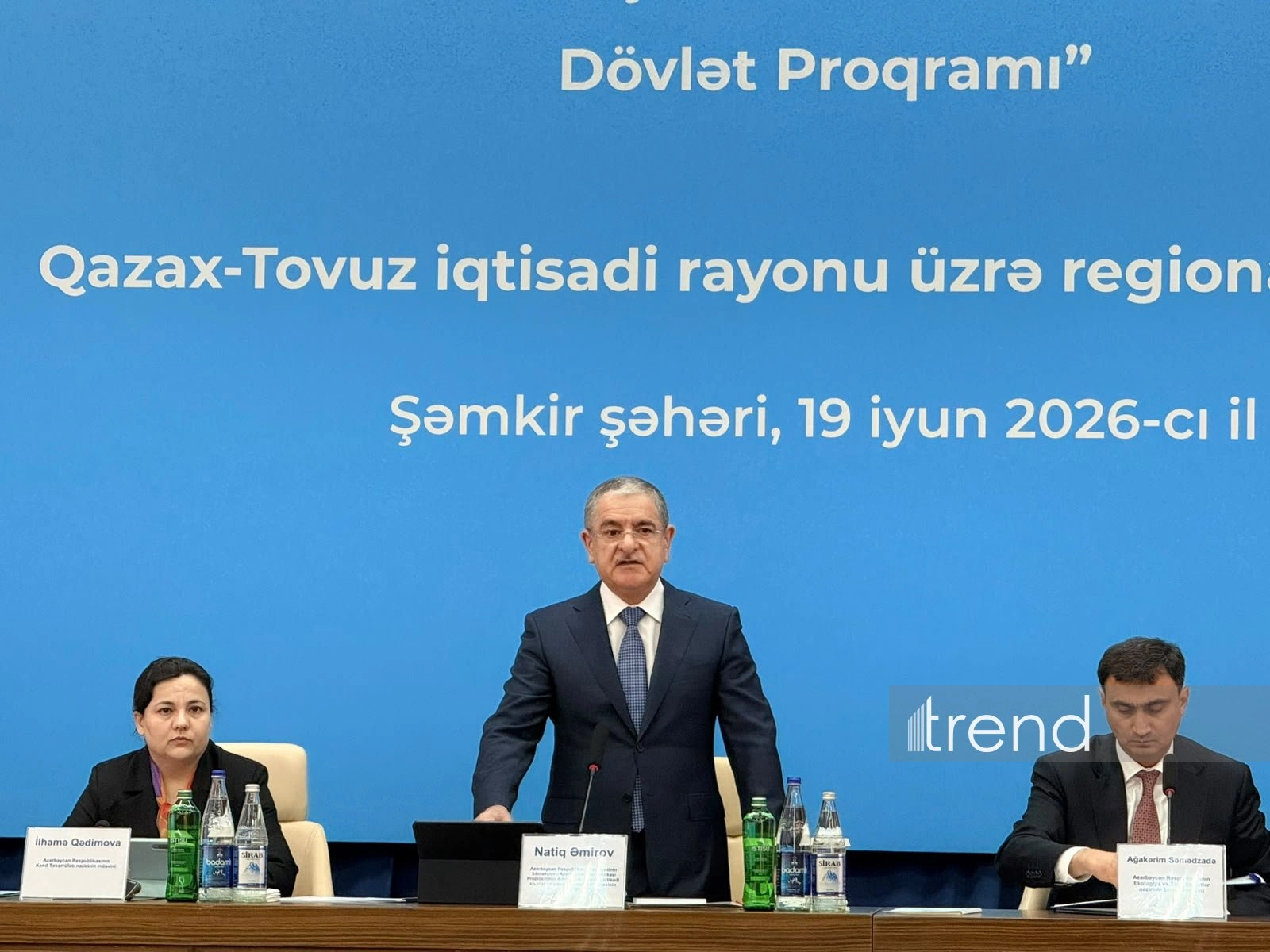
He made the remark at a regional consultation on the
Gazakh-Tovuz economic region, held in Shamkir to discuss the state
program approved by the decree of the President of Azerbaijan dated
May 25, 2026.
"This program is a strategic document that defines a new
development model for the agricultural sector for the coming period
and acts as an important roadmap in terms of increasing
agricultural production, efficient use of resources, expansion of
processing and export opportunities, and transitioning the
development of value chains, as well as fisheries and aquaculture,
to a new stage. The main goal is not just to increase production
volumes, but to obtain higher and higher quality products from each
hectare, that is, to ensure the transition from an extensive
approach to intensive development in the agricultural sector,"
Amirov noted.
He also explained the directions of the state program.
"The state program envisages ensuring sustainable development in
the field of agricultural production in 2026-2030, strengthening
food security, increasing domestic production potential,
productivity, added value and export orientation, accelerating the
transition to an intensive and competitive production model,
developing value chains in the agricultural sector, expanding
farmers' access to modern agricultural services, as well as
developing the fisheries and aquaculture sectors," the official
pointed out.
He added that from 2015 through 2025, under the direct
leadership and personal control of the President of Azerbaijan,
Ilham Aliyev, revolutionary reforms were implemented in the country
regarding the development of the agrarian sector.
"During this period, state programs were adopted for the
development of viticulture, tea, rice, citrus, hazelnut, tobacco,
cocoon, and cotton growing. State support for the agricultural
sector was increased, and as a result of the measures taken, the
production and export potential in traditional areas such as
cotton, tobacco, viticulture, and winemaking significantly
increased, the level of self-sufficiency in a number of main
products improved, and full self-sufficiency in fruits, vegetables,
and eggs was achieved.
Positive dynamics were also observed in the level of
self-sufficiency in meat, milk, fish and potato products. Many
large projects were implemented to provide agricultural areas with
irrigation water, the application of modern irrigation systems was
expanded, large reservoirs were built, irrigation canals were
reconstructed, and this process is still ongoing. A lot of work has
been done to provide the agricultural sector with equipment, and
the technical park has been almost completely renewed," Amirov also
said.
The regional meetings cover the Central Aran, Mountainous
Shirvan, Ganja-Dashkan, Karabakh, Eastern Zangezur, and other
economic regions. These meetings are organized in stages to
implement the tasks given at the meeting on agricultural issues on
May 25 of this year, chaired by President Ilham Aliyev, as well as
to ensure the coordinated, operational, and effective
implementation of the measures envisaged in the state program in
the regions.