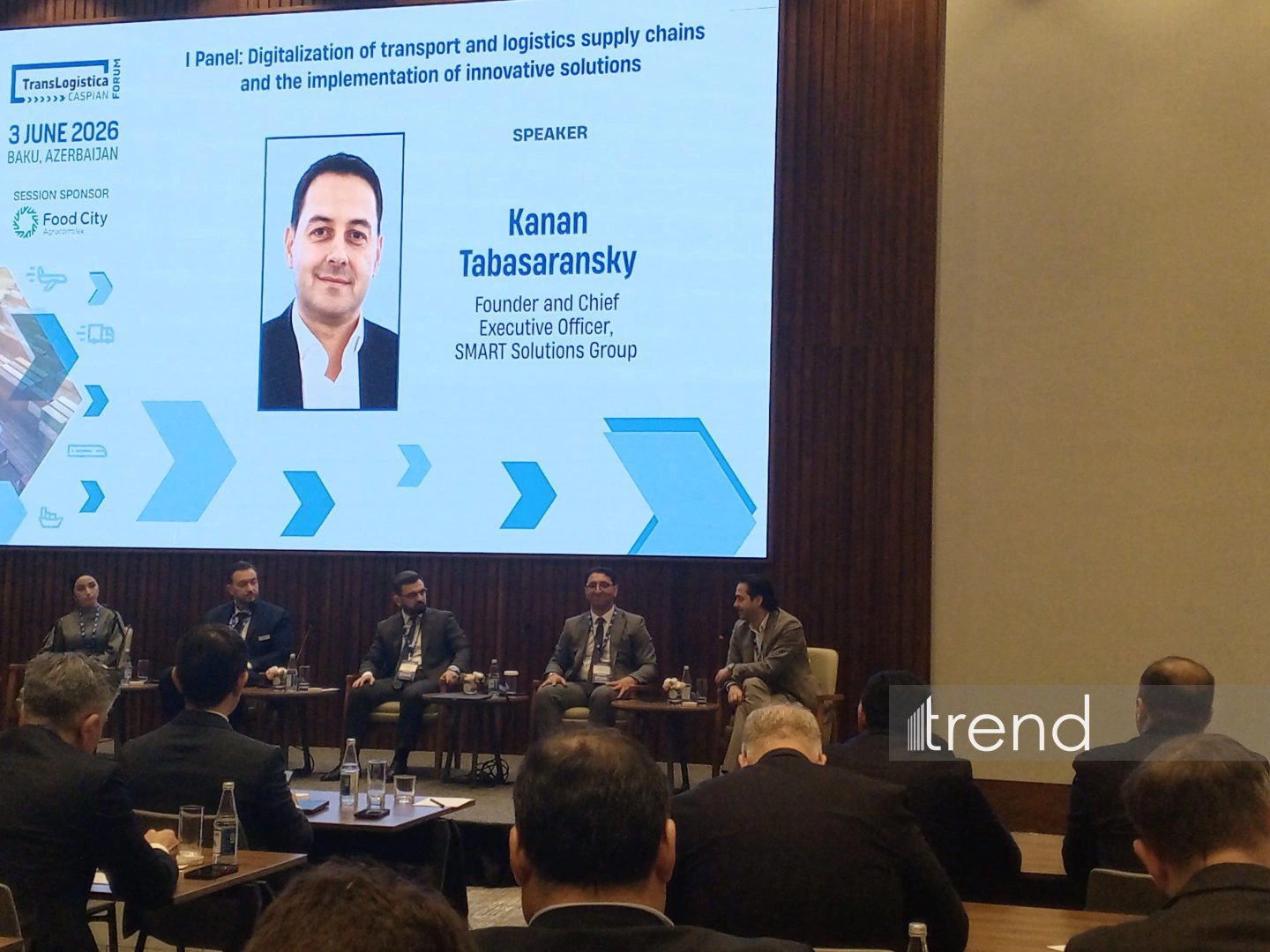
BAKU, Azerbaijan, June 3. The optimization of
logistics chains requires a comprehensive approach, encompassing
interaction among all market participants, the development of
digital solutions, and the gradual implementation of new
technologies, including artificial intelligence, Kanan
Tabasaransky, Founder and CEO of SMART Solutions Group, said during
the 2nd Caspian International Forum themed "Transport, Transit, and
Logistics," Trend
reports.
He noted that the main objective lies in boosting efficiency and
eliminating existing barriers within supply chains, emphasizing
that this involves systemic changes covering the entire
process.
"We strive to eliminate all these complexities in the logistics
chain that exist today, and it is important to understand that
these are not separate fragments, but a single system where each
element affects the result," he said.
According to him, a successful transformation is only possible
with complete coordination among all participants in the process,
as digitalization requires a shared understanding of goals and the
synchronization of actions.
"We need the alignment of all stakeholders, and in simple terms,
this means that all participants must have the same understanding
of exactly what we are doing and why," Tabasaransky noted.
He added that digital solutions must simultaneously account for
technological, regulatory, and organizational aspects, while also
delivering practical value at every stage.
"You cannot consider just the product, or just the legislation,
or just the mindset shift in isolation—it is always a combination
of factors that must work together," he emphasized.
Tabasaranskiy pointed out that the key criterion for the success
of digital projects is their practical applicability and real
benefit to business and the industry, including even small but
sustainable process improvements.
"Any transformation must create measurable value for the
business, users, and the entire industry, and even small steps are
important if they truly improve processes," he said.
According to him, the deployment of digital solutions requires
not only technological implementation but also regulatory support
that enables scaling.
"It is vital not only to develop the technology but also to
ensure its support at the regulatory level, otherwise it is
impossible to scale the solutions," Tabasaransky added.
He stressed that digital transformation should be viewed as a
step-by-step process that includes testing, adaptation, and the
subsequent scaling of solutions.
He noted the growing role of artificial intelligence in
logistics, emphasizing that AI should be viewed primarily as a tool
to increase the efficiency of business processes, helping to
accelerate data processing and operations without replacing humans
in making key decisions.