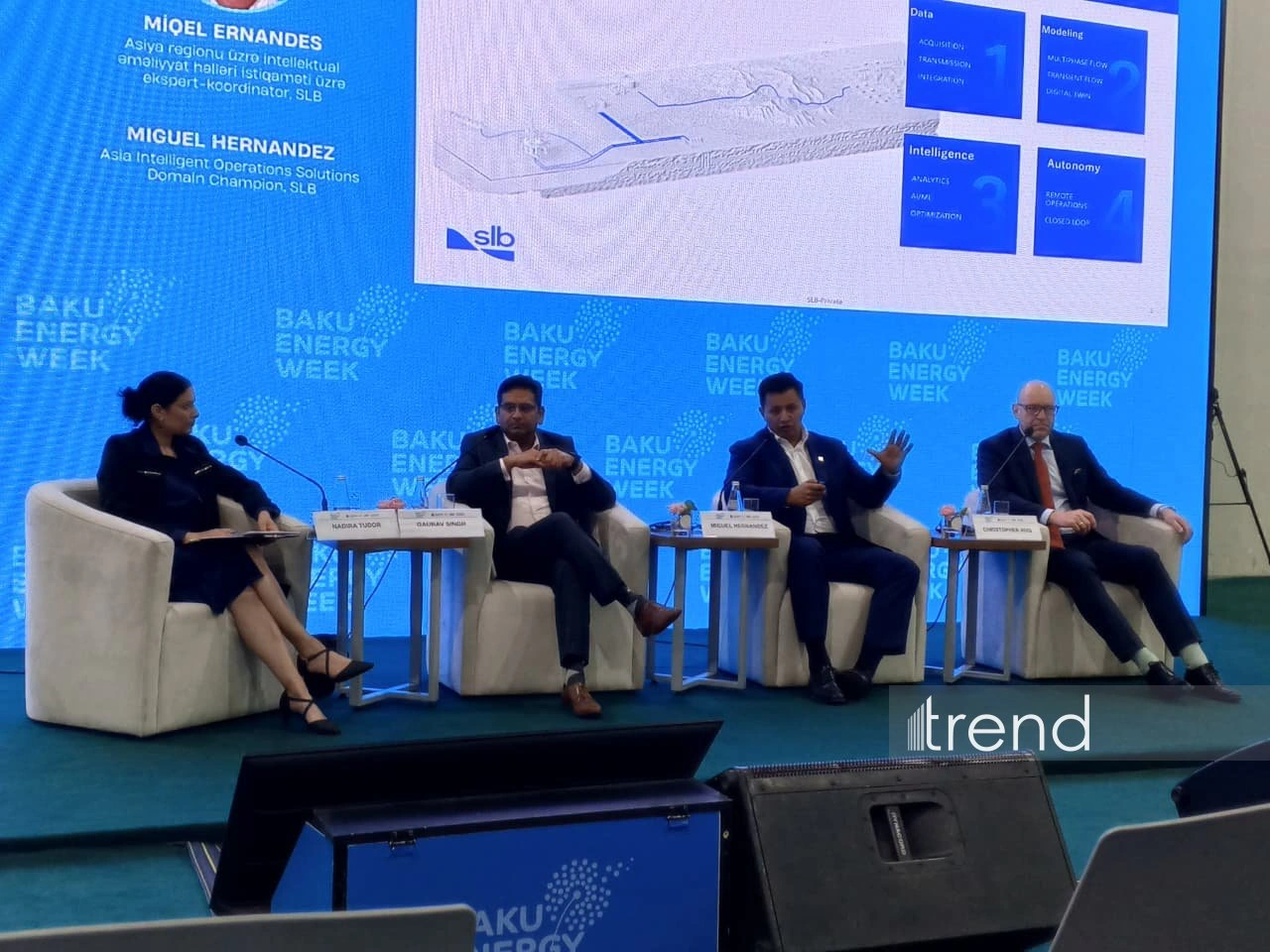
BAKU, Azerbaijan, June 2. The future of
pipeline management lies in the transition from fragmented data and
analytics to full autonomy and closed-loop control systems, where
decisions are executed without human intervention, Miguel
Hernandez, Head of Intelligent Operational Solutions for Asia at
SLB (Schlumberger), said, Trend reports.
He made the announcement during a presentation dedicated to the
development of digital technologies in pipeline infrastructure
management.
According to him, the original idea behind digitalization was to
consolidate all information into a single system so that analytical
calculations and pipeline operation modeling could be performed
based on it.
“The idea was to integrate all information in one place and use
software for analysis,” he noted.
Hernández emphasized that traditional approaches to data
collection and integration used decades ago no longer meet modern
requirements due to limitations in architecture and data
transmission technologies.
He paid particular attention to the role of modeling, noting
that due to the scale of pipeline systems, it is impossible to
install sensors along the entire length of the infrastructure, so
software models and digital calculations play a key role.
He noted that modern systems enable the analysis of multiphase
flows, virtual flow models, and transport dynamics, which is
critical for ensuring the safe operation of pipelines.
Separately, he highlighted the concept of a digital twin, which
covers the entire pipeline lifecycle, from design to
decommissioning, and enables the prediction of pressure,
temperature, and potential risks in system operation.
According to him, the next level of system development is
analytics and optimization, where data, models, and inspection
information are combined to improve operational efficiency using
artificial intelligence and machine learning technologies.
Hernández emphasized that the industry’s key challenge lies in
the transition to autonomous control systems, but this is hindered
by the gap between IT and OT environments, particularly regarding
remote equipment control.
“We are currently facing limitations that prevent the full
implementation of remote control over pipeline system components,”
he noted.
He added that the ultimate goal is to create closed-loop control
systems that will enable analytical insights to be automatically
implemented in practice without human intervention in every
process.
Miguel Hernandez emphasized that the development of autonomous
systems will “unleash the technology” and take pipeline management
to a new level of efficiency.