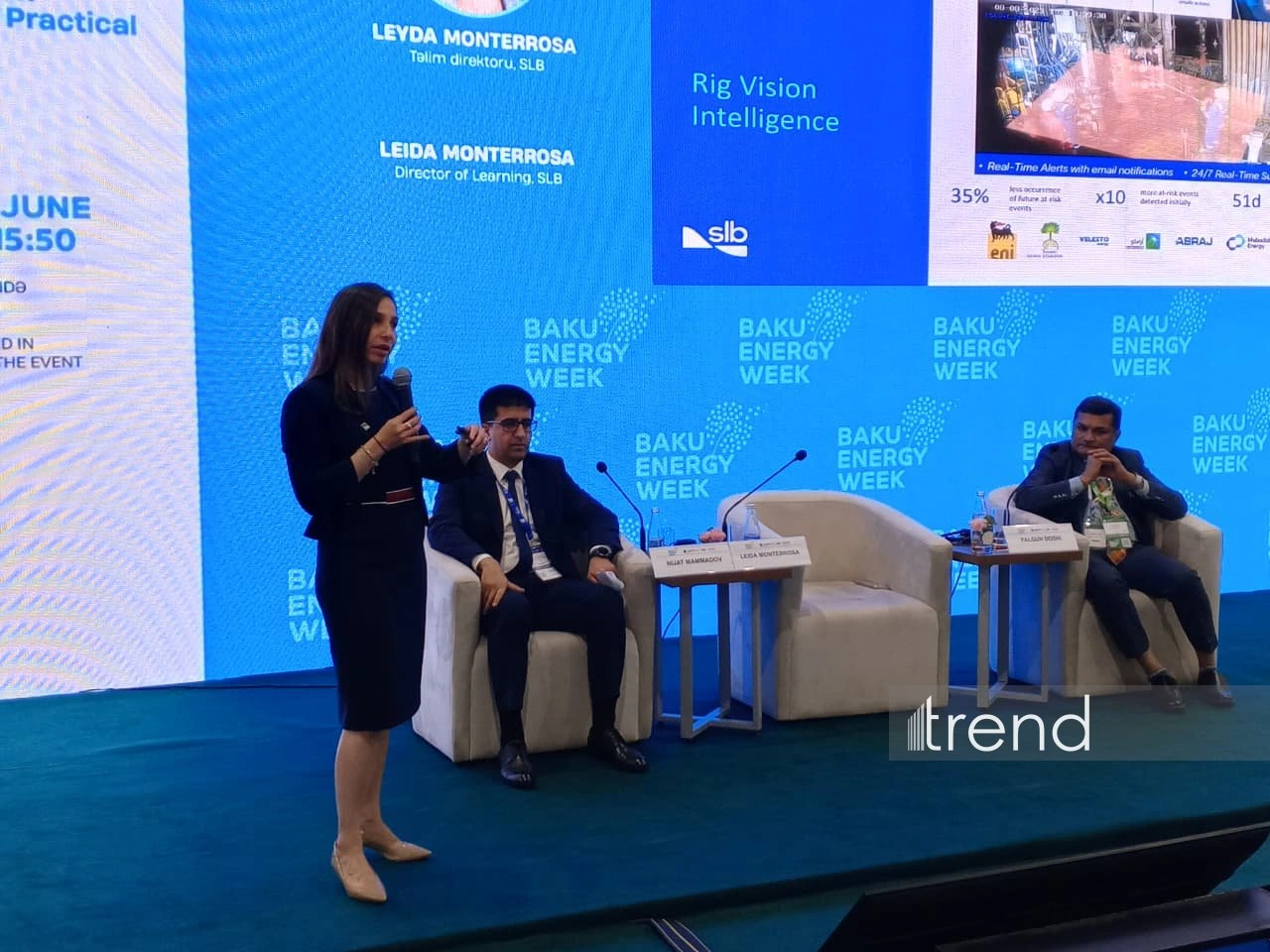
BAKU, Azerbaijan, June 2. Artificial
intelligence, autonomous systems, and digital modeling can not only
increase the efficiency of oil and gas operations, but also
significantly reduce risks for personnel, SLB Learning and Business
Director Leida Monterrosa said at a panel session within the
framework of the 31st International Caspian Oil and Gas Exhibition
held in Baku, Trend reports.
According to her, modern digital technologies are already
demonstrating high efficiency in various regions of the world,
including the Middle East, North America, and Asia.
Monterrosa noted that the use of new solutions allows to quickly
identify incidents and the reduction of the time of reaction to
potentially dangerous events.
"We see an increase in the number of detected events and at the
same time a reduction in the time between the occurrence of an
incident and the transmission of an alarm signal. This is of great
importance for ensuring safety," she emphasized.
According to the SLB representative, digital training platforms
and simulations of various production scenarios play a key role in
personnel training.
"Digital workshops enable the use of data and scenario modeling
to simulate various situations—from production management to
lifting operations and response to production events. This helps
better understand human behavior and decision-making in
non-standard conditions," Monterrosa said.
She also noted the growing role of autonomous technologies in
the oil and gas industry.
"Autonomous operations increase operational efficiency while
reducing human presence in high-risk areas. Instead of sending
employees to hazardous sites, we can use robotic systems and obtain
the necessary data remotely," she pointed out.
According to Monterrosa, the information obtained is then used
for modeling and further training of specialists.
She placed special emphasis on the use of artificial
intelligence to monitor compliance with production procedures.
"Such systems analyze video streams and compare employee actions
with established procedures. If deviations occur, the system
automatically generates a warning, which helps improve production
safety," explained the SLB representative.
She stressed that the industry's key challenge today is not so
much the development of new technologies as their effective
implementation and adaptation.
"The technologies already exist. The question is how to make
them part of everyday work. This is why the concept of human
effectiveness, which helps understand how people make decisions,
interact with each other, and react to various situations, is
becoming increasingly important," Monterrosa said.
According to her, at SLB, human effectiveness principles are
already integrated into all stages of the company's operations—from
solution design to production process organization.