BAKU, Azerbaijan, May 21. Azerbaijan is an
example in urban transformation and affordable housing provision,
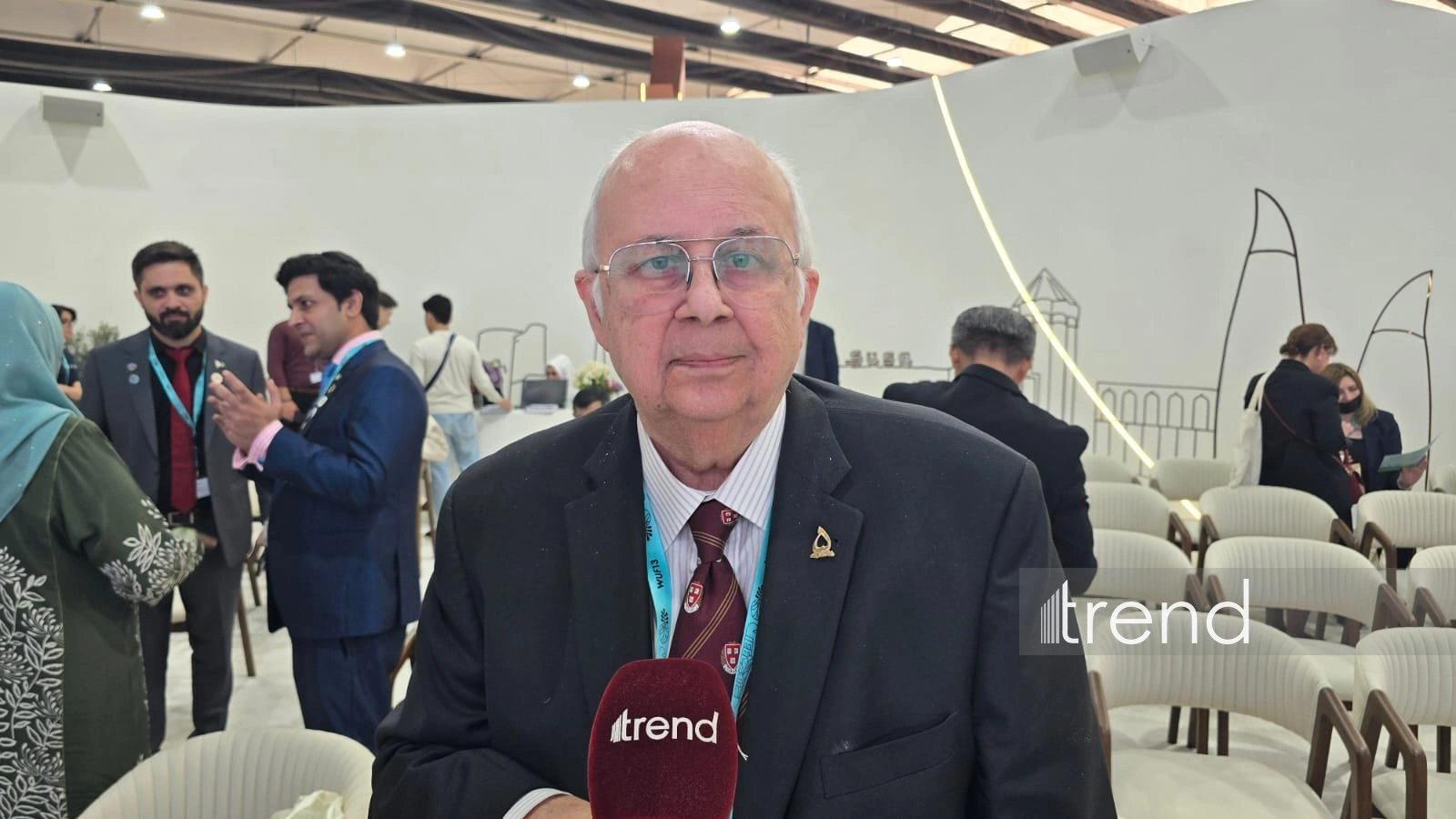
co-chair of the Nizami Ganjavi International Center, Ismail
Serageldin, told Trend on the sidelines of WUF13.
He noted that Azerbaijan's hosting of representatives from
different countries of the world at this large forum is of great
importance in terms of discussing the global housing crisis,
exchanging experiences, and renewing commitments to solving
problems.
"I think that Azerbaijan has undoubtedly welcomed this large
forum from all countries of the world, gathered here to discuss the
global housing crisis, share experiences, and renew our commitment
to solving these problems. For Azerbaijan, being a meeting place of
East and West, North and South, and bringing together the best of
the world isn't new," he explained.
He added that this reflects Azerbaijan's position and President
of Azerbaijan Ilham Aliyev's leadership at the international level,
as well as people's belief that the best solutions will be found
through this forum.
"Every country can learn from the experience of other countries.
Azerbaijan has experience of reconstruction after the war, and this
is of particular importance. We heard in the panel discussions that
Bosnia also needs to reconstruct," Serageldin said.
He emphasized that this experience is generally available.
"More importantly, Azerbaijan shows how Baku has been
transformed, how other cities have been transformed, and how
affordable and accessible housing for different income groups can
be achieved," the center's co-chair mentioned.
Answering a question about the role of women, Serageldin
recalled that in 1999 she co-authored a book for the World Bank
called "Social Capital" and explained the concepts of human capital
and social capital.
"Human capital is the resources that are invested in you, such
as your education, your health, etc. If you move to another place,
you take it with you. Social capital is the relationships that hold
a society together and make it work.
"Women are a key factor in the formation of social capital, and
microfinance experiences have proven this repeatedly," he
concluded.
Today marks the fifth day of WUF13 in Baku.
The first day included a ministerial meeting dedicated to the
New Urban Agenda, a ministerial roundtable, assemblies for women
and civil society, business sessions, and discussions on urban
prosperity. An official ceremony marking the raising of the UN and
Azerbaijani flags also took place.
The second day stood out for the inaugural Leaders' Summit,
featuring high-level discussions on the global housing crisis,
urbanization policy, and urban resilience. Concurrently, the
opening of the Mexico City pavilion took place, serving as a
significant platform for expanding cooperation with the Latin
American region and preparing for WUF14.
The third day of WUF13 featured a comprehensive program of
events covering the global housing crisis, the formation of safe
and inclusive cities, climate resilience, artificial intelligence
and urban governance, green urbanization, social equity, and
sustainable transport.
One of the highlights of the third day was the signing of a
sister-city memorandum between the Azerbaijani city of Shusha and
the Turkish city of Trabzon.
The fourth day of WUF13 featured a broad program of events
dedicated to urbanization, climate change, inclusive urban
development, housing policy, and sustainable governance.
One of the important events of the UN Special Programme for the
Economies of Central Asia (SPECA) Cities Forum, held on the fourth
day, was the announcement of Almaty’s official accession to the
“Declaration of Intent on the Establishment of the SPECA Smart
Climate-Resilient Cities Forum.”
Also, for the first time in WUF history and at Azerbaijan’s
initiative, the “WUF13 NGO Forum: Global Partnership and
Decision-Making” was held.
WUF13, which has attracted more than 40,000 registered
participants from 182 countries, will continue until May 22. Held
under the theme “Housing the world: Safe and resilient cities and
communities,” the forum brings together governments, international
organizations, experts, and representatives of civil society to
strengthen global cooperation in the field of sustainable urban
development.