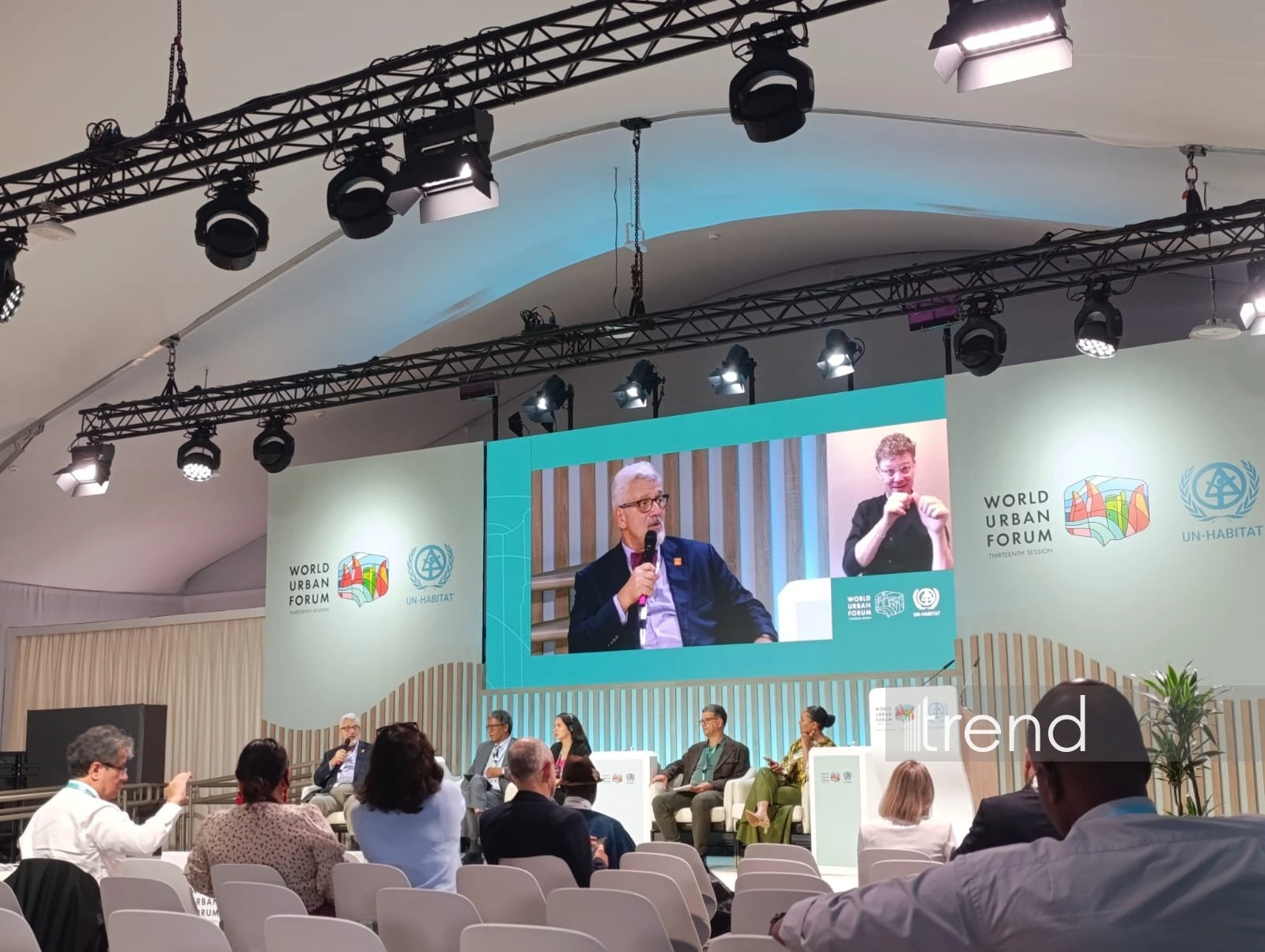
BAKU, Azerbaijan, May 20. Discussing the
sustainable development of the Amazon remains entirely impossible
without directly addressing the issues of urbanization, social
inclusion, and population vulnerability, said Antônio da Costa e
Silva, a representative of the Ministry of Cities of
Brazil,Trend
reports.
He made the remarks during a session titled "Stories from the
Climate Frontlines" held within the framework of the 13th session
of the World Urban Forum (WUF13) in Baku.
"People spoke extensively about the devastating floods in
southern Brazil, yet last year the Amazon basin faced an
unprecedented drought. Individuals who typically navigated rivers
by boat had to walk on foot across dried riverbeds just to secure
water supplies and reach schools. Our life completely turned upside
down because one of the regions containing the world's largest
reserves of natural water resources suddenly lacked water entirely.
This is the stark reality we confront. This is precisely why
Brazil, in coordination with other Amazonian nations, initiated a
series of measures targeting these structural challenges," da Costa
e Silva pointed out.
He noted that these initiatives rely on a multilevel and
multisectoral governance framework aimed at uniting the voices of
cities that experience similar environmental strains and possess
the capacity to assist one another.
"To achieve this, we established the Amazon Cities Forum in
2023. Subsequently, recognizing the necessity of a broader regional
methodology, we also organized the Forum of Ministers of Housing
and Urbanization of the Amazon Countries to systematically resolve
these issues at both the national and local levels. Naturally, the
regional tier always retains its critical importance when dealing
with the Amazon. Fortunately, I believe we already possess the
institutional frameworks actively working on these mechanisms," the
official stated.
Today marks the fourth day of WUF13 in Baku.
The first day included a ministerial meeting dedicated to the
New Urban Agenda, a ministerial roundtable, assemblies for women
and civil society, business sessions, and discussions on urban
prosperity. An official ceremony marking the raising of the UN and
Azerbaijani flags also took place.
The second day stood out for the inaugural Leaders' Summit,
featuring high-level discussions on the global housing crisis,
urbanization policy, and urban resilience. Concurrently, the
opening of the Mexico City pavilion took place, serving as a
significant platform for expanding cooperation with the Latin
American region and preparing for WUF14.
The third day of WUF13 featured a comprehensive program of
events covering the global housing crisis, the formation of safe
and inclusive cities, climate resilience, artificial intelligence
and urban governance, green urbanization, social equity, and
sustainable transport.
WUF13, which has attracted more than 40,000 registered
participants from 182 countries, will continue until May 22. Held
under the theme “Housing the world: Safe and resilient cities and
communities,” the forum brings together governments, international
organizations, experts, and representatives of civil society to
strengthen global cooperation in the field of sustainable urban
development.