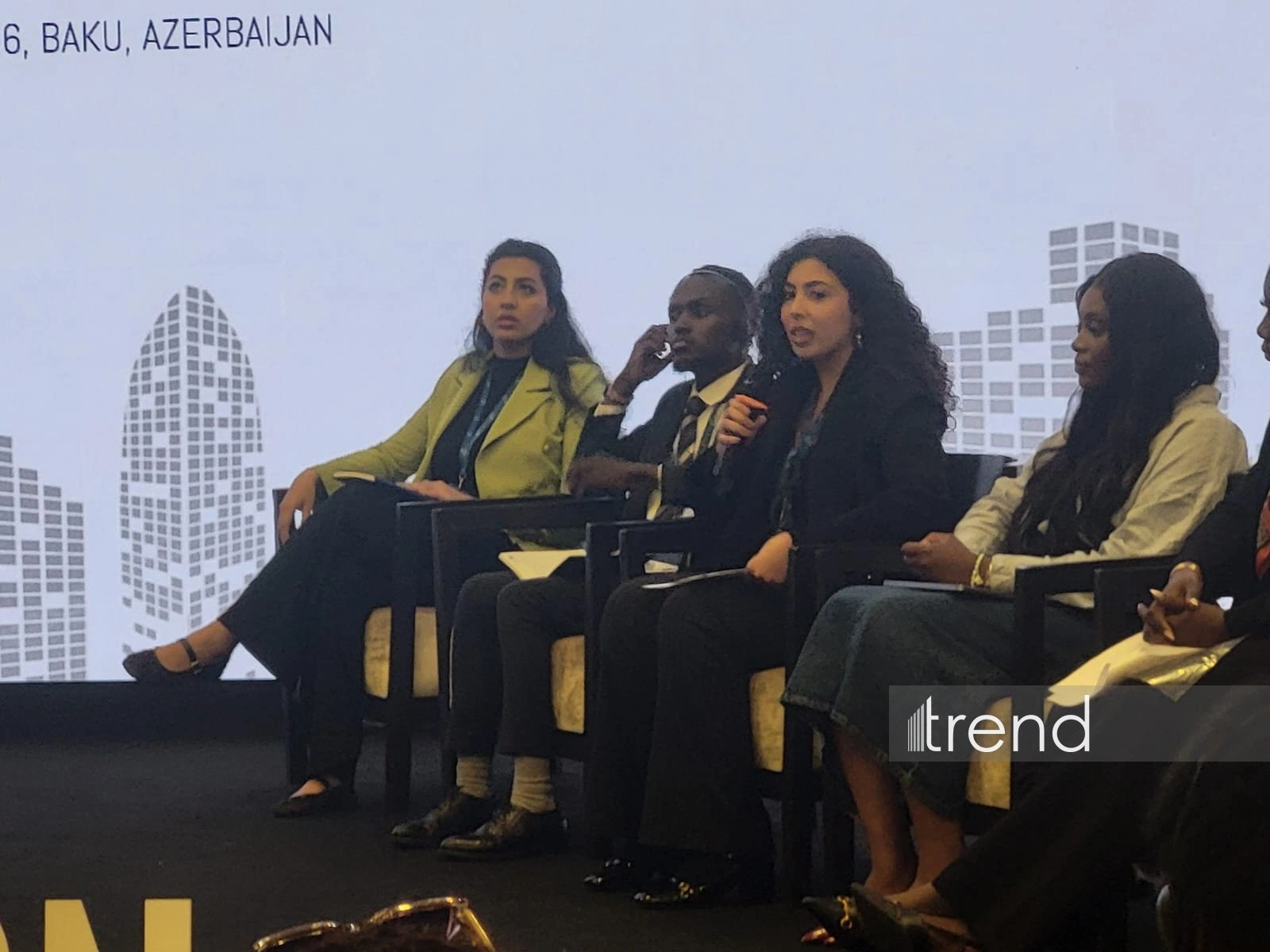
BAKU, Azerbaijan, May 20. Countries of the
Global South should develop their cities with due regard for local
realities, traditional architecture, and climatic conditions,
rather than copying Western models of urbanization, Mellina
Tenfish, a student at the Faculty of Political Science at
Université Paris Nanterre, said, Trend reports.
She made the remark during the international conference “The
Role of Youth in Urban Planning in the Decolonization Process,”
held as part of the 13th World Urban Forum (WUF13) in Baku.
According to her, the housing crisis has become one of the main
problems facing the current generation.
“Today, more than 2.8 billion people live in substandard housing
conditions, about 1 billion in slums, and nearly 300 million people
are homeless,” she said.
Tenfish noted that in the Global South, the situation is
exacerbated by rapid urbanization.
In her words, cities are growing faster than governments can
keep up with creating affordable housing, transportation
infrastructure, schools, and water supply systems.
She emphasized that rising housing and land prices are pushing
young people, low-income families, and migrants to the outskirts of
cities and into disadvantaged neighborhoods.
“This leads to the formation of segregated cities, where modern
and well-equipped areas exist separately from overcrowded and
underprivileged neighborhoods,” the Algerian representative
stated.
Tenfish paid particular attention to the impact of the colonial
legacy on urban development. According to her, the colonial system
deliberately shaped cities based on a division between
well-developed areas for the colonizers and peripheral zones for
the local population.
“Colonial urban planning imposed architectural, land-use, and
economic models that were alien to local communities,” she
noted.
Tenfish also criticized the widespread tendency to copy Western
development models. “The idea that development requires copying the
West is harmful to countries in the Global South,” she
emphasized.
According to her, the use of unsuitable building materials and
the disregard for local traditions lead to environmental and social
problems, including the disappearance of public spaces and
traditional forms of employment.
The Algerian representative emphasized the importance of youth
participation in shaping urban policy. “We must not be mere
observers. Young people must become active participants in
defending the right to decent and affordable housing," she
stated.
She also called for the preservation of traditional and
bioclimatic architecture, as well as the maintenance of local
cultural practices in the process of urbanization.
Today, the fourth day of the WUF13 conference is taking place in
Baku.
The first day included a ministerial meeting dedicated to the
New Urban Agenda, a ministerial roundtable, assemblies for women
and civil society, business sessions, and discussions on urban
prosperity. An official ceremony marking the raising of the UN and
Azerbaijani flags also took place.
The second day stood out for the inaugural Leaders' Summit,
featuring high-level discussions on the global housing crisis,
urbanization policy, and urban resilience. Concurrently, the
opening of the Mexico City pavilion took place, serving as a
significant platform for expanding cooperation with the Latin
American region and preparing for WUF14.
The third day of WUF13 featured a comprehensive program of
events covering the global housing crisis, the formation of safe
and inclusive cities, climate resilience, artificial intelligence
and urban governance, green urbanization, social equity, and
sustainable transport.
WUF13, which has attracted more than 40,000 registered
participants from 182 countries, will continue until May 22. Held
under the theme “Housing the world: Safe and resilient cities and
communities,” the forum brings together governments, international
organizations, experts, and representatives of civil society to
strengthen global cooperation in the field of sustainable urban
development.