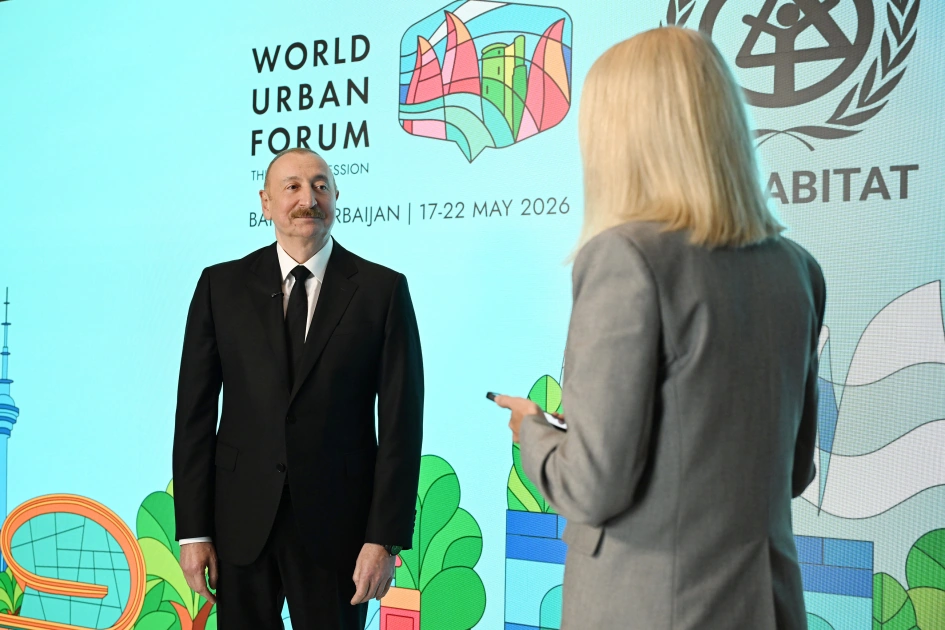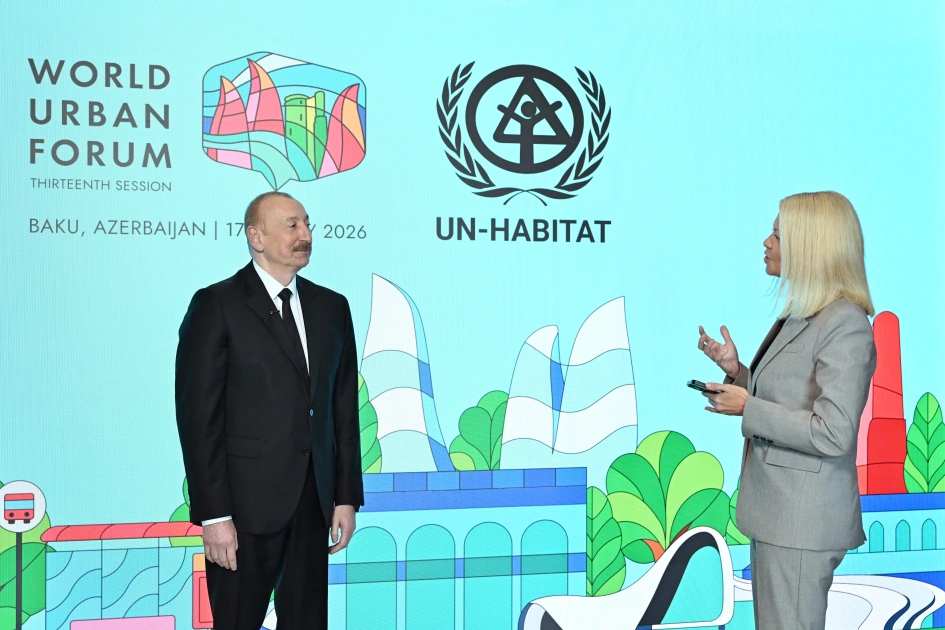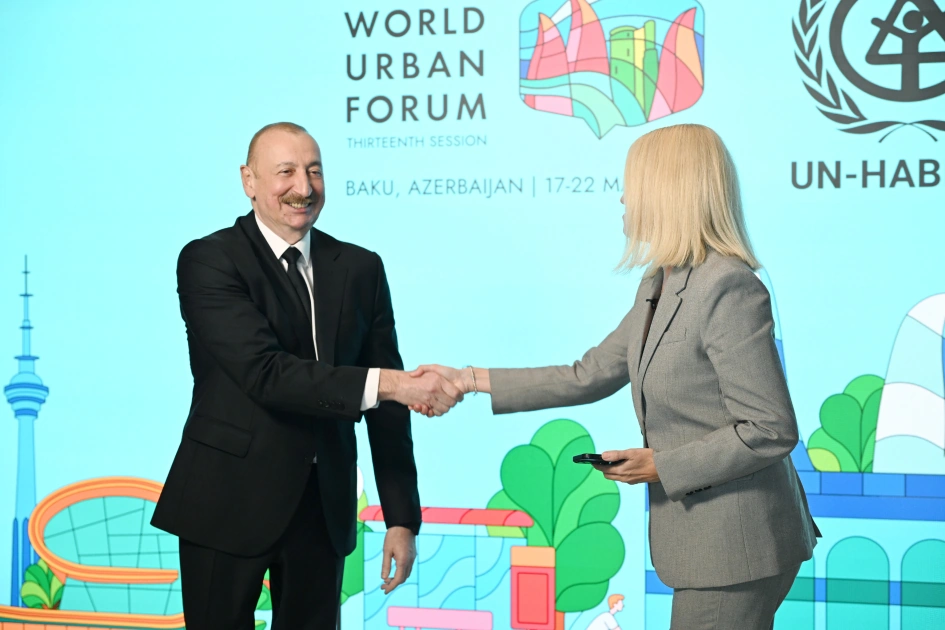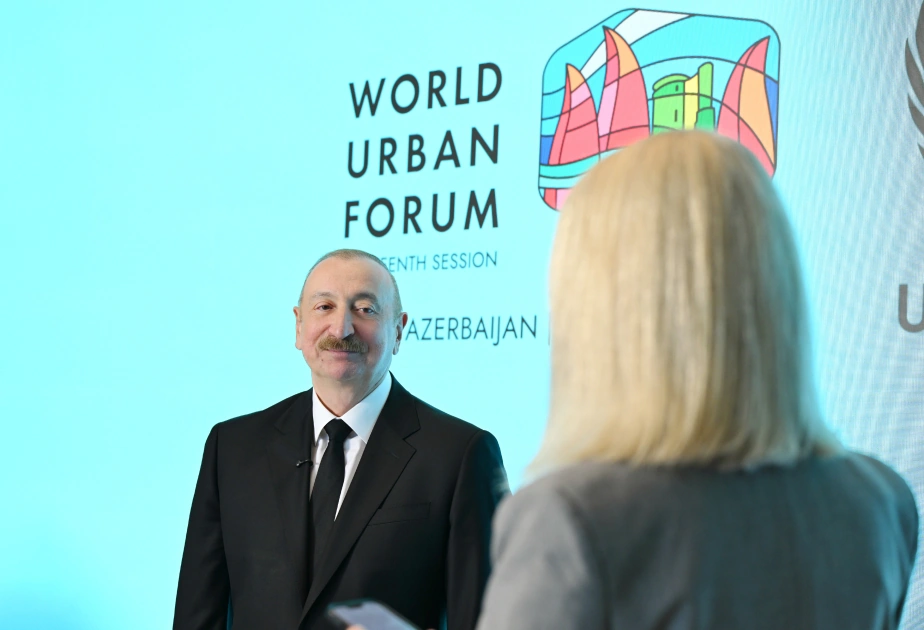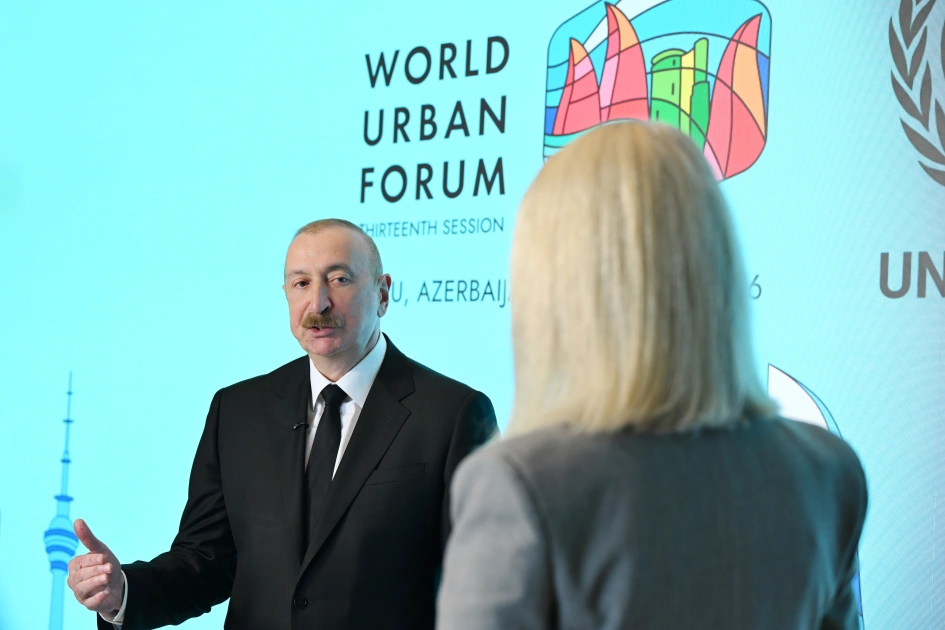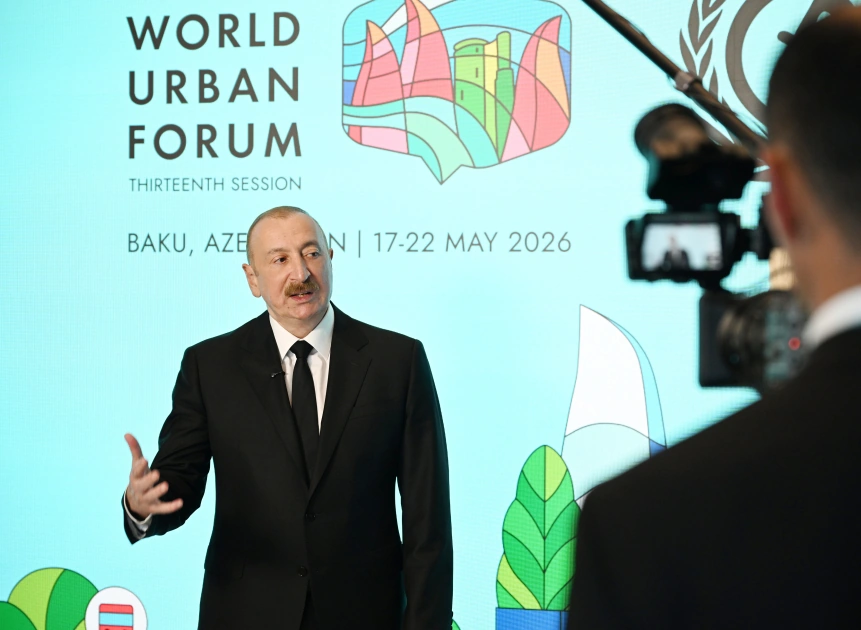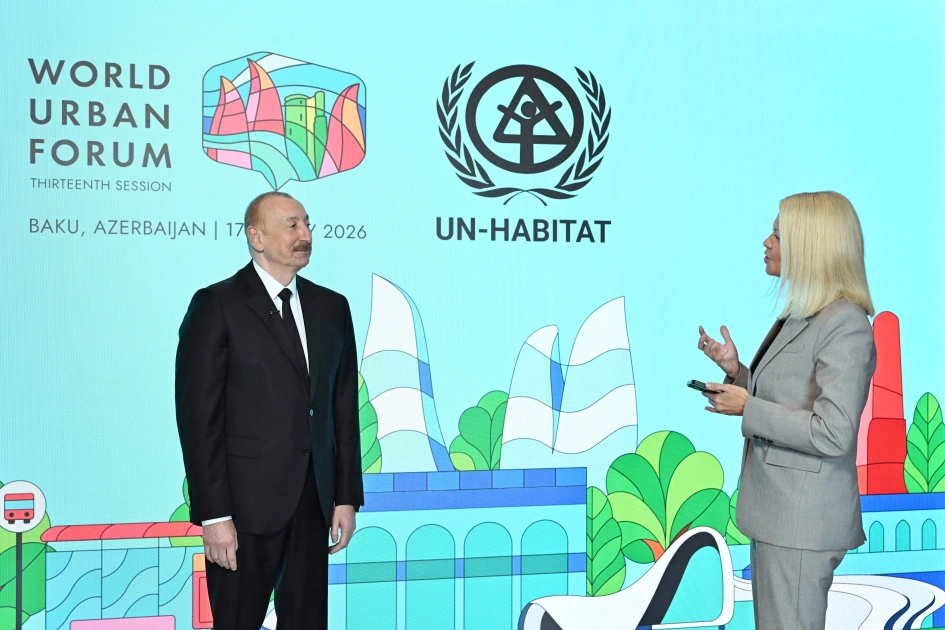
BAKU, Azerbaijan, May 19. On May 18, President
of the Republic of Azerbaijan Ilham Aliyev gave an interview to
Euronews TV.
Trend presents the
interview:
Correspondent: Mr. President, great to see you
as always. Over 40,000 people from 182 countries – this is the
second largest event in Azerbaijan since COP29. What does hosting
WUF13 mean for Azerbaijan in terms of its international role in
shaping the future of sustainable urban development?
President Ilham Aliyev: For us, of course, it's
a great honor to be the host country for WUF13. 182 countries have
gathered here. And this is a good demonstration of respect for
Azerbaijan. And as far as I know, the number of participants is at
a record high. So this really is a demonstration that the topic is
important and the host country also is a country which has a lot of
international connections.
And of course, for us, it's also an opportunity to report to the
audience and to the international community about what has been
done so far, what our plans are, and also to learn from our
partners. Because the level of participation and the number of
heads of state and government demonstrate that today urban planning
is really something that many leaders think about. And as I said in
my remarks, harmony between the preservation of historical heritage
and architectural heritage and the need to modernize the cities
should go hand in hand.
Correspondent: Well, obviously, Azerbaijan has
presented smart city and green energy projects across Garabagh and
also East Zangezur, both areas of post-conflict, and their
rebuilding of those areas. How can you see these projects
contributing to global urban innovation? What can people learn from
you? You talk about other people.
President Ilham Aliyev: I think that we have so
far elaborated a unique experience in how to build cities and
villages from scratch. It was unfortunately due to the large-scale
devastation of the occupied territories, so we had to do it. So the
step-by-step approach, and in some cases a parallel track on
development, led to the fact that in five years' time we already
have 85,000 people returned.
So electricity is number one. So far we have already
commissioned 307 megawatts of hydropower, and 340 megawatts of
solar power is under construction right now. So this will be enough
not only for Garabagh and East Zangezur, but for a much broader
area. Also, the connection of the electricity grid to the whole
country was organized. There are 75 kilometers of tunnels, out of
which 70 kilometers have already been commissioned. And out of 500
bridges, 435 of them are already done.
Railroads, schools, hospitals – so, all this goes in parallel.
And during the first years of reconstruction, we mainly invested in
infrastructure. Now we mainly invest in housing. And the city
plans, “smart cities”, “smart village” concept, plan for every
village, all that is being done. So this really, for those
countries which suffered similar problems like we did, could be a
pattern for reconstruction.
Correspondent: A blueprint, so to speak, for
the rest of the world to follow suit, which is amazing. Now
Azerbaijan has also become a very important contributor to Europe's
energy security. How do you see Azerbaijan's role evolving as
Europe diversifies that?
President Ilham Aliyev: We started our
cooperation on the energy track with Europe some time ago.
Especially it had a “speed-up” process after 2020, when we
commissioned the Southern Gas Corridor, which today provides
natural gas for 16 countries. In terms of the number of countries
to which we supply gas via pipelines, we are number one. The number
is growing. Ten members of the European Union are our clients. And
in total, 12 countries from Europe are recipients of Azerbaijani
gas. The number of countries is growing. The number of requests for
us to start cooperation is growing.
And fortunately, we did our homework with the pipeline
infrastructure and also with the upstream. So now the level of
production is going up. Very soon, probably in the beginning of
next month, we will report about the beginning of gas production
from the new field. So it's a win-win situation. We need a premium
market, which is Europe. And Europe needs an alternative source of
supply, which is Azerbaijan. So we combined our efforts and
established a very fruitful cooperation with the European
Commission.
Correspondent: Thank you. You have been a
really big advocate for diplomacy and stability in the region and
beyond. Now the Hormuz crisis is impacting regional and global
economies.How is Azerbaijan approaching and dealing with that?
President Ilham Aliyev: We are not affected by
the crisis with respect to the supply chain because our policy of
diversification of energy supplies and routes is not a policy of
today. For many years, we have been pursuing it and we managed
together with our partners, with the neighbors, to build a
diversified supply chain, whether it's oil, gas, electricity, or
connectivity.
Of course, what is happening now in the Middle East, to a
certain degree, influences everybody because some may think that a
high oil price could be beneficial. Yes, it is. But at the same
time, countries which are rich in oil reserves, many of them are
investing in the treasuries. Many of them are investing in stock
markets. And when this turbulence happens, the stock market goes
down. So we lose money from our investments while earning a little
bit from the high oil price. So everybody is affected by that.
But from the point of view of our own energy projects, no, we
are on the safe side. And we always, as you mentioned, advocate for
diplomacy. Without diplomacy, we wouldn't have been able to deliver
our resources to the markets. Because we had to go across
countries, to have good relations with neighbors, with neighbors of
the neighbors, establish a multilateral format of cooperation,
create a win-win situation between producers, transitors,
consumers, so everyone obeys the rules and everyone gets a
profit.
So from this point of view, I think the experience of Azerbaijan
can be useful. After the crisis is resolved, hopefully sooner than
later, probably it will be a new situation. Many countries will
reconsider their energy policy and the ways of delivery of energy
supplies. And most probably, Azerbaijan's geography and already
assets will be needed more than today.
Correspondent: Mr. President, always a pleasure
to speak to you.
President Ilham Aliyev: Thank you. Glad to see
you again in Azerbaijan.
Correspondent: Always great to be back. Thank
you for having me.