BAKU, Azerbaijan, February 10. Implementation
of the Trump Route for Peace and Prosperity (TRIPP) aligns with the
strategic interests of the countries of Central Asia, Tair
Nigmanov, told Trend.
According to him, the road that will connect the main territory
of Azerbaijan with Nakhchivan through Armenia is of particular
interest to Central Asian countries as it creates additional
transportation opportunities. This holds particular significance
for Uzbekistan, he specified, as it is a landlocked nation that
shares borders exclusively with other landlocked countries lacking
access to oceans.
Nigmanov reminded that there are currently four main transit
routes for goods in the region.
"In essence, there are four such routes. The first and most
frequently used by Kazakhstan is through the territory of the
Russian Federation. The alternatives are: through the Caspian Sea,
the Caucasus, and Türkiye; through China; and the southern route
towards Pakistan and India," he explained.
At the same time, the expert emphasized that the southern routes
remain the most complex and underdeveloped.
"The most realistic option, aside from the Russian route, is the
Caucasus direction via the Caspian," Nigmanov said.
He noted that only recently, after Azerbaijan lifted the
embargo, Kazakh wheat finally reached Armenia.
"This was an important event last year because, despite
Armenia's membership in the EAEU (Eurasian Economic Union), trade
with it had long been seriously complicated due to purely
geographical reasons," Nigmanov explained.
The expert believes that the normalization of relations between
Baku and Yerevan, as well as the implementation of specific
investment projects in the logistics sector, serve Kazakhstan's
interests, as the country is constantly seeking markets for its
agricultural products and sustainable import/export routes. For
this reason, Nigmanov said, Kazakhstan supports the TRIPP
project.
Nigmanov pointed out that Kazakhstan, like other countries in
the region, follows a multivector foreign policy. He emphasized
that the country's agenda is not only to maintain good relations
with its neighbors but also to develop ties with all countries.
Nigmanov stressed that relations with the United States are of
great importance to Kazakhstan.
"The U.S. is one of the main investors in our economy. Last
year, there were two important visits of our head of state to the
U.S. In September, it was for participation in the general debates
at the United Nations General Assembly, which is an annual trip.
Later, a month and a half after that, the president visited the
U.S. again for participation in the 'Central Asia plus U.S.'
summit," he said.
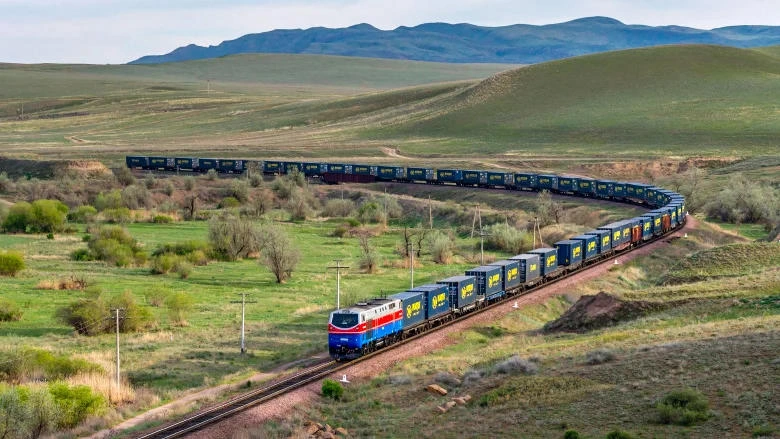
He pointed out that these visits bore fruit, leading to
substantial agreements, including a whopping $4 billion investment
deal from the American company Wabtec in Kazakhstan's railway
sector.
The expert believes that building up logistics infrastructure
and enhancing transportation connections are key for Kazakhstan's
success.
"Of course, we view it positively when American investors make
similar investments in other countries in the region. Logistics is
a shared matter, and the development of railways or any other
transportation infrastructure is beneficial for all. Kazakhstan,
like other countries in the region, is interested in multilateral
development and diversification of its economic ties. It is
especially important for us to continue reducing dependence on oil
and natural resources, including iron and metals. We are actively
looking for opportunities to invest in the processing industry and
logistics, and we will support projects that contribute to this,"
the expert concluded.
On August 8, 2025, in Washington, with the participation of US
President Donald Trump, President of the Republic of Azerbaijan
Ilham Aliyev, and Prime Minister of Armenia Nikol Pashinyan, a
joint declaration was signed. One of the points of the document
provides for the launch of the Zangezur corridor ("Trump Route" or
TRIPP) to unblock regional communications. In addition, the foreign
ministers of Azerbaijan and Armenia initialed an agreement on peace
and interstate relations.
In January 2026, the Armenian Foreign Ministry published the
agreement signed between Armenia and the U.S. on the implementation
of the TRIPP project. Armenian Foreign Minister Ararat Mirzoyan and
U.S. Secretary of State Marco Rubio met in Washington and presented
a framework program for the implementation of the TRIPP project.
The published document was assessed as a new step towards
fulfilling the commitments made at the White House on August 8,
2025, to support the establishment of a sustainable peace in the
South Caucasus.
The joint statement of Mirzoyan and Rubio said that Armenia
intends to approve and support the establishment of the TRIPP
Development Company, which will be responsible for the development
of the TRIPP project. The company will be granted the right to
implement the project for an initial period of 49 years. Yerevan
plans to offer Washington 74% of the shares of TRIPP Development
Company while retaining 26%.